
The National Securitization of Immigration.
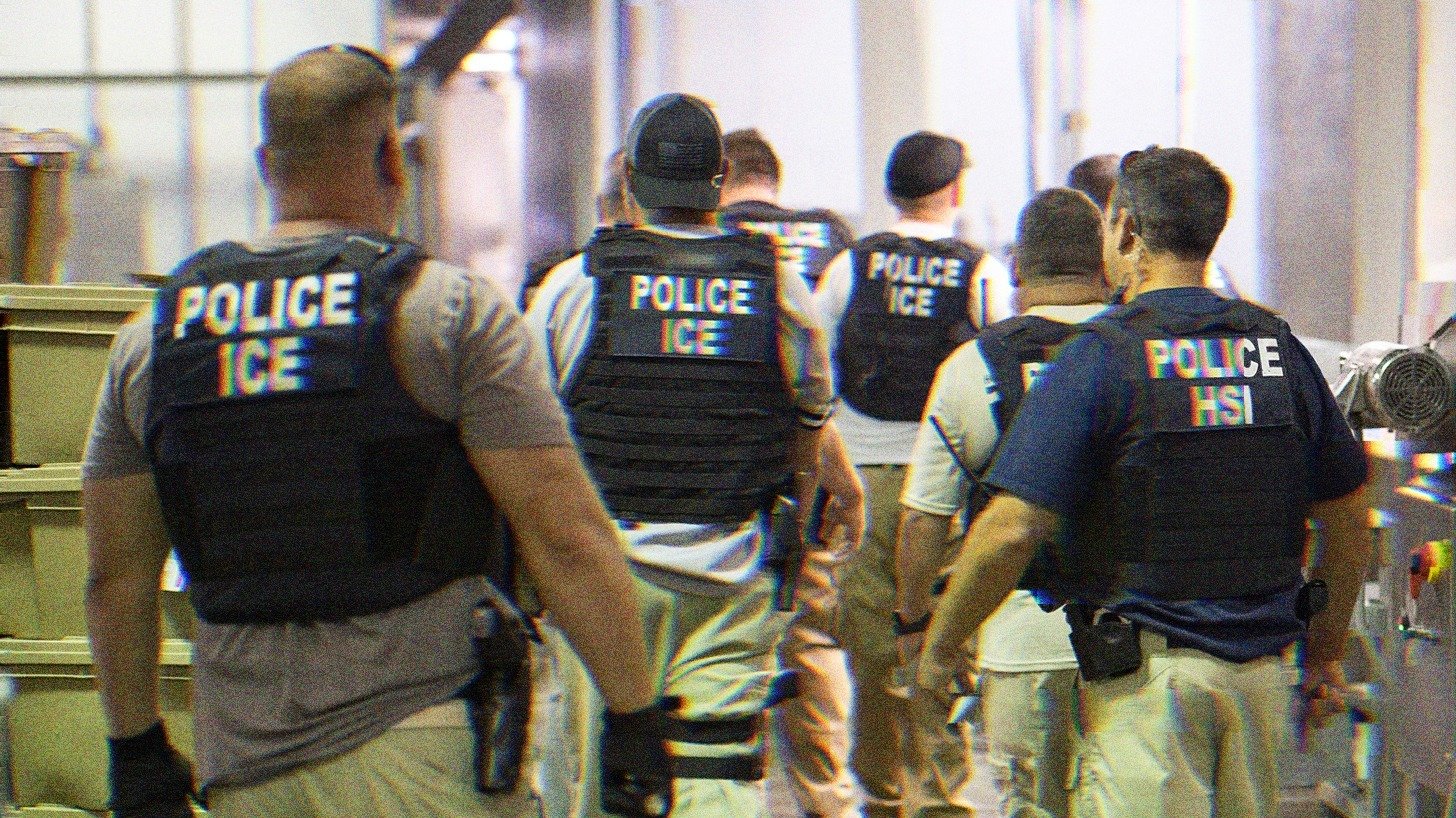 Image Description: A group of ICE men investigating a workplace.
This essay appeared in the Jan. 29, 2026 edition of UNFTR’s premium newsletter. Become a UNFTR member to receive our bonus newsletter each week and for other perks.
The attacks on 9/11 irrevocably changed the fabric of the United States—and the ostensible liberties afforded to us—in ways that have become increasingly difficult for the human mind to grasp.
But with each passing year, the policies and infrastructure created ostensibly in the name of national security have calcified into something permanent. The surveillance apparatus didn’t recede after the immediate post-9/11 panic—it metastasized. Free speech, if not fully eroded, has been chilled to the point where dissent itself has become suspicious. And the state has developed the capacity to monitor Americans indiscriminately, as “more than a dozen secret and obscure watchlists” now document the actions of protesters, specifically those expressing outrage over immigration enforcement crackdowns and the genocide in Gaza.
What began as a response to an unprecedented attack has become routine governance as colonialism and militarization have turned inward. We are not, as a nation, ever going back. And future generations won’t be able to comprehend a time without Thought Police knocking on people’s doors or college students being disappeared and threatened with deportation because they object to another country’s genocide.
Few policies underscore the breadth of the change to American political and societal life more than immigration. Many have reacted with outrage and horror to roving immigration enforcers operating under ICE and CBP on American streets—recalling some of the more dystopian scenes fictionalized in shows like “Andor.” Alas, that galaxy does not appear so far away, not when millions across the world saw the slaying of Alex Pretti in Minneapolis. It didn’t take long after he was gunned down for the propaganda campaign to shift into high gear, with officials labeling the beloved healthcare worker a “domestic terrorist” and accusing him, falsely, of wanting to massacre law enforcement. This came just days after Renee Good was similarly fatally shot inside her car in Minneapolis, sparking further waves of protests in a city in which dissent appears to be in its DNA.
No doubt, it’s completely justified to be outraged at the Trump administration for its indiscriminate arrests of thousands of immigrants and its aggressive policing of protesters. But anti-immigrant enforcement is not an inherently Trumpian phenomenon. Like so much in American life, the modern crackdown on people seeking a better life in the United States has its roots in the system created in the months and years after 9/11. And it’s a system that the duopoly has embraced wholeheartedly—which is why figures such as President Obama, absurdly ridiculed as some sort of liberal dove, was dubbed “The Deporter-in-Chief” by many of his critics on the left. This is not about whitewashing anything the Trump administration has done, but about underscoring the way in which “immigration”—especially for those considered undocumented—has become part and parcel of the national securitization of the United States. And because of that, the resources for agencies such as ICE and CBP, which didn’t exist prior to 9/11, have exploded over the past 24-plus years.
“Federal spending on immigration enforcement shifted dramatically after 9/11, significantly overtaking what the federal government spends on the principal federal criminal law enforcement agencies,” explains the Migration Policy Institute. “By FY 2006, the budget of the immigration enforcement agencies within DHS was $12.5 billion—nearly triple the FY 2000 level and 18 percent more than the $10.6 billion appropriated that year for the federal government’s principal criminal law enforcement agencies. And by FY 2020, appropriations for immigration enforcement reached $25.1 billion, a nearly sixfold increase since FY 2000 and 28 percent more than the $19.5 billion directed to the principal federal criminal law enforcement agencies.”
The shift in immigration “enforcement” also came in the form of increased calls for physical barriers at the border—perhaps the most indelible memory of Trump’s political rise.
“[F]unds for border fencing and other construction increased dramatically in the early 2000s, tripling from $92 million in FY 2005 to $270 million in FY 2006,” the Institute said.
As Camille J. Mackler, the executive director of Immigrant ARC, which was formed during Trump’s Muslim ban in 2017, wrote in an article comparing immigration policy pre- and post-9/11: “The creation of DHS irrevocably set the country on a path that made immigration enforcement a matter of national security and justified treating migrants as dangers to the homeland.”
“Although the blurring of lines between immigration and criminal law had begun years before DHS opened its doors—when President Bill Clinton signed the Illegal Immigration Reform and Immigrant Responsibility Act (IIRIRA)—the establishment of DHS after 9/11 escalated this adversarial approach to immigration. IIRIRA transformed the immigration system into the punitive, quasi-criminal system it is today. But it was the post-9/11 creation of DHS that opened the door to the dark policies of the recent past—mass detention of asylum seekers, deportations that tear communities apart, and large investments in private detention complexes.”
Rhetorically, the conversation around immigration isn’t completely different from what the neocons in the Bush administration were putting out there. For example, in his testimony to the U.S. Senate Judiciary Committee in 2005, DHS Secretary Michael Chertoff called “illegal immigration” a “severe and growing problem” that “hurts everyone,” adding, “if we cannot control our borders, we leave the way open for terrorists hoping to do us harm.”
Today it’s supposed narco-terrorists that are a major threat to the nation, while in the Bush administration it was those darn Muslims.
In what seems like ancient history but is no doubt relevant today, the Bush administration enacted Red Scare levels of anti-immigration policies that ended up ensnaring innocent people—as is happening today.
No one wants to compare the worst of the worst in terms of anti-immigration policies, but the Bush administration effectively birthed many of the systems, policies, and laws, including via the Patriot Act, that enable today’s mass deportation regime and counterinsurgency operation, all in the name of preventing the many mistakes made in the lead up to 9/11.
As the United States began registering Muslim Americans into databases as part of a hysterical response to the attacks, the New York Times quoted the then-general counsel for the Justice Department, Kris Kobach, who said: “Sept. 11th awakened the country to the fact that weak immigration enforcement presents a huge vulnerability that terrorists can exploit.”
In that same piece, the Times noted that nearly 130,000 male immigrants and visitors—predominantly Muslims—were questioned in what the paper called “the largest effort to register immigrants in decades.”
The same month the Times ran that piece, the DOJ’s Office of Inspector General released a report that confirmed 762 “detainees”—all Muslims living in the United States—were placed on an “INS Custody List” because the FBI assessed them to have “had a connection to the September 11 attacks or terrorism in general, or because the FBI was unable, at least initially, to determine whether they were connected to terrorism.”
As the OIG stated, the Bush administration made the choice to hold many of these so-called detainees without bond “until the FBI cleared them of any connections to terrorism.”
“[W]e criticize the indiscriminate and haphazard manner in which the labels of ‘high interest,’ ‘of interest,’ or ‘of undetermined interest’ were applied to many aliens who had no connection to terrorism,” the report said.
For the U.S. government, the aftermath of 9/11 provided the opening to enact and enforce many of the draconian policies that hawks previously couldn’t have even dreamed of. Among those was the Patriot Act, which included a provision that created a new information system called Foreign Student Monitoring (SEVIS). It’s SEVIS’ existence that has allowed the Trump administration to end so many immigrants’ legal status during its first full year in power.
Meanwhile, a Politico review found that judges across the country “have ordered immigrants’ release or the opportunity for bond hearings in more than 1,600 cases.”
“In recent weeks, the judges’ conclusions have become increasingly urgent, describing shocking mistreatment and inhumanity as thousands of people—the majority not charged with any crime—are abruptly ripped from family members and locked up in squalid detention centers, even if they have lived in the country for decades,” the article adds. “Many have been arrested while attending required immigration court proceedings or check-ins with Immigration and Customs Enforcement that they had attended for decades.”
Sounds shockingly familiar.
This is all to say, as disastrous as Trump’s policies have been, and as extensive as the damage has been to families and communities, in so many cases, the administration is leveraging the systems and processes set in place in the aftermath of 9/11. From surveillance to militarization to immigration, so much of our world changed on that day. We are a different America, one in which “security,” in whatever form it takes, trumps all.
Image Source
- U.S. Immigration and Customs Enforcement “ICE HSI worksite enforcement operation in Canton, Mississippi” Flickr, 9 August 2019. Public Domain. Changes were made.
 Rashed Mian
Rashed Mian is the managing editor of the award-winning News Beat podcast and co-founder of the newly launched Free The Press (FTP) Substack newsletter. Throughout his career, he has reported on a wide range of issues, with a particular focus on civil liberties, systemic injustice and U.S. hegemony. You can find Rashed on X @rashedmian and on Bluesky @rashedmian.bsky.social.