 Image Description: On The Record 11-17-26. The Fed on AI. Adam Carolla Sucks. Duffy is a Loser. Second Thought. +Lee Camp. UNFTR.
The Report Nobody Reads
The Fed just released its latest Financial Stability Report. It’s a useful tool because it covers every major part of the financial economy, and the Fed has access to all the government’s data, including private SEC filings that most of us never get to see. That’s incredibly useful.
As a reminder that we’re in the Trump-influenced era, there’s one notable update to the nomenclature: The Fed now attributes stock valuations to “market enthusiasm for super intelligence.” Ironic, saying Trump and super intelligence in the same sentence.
Anyway.
Outside the financial journals and channels, this report doesn’t get much exposure. It should. I have a lot of thoughts, and not all of them are doomsday thoughts, mind you. There’s plenty in here to set your mind at ease about whether we’re heading into the next Global Financial Crisis. There are plenty of warning signs too, believe me. And there’s one thing that concerns me above all the others. It gets a slight nod in the text, but not much more.
Risky Business
Here’s the big takeaway if you read this report in its totality and don’t question any of the underlying data or assumptions: There is no current systemic threat to the financial system like the one we had in 2008. Hold that thought.
The report, and every summary of it, can make that claim because the part of the financial system we can see—the part that’s heavily regulated by the government, the same one that nearly imploded in 2008—is on solid ground by nearly every metric. Bank capital ratios sit near historic highs. Large banks hold liquidity coverage at about 120% of what’s required. Household debt relative to GDP has fallen below its historical median. Uninsured deposits, the thing that took down Silicon Valley Bank, are well below their 2022 peak. Most of the cash parked in money market funds sits in government funds, the kind that don’t run. Dealers are actually doing more in the Treasury market, not less. That’s the data, and there are nuances we’ll get to in a moment.
That being said, the people the New York Fed surveyed raised elevated risk in five key areas: AI, a risk asset correction, higher long-term rates, cyberattacks and fiscal debt sustainability. AI came in at 87%, up from 50% in the spring. Nothing else came close. And when respondents explained their AI worries, one of them was “complex forms of AI-related financing.” Which is where the Fed itself lands.
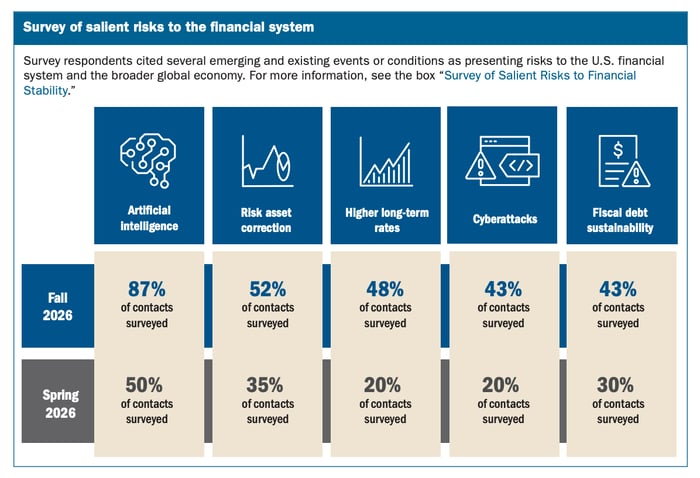
Sources: Financial Stability Report
“The complex interlinkages among firms engaged in the data center buildout, public credit markets, private lenders, and special purpose financing vehicles create vulnerabilities that necessitate close monitoring.”
So let’s follow those interlinkages, because that’s where the warning signs are. Start with the debt everybody can see:
“Advanced computing–related debt issuance rose to more than $680 billion by October 2026, about a fivefold increase from $130 billion in all of 2023. Investment-grade technology companies issued most of this debt, and advanced computing–related borrowing as a share of nonfinancial investment-grade corporate debt issuance increased from less than 6 percent in 2023 to about 31 percent in 2026. Outstanding public debt related to advanced computing is estimated at more than $1.1 trillion as of October 2026. Sizable transactions also occur in the private credit market, making the exact magnitude of advanced computing–related debt outstanding more difficult to measure.”
Nearly a third of all high-grade corporate borrowing is now one trade. And investors are barely charging extra for it. The Fed says corporate bond spreads sit at the low end of their historical range. In other words, lenders are pricing in confidence, and very little risk. The Fed even lines this boom up against the late-1990s telecom buildout. Hyperscaler spending has tracked that cycle closely and is accelerating, and the Fed says it may pass the telecom pace “relatively soon.” Up to now, these companies have paid for it out of their own cash flow. The Fed’s phrase: “at least until this year.” This year is when the borrowing kicked in.
Then there’s what isn’t counted as debt at all. The Fed tallies more than $1 trillion in data center leases that haven’t started yet and more than $2 trillion in take-or-pay contracts and residual value guarantees. A hyperscaler signs a lease, the developer borrows against it, and the chipmaker guarantees what the GPUs will be worth later. The Fed’s own words: These firms’ exposure “may be substantially larger than suggested by their on-balance-sheet liabilities.”
So who holds the risky pieces? The Fed answers that too. These deals run through special purpose entities, and the subordinated and equity slices go to “high-yield bond funds, life insurance companies, BDCs, and other private debt vehicles.”
“Leverage at the largest life insurers remained at historically high levels in the second quarter of 2026, while leverage at property and casualty insurers stayed low. Life insurers have also steadily increased their investments in risky and illiquid assets over the past decade, and their activity has contributed to the expansion of private credit.”
About 38% of life insurers’ general account assets are illiquid. That’s your annuity. That’s someone’s pension buyout. On the funding side, life insurers have piled up more than $580 billion in what the Fed calls nontraditional liabilities, things like funding agreements and Federal Home Loan Bank advances. Those are more like short-term wholesale money than a 30-year policy. Funding illiquid assets with money that can leave is the exact combination that’s supposed to keep regulators up at night. And plenty of that paper is graded by private letter ratings, issued mostly by smaller agencies and seen only by the insurer and its regulator. Columbia researchers found those privately rated bonds were twice as likely to suffer losses as public bonds with the same grade.
Private credit itself has grown from about $350 billion in assets in 2012 to more than $2.6 trillion. Its default rate has climbed to the upper end of its short history, and the Fed flags heavy use of payment-in-kind, which means a borrower that can’t pay its interest in cash just adds it to the loan. That keeps the default numbers looking tidy right up until it doesn’t. The Fed’s comfort is that these funds carry relatively little leverage and can limit redemptions. Hold onto that, because the leverage didn’t disappear. It’s sitting somewhere else.
Hedge fund leverage just hit its highest level since the data began in 2013, concentrated in the biggest funds. Gross hedge fund assets have gone from $4 trillion in 2012 to $13 trillion now. That leverage sits in Treasuries, rate derivatives and stocks, exactly the markets that need to stay calm if AI wobbles. Leverage works in both directions. When prices move against a highly levered fund, its lenders demand more collateral, the fund sells what it can, and those sales hit everybody holding the same assets. That’s how a bad week in tech stocks turns into a bad week in Treasuries.
And commercial real estate hasn’t gone away. The Fed still calls refinancing risk “salient,” with a big slug of commercial mortgage-backed debt maturing in late 2026. The Mortgage Bankers Association counts $875 billion in commercial mortgages coming due this year, and much of it is refinancing at far higher rates than when it was written. To be fair, the Fed notes that lenders have been willing to extend and restructure, and that this slice is a small share of total commercial real estate debt. It’s not 2008’s subprime. It’s one more source of losses landing on the same lenders at the same time.
Rerouted Pipes
On the surface, this report shows the government and regulators did a great job protecting the banking sector. All the metrics there look good, considering how uneasy the respondents were and how hard things are for people in this K-shaped economy.
Or did they?
Sure, the banks are liquid. Their liquidity coverage ratios show it, and they’re holding plenty of high-quality liquid assets. But look at how much exposure the banks have to all those other areas:
“Bank credit commitments to other financial institutions continued to grow, surpassing $2.8 trillion in the second quarter of 2026. Private equity, BDCs, and private credit remained the largest exposure category, accounting for one-fourth of total commitments. Growth of commitments was highest for the SPEs, CLOs, and ABS category, rising nearly 30 percent over the year to the second quarter of 2026.”
That acronym soup is Business Development Companies—that’s private credit—Special Purpose Entities, Collateralized Loan Obligations and Asset-Backed Securities.
The report acknowledges that these areas face rules that are “less stringent than banks’ regulatory capital requirements.”
So risk moves out of the bank and into the vehicle, and then the bank lends money to the vehicle. Add to that the nearly $1 trillion the largest banks have tied to big tech, data center developers, AI financing vehicles and private credit.
We might not have fixed the plumbing of the system. We might have just rerouted the pipes.
When the system cracked last time, the water dried up, and the shit coating the pipes got dumped onto the Fed’s balance sheet. This time we’re not sure where the pipes were rerouted. But it’s easy to see credit slowing to a trickle if something breaks: the circular financing deals in AI, $680 billion in AI-related debt on the books, roughly $3 trillion in commitments off the books, and private credit, life insurers and hedge funds all stretching to keep that flow going. And on the debt side, they’re all trusting a ratings system that’s paid by the borrower, the same model that gave mortgage-backed securities a thumbs-up in the early 2000s.
So when does everyone start asking who supplies all that leverage to the insurers, the hedge funds and private credit? (Spoiler: It’s the banks.)
So when a big piece of this breaks bad and the shit needs somewhere to go, where does it flow? Kevin Warsh has spent years saying the Fed’s balance sheet should be smaller, not bigger. Maybe this time they just let some big guys fail.
Last week I quoted Michael Howell, who said, “All money that’s anywhere must be somewhere.” Betcha anything we’ll be covering it all when the time comes.
Eric and Don Jr. Swinging in the Breeze
Stablecoins are eating a bigger and bigger slice of Latin America’s crypto economy. According to Chainalysis, by June of this year stablecoins made up about 32% of the region’s cross-border crypto value, 22% of person-to-person activity, and nearly 18% of what people actually hold in their wallets. The region’s crypto economy grew almost 10% to roughly $594 billion over the past year, while activity everywhere else was shrinking.
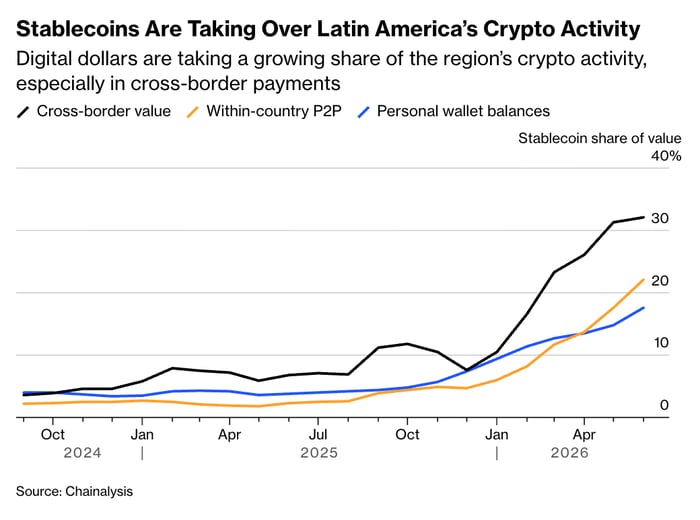
Sources: Chainalysis via Bloomberg
One honest caveat before we go further. Part of that rising share comes from everything else in crypto getting crushed. When bitcoin and the rest of the casino lose half their value, the stable slice of the pie looks bigger by default. But the trend shows up on the ground too. In Argentina and Venezuela, people are using digital dollars to protect their savings from currencies that keep melting. In Mexico and Brazil, businesses are using them to pay suppliers across borders without waiting days on a bank wire. Mexico’s stablecoin inflows hit $8.4 billion in the second quarter alone, more than eight times their 2021 level.
That’s great for Tether. It’s great for Coinbase. And it’s quietly good for the U.S. dollar, which brings me to the first piece of good news.
When a shopkeeper in Caracas swaps bolivars for Tether, that’s a new person holding dollars who wasn’t holding them before. The issuers then park those dollars mostly in short-term Treasury bills. Tether alone held about $122.8 billion in T-bills at the end of September, roughly what South Korea holds. I don’t want to oversell it. Stablecoins hold about 2% of outstanding bills, and they don’t touch the long bonds where the real auction stress lives. But this is the one version of the stablecoin story that actually extends the dollar’s reach: dollarization from abroad, one phone at a time.
A little bit of bad news before we get to what I think is the best news.
On October 29, Binance, the biggest crypto exchange on the planet, lost $6.3 billion in the largest crypto heist ever recorded. The FBI pinned it on North Korea. And how did they get in? Fake job interviews and malware on engineers’ laptops. Billions moved in minutes. Tether and Circle then froze about $2.4 billion tied to the hack, which tells you these “decentralized” dollars have a pretty centralized off switch when it suits the people running them.
Then there’s the laundering. Chainalysis estimates that illicit crypto addresses took in at least $154 billion last year, and stablecoins carried 84% of that volume. Russia’s ruble token moved more than $93 billion in under a year. The technology doesn’t care who’s using it.
Okay, now the fun part—the second piece of good news. On September 15, Senate Democrats, joined by four Republicans, blocked the CLARITY Act, the crypto industry’s big market-structure bill. The cloture vote on the motion to proceed failed 49-50. Democrats held the line on one demand: real ethics rules covering the president’s family’s crypto business.
And look at how the Trump boys’ own stablecoin is doing. USD1 got as high as about $4 billion, and it’s now around $3.1 billion, down more than 24% in the last month. Roughly 64% of it reportedly sits on Binance, where holders get paid to keep it parked. And an Abu Dhabi royal-linked prediction market that bragged it only took USD1 quietly scrubbed it from its website after Bloomberg found it had been running on Circle’s USDC the whole time.
Now, let’s stay clear-eyed. USD1 still exists, it’s already legal under last year’s GENIUS Act, and World Liberty picked up a conditional federal trust-bank charter in August so it can issue the thing itself.
CLARITY isn’t dead either. A motion to reconsider keeps it alive, and the lame-duck session could try to sneak it through before Democrats take both chambers in January.
So we stay vigilant. And the bigger job is to rebuild this whole framework under Democratic leadership: ethics rules that reach all the way into the White House, real anti-money-laundering teeth, and dollar rails designed for the nurse in Caracas instead of the guy with a charter and a family business. But for this week, I’ll take it. Chalk one up in the win column.
 Max
Max is a political commentator and essayist who focuses on the intersection of American socioeconomic theory and politics in the modern era. He is the publisher of UNFTR Media and host of the popular Unf*cking the Republic® podcast and YouTube channel. Prior to founding UNFTR, Max spent fifteen years as a publisher and columnist in the alternative newsweekly industry and a decade in terrestrial radio. Max is also a regular contributor to the MeidasTouch Network where he covers the U.S. economy.