
The Crypto Heist Happening Right Under Our Noses.
Full Clarity.
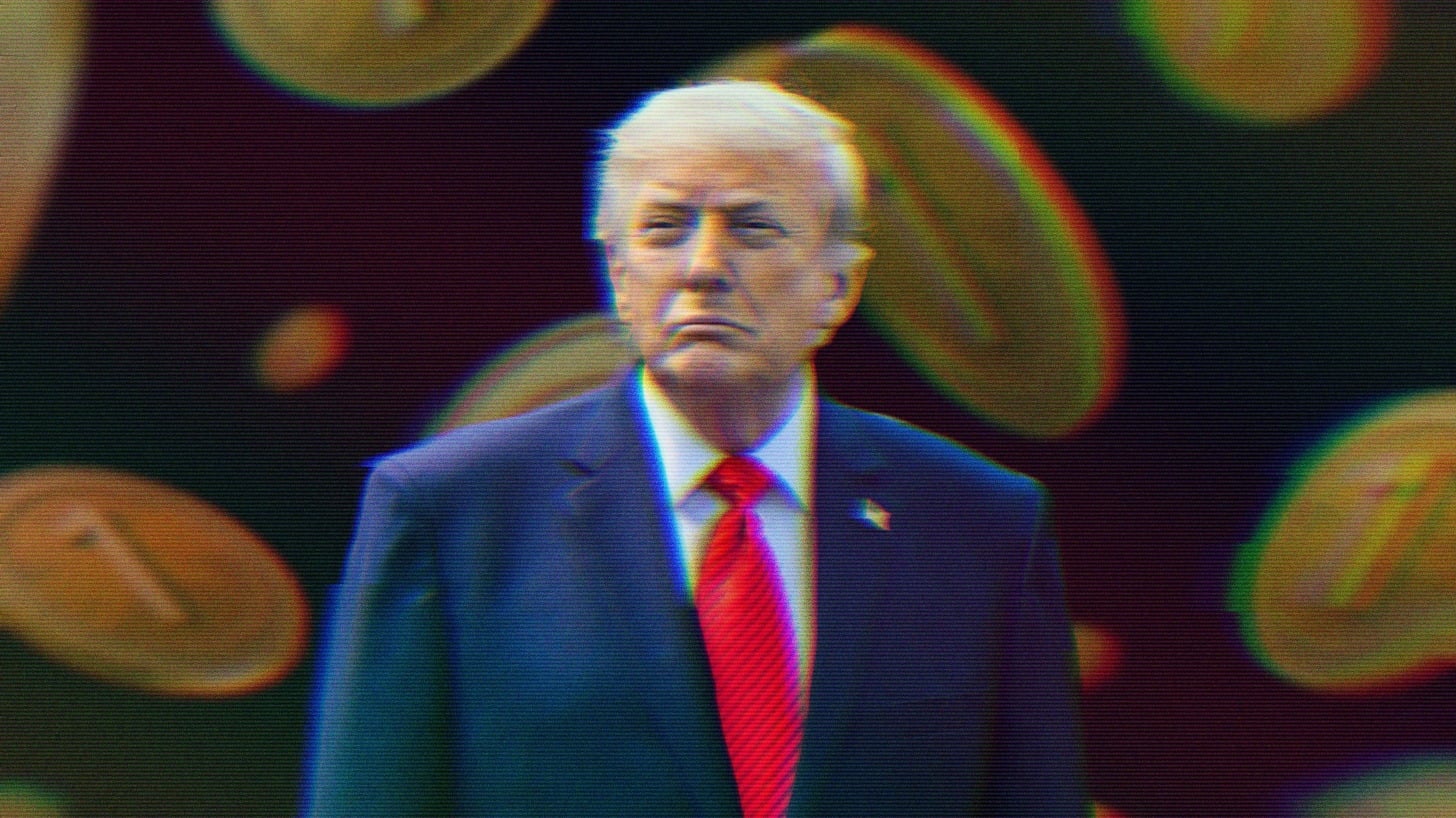 Image Description: Donald Trump in front of renderings of the USD1 Stablecoin.
The Trump family crypto grift moved into high gear by clearing an important legislative hurdle this week. The CLARITY Act officially moved out of committee and now goes to the Agriculture Committee before being paired with the House version and going for a final vote. Despite valiant attempts by Elizabeth Warren to put some guardrails and ethics provisions in place, the GOP shot them all down. Hundreds of millions in lobbying from the crypto industry has been sunk into a bill that has the potential to damage the banking system and enrich the President’s family. This is an update to an ongoing story about the ultimate financial heist happening in real time and right under our noses.
“The findings uncovered by Bloomberg News show that World Liberty Financial, co-founded by Trump and his sons, is now worth more to the family than any other business, including their stake in Trump Media & Technology Group Corp., or even the famed Mar-a-Lago resort. World Liberty’s additional sales of a token called WLFI boosted the Trump family’s wealth by about 9% to $6.8 billion… In total, the 5.9 billion white-glove token sales push the Trump family’s proceeds up by about $660 million, according to the Bloomberg Billionaires Index.“ -Bloomberg
Elizabeth Warren is, by my count, the only person in the United States Senate who both fully understands what is happening and is willing to say it out loud. She filed 44 amendments to the CLARITY Act and Republicans killed every single one of them through procedural means.Last week the Senate Banking Committee voted 15 to 9 to advance the CLARITY Act out of committee. Thirteen Republicans. Two Democrats. Every amendment on ethics, anti-money laundering, and consumer protection—rejected or ruled out of order.
The bill now heads to the Senate floor, where it needs 60 votes. The White House wants a signing ceremony by July 4th. And if you want to understand why the urgency, why they need this done before the midterms, why they refused to engage a single Democratic concern—you have to go back to where we started.
About a year ago I did a deep dive on Donald Trump’s plan to become one of the central bankers to the world. This is the sequel. Because since we wrote that piece, two of the three bills we warned you about have either been signed into law or just cleared a major hurdle. And the third one is waiting in the wings.
Where We Left Off
In the piece we discussed an important word: seigniorage. This is the profit a government makes by issuing currency; essentially the difference between what money costs to make and what it’s worth. It’s how central banks fund themselves. And we said at the time Congress had just cleared a path for Donald Trump to capture a meaningful piece of that for himself and his family, in perpetuity.
Let’s revisit this to set the scene for how they’ve just moved to the next stage.
The modern financial system was built at Bretton Woods in 1944. The dollar became the world’s reserve currency—backed first by gold, and after Nixon in 1971, backed by nothing but the credit of the United States. The belief that we’d be here tomorrow, that we’d honor our debts, that the system would hold. That belief is what gives the dollar its power.
Whoever controls the currency that the world uses to settle transactions captures a piece of every transaction. Forever. That’s seigniorage.
Now we are at the threshold of the fourth era of money in the modern age: Digital tokens tied to stores of value called stablecoins. And the race to become the private issuer whose coin becomes the default settlement currency for global trade is the most consequential financial competition happening on the planet. Incredibly, one of the competitors is a sitting American president.
To offer a sense of scale, when I first reported on this a year ago, Tether’s USDT was generating roughly $6.4 billion in annual reserve income, and Circle’s USDC was pulling in about $1.6 billion. In under a year, Tether posted over $10 billion in profit for 2025 alone—and Circle just reported $694 million in a single quarter, putting them on pace for nearly $3 billion annually.
As of this publication date, the Trump family stablecoin is the fourth largest in global circulation, having doubled in the past year. It’s a distant fourth behind Tether and Circle, but it’s nipping at the heels of Ethereum’s stablecoin DAI. Make no mistake, Trump is a significant player in this market.
All of these numbers will look small in a matter of years as stablecoin adoption continues its current trajectory.
To show how profitable minting a popular stablecoin alone is—before it’s actively purchased and circulated—when the Trump family issued USD1 by World Liberty Financial, they reportedly pocketed $57 million on the launch. That’s before a single coin went into circulation.
The Legislative Trilogy
I want to frame these three bills the way I think they should be understood—not as separate pieces of financial regulation but as a coordinated transfer of power. Three acts of the same play.
Act One: The GENIUS Act
Already signed into law. The Guiding and Establishing National Innovation for U.S. Stablecoins (GENIUS) Act establishes a regulatory framework for payment stablecoins. It requires issuers to back their coins one-for-one with dollar-denominated assets, primarily Treasury securities. It creates a federal licensing system.
Here’s how I’d frame this one. It’s the bill that looks out for the Treasury. By requiring stablecoin reserves to be parked in Treasuries, it creates a new captive buyer for U.S. government debt at a moment when foreign demand is softening and rates are climbing. If you’ve listened to our work on fiscal dominance, you know why that matters. The Treasury needs buyers. Stablecoin issuers are now required to be buyers. There’s a public interest rationale there that you can at least hold in your hand without dropping it.
In our original piece I noted that the GENIUS Act achieved bipartisan support in both chambers. It did. And it’s the one I’m least exercised about in isolation. This is a genuine financial innovation that the rest of the world is working on as well, so if we want to remain competitive, this is the move. The problem is it doesn’t exist in isolation.
Act Two: The CLARITY Act
This is the one that cleared committee this week. And just know, this is the crypto industry’s bill primarily. They’ll tell you otherwise, but it is. This is the one they’ve been lobbying the hardest for and there are timing reasons why they’re accepting the smallest of concessions right now.
After years of regulatory warfare with the Securities and Exchange Commission (SEC)—years of enforcement actions, subpoenas, lawsuits, and court battles over whether digital assets are securities—the industry spent over $200 million on the 2024 elections to buy its way out from under that framework. The Senate Banking Committee voted to give them exactly what they paid for.
The CLARITY Act draws a jurisdictional line. Most of the crypto market—anything classified as a “digital commodity” tied to a functioning, decentralized blockchain—moves from SEC oversight to Commodity Futures Trading Commission (CFTC) oversight. The SEC is a disclosure-based regulator with a strong enforcement apparatus and an institutional mandate to protect investors. The CFTC is a principles-based regulator, roughly a third of the size, with a long history of being more industry-friendly.
A little context on why this matters is worth refreshing.
Wendy Gramm was head of the CFTC from 1988 to 1993 and was a champion of deregulation. After serving her time in the role, she joined the Enron board immediately upon leaving government. Her husband Phil passed two pieces of legislation: the Gramm-Leach-Bliley Act that repealed Glass-Steagall, and the Commodity Futures Trading Act that moved derivatives—another complex, dangerous financial instrument—from tight oversight to the CFTC. Within two years, Enron imploded. Within a decade, the global financial system nearly did the same.
We are doing this again. We are making the same choice. We are moving a vast, complex, poorly understood financial instrument out of the hands of the regulator with the institutional capacity to oversee it and into the hands of the one the industry prefers.
Act Three: The Anti-CBDC Surveillance Act
This one is still moving. And it might be the most important of the three. This is the one that closes the loop for the Trump family personally.
The Anti-CBDC Surveillance Act prohibits the Federal Reserve from issuing a retail central bank digital currency. Ever. The stated rationale is privacy—the government shouldn’t be able to track your digital spending, control your money and potentially turn off your wallet. The Chinese digital yuan, integrated with their social credit system, is the horror story they invoke.
And I’ll grant you: those aren’t hypothetical concerns. A government-issued digital currency in authoritarian hands is a genuine threat to liberty. This is the crypto libertarian privacy argument that I’m happy to have because it’s a fine discussion. But outside of laundered cash, all of our money is currently traceable anyway. The only people who get away with hiding money are gangsters and gangster capitalists (known as billionaires). So who are we really protecting here?
But here’s the bigger problem. Shouldn’t the same concern apply to a private stablecoin controlled by a small number of unaccountable corporations? Or, worse, by let’s say…Eric Trump? As it is, Tether moved its headquarters to El Salvador and we’re supposed to trust them more than the Federal Reserve? I know confidence in the government is low, but come on.
With a Fed-issued digital dollar off the table permanently, the field is clear for USD1. If authorized by the Trump-controlled CFTC, World Liberty Financial becomes a participant in the regulated U.S. stablecoin framework. No government competitor. A favorable regulatory regime courtesy of the GENIUS Act. CFTC oversight courtesy of the CLARITY Act.
And a family that collects fees on every transaction, in perpetuity, at a scale that could eventually rival the Federal Reserve’s own seigniorage.
Following the Money
Let’s talk about the vote that just happened.
The Senate Banking Committee has 24 members—13 Republicans and 11 Democrats. The committee chairman is Tim Scott of South Carolina. The ranking member is Elizabeth Warren of Massachusetts. The Subcommittee on Digital Assets is chaired by Cynthia Lummis of Wyoming. The Ranking Democrat on that subcommittee—the lead Democrat on the committee most directly overseeing this legislation—is Ruben Gallego of Arizona.
The vote was 15 to 9. Every Republican voted yes. Two Democrats crossed over: Gallego and Angela Alsobrooks of Maryland.
Ruben Gallego
In his 2024 Senate race, Gallego received approximately $10 million in crypto industry support. Three million dollars from Fairshake’s affiliate Protect Progress in direct independent expenditures. Another seven million from individual donors including Coinbase CEO Brian Armstrong and Andreessen Horowitz partners Chris Dixon and Ben Horowitz. He won that race. He then was named the top Democrat on the Senate Banking Subcommittee on Digital Assets—the exact subcommittee overseeing today’s markup.
Then, earlier this year, Gallego held a three-day fundraising retreat at the L’Auberge de Sedona resort—suggested donation $5,000 to attend—alongside Marc Andreessen of Andreessen Horowitz, whose firm has invested in over 100 crypto startups and contributed over $44 million to Fairshake, the same PAC that spent $10 million getting Gallego elected.
Alsobrooks voting yes is more complicated. She co-authored the stablecoin yield compromise—the Tillis-Alsobrooks deal that became the centerpiece of the bill’s banking negotiations. And I actually understand her position more than Gallego’s, because she put genuine work into a compromise and felt ownership over it. But she still voted to advance a bill without the ethics provisions that every other Democrat, including ones who support crypto regulation in principle, said were non-negotiable.
Nine Democrats voted no. Including Mark Warner, who sits on the Digital Assets subcommittee and has been one of the more crypto-friendly Democrats in the chamber. His no vote tells you everything about the ethics question. He didn’t oppose the bill’s substance. He opposed the refusal to address Trump’s direct financial stake in the outcome.
So we understand what the Crypto industry’s position is in the fight. And you can understand what the Fed stands to lose in this new stablecoin world. But there’s another player at the table that has a pretty big voice and, if I’m reading the tea leaves correctly here, just got played.
The loudest pre-markup battle was over stablecoin yield. Whether crypto platforms could pay interest on stablecoin balances.
Let’s say you have $10,000 in savings or an interest bearing checking account. The crypto industry wants you to move that money to a digital wallet so you can move funds around quickly with fewer fees. In the present scenario, the banks still hold an edge because they can offer you interest. So the crypto industry decided to call their incentives rewards, but it didn’t fool anyone. It’s interest.
If you think about the potential repercussions of this it’s quite staggering. So the banks went to war over this. The Consumer Bankers Association research shows bank lending could fall by $65 billion–$1.26 trillion depending on stablecoin growth. The American Bankers Association put the deposit flight risk at up to $6.6 trillion.
This was the fight that nearly killed the bill in January, when Coinbase pulled its support and caused the markup to collapse. It was the issue that drove four months of White House-mediated negotiations between the crypto industry and banking trade groups. It is the most-covered controversy in the entire CLARITY Act story.
And the crypto industry won it. Almost completely.
The Tillis-Alsobrooks compromise—the deal that’s now baked into the bill—bans “passive” yield. Simply holding a stablecoin cannot generate interest. What remains fully permitted: activity-based rewards tied to transactions, platform usage, staking, account activity, loyalty programs. Coinbase’s chief policy officer said it directly: “The banks were able to get more restrictions on rewards, but we protected what matters—the ability for Americans to earn rewards.”
So let’s say you make one transaction a month. Under the bill’s language, you can earn interest on your balance because of that. I think the banks just got rolled because of the other big shift in this bill that moves oversight from the SEC to the CFTC. I think once the CFTC is governing one of the fastest growing sectors in finance, all bets are off and the crypto firms will just have their way with regulators like they did in the mortgage crisis. There’s simply no way the handful of employees at the CFTC would be able to keep up and, of course, that’s the point.
Tick Tock
Here’s where we are procedurally. The Senate Banking Committee vote was the first gate. The bill now needs to be reconciled with the Senate Agriculture Committee version—that might seem weird but this is still a commodity so they have a role. Those two Senate versions have to be merged into one before a floor vote. Then the Senate version has to be reconciled with the House version, which passed 294-134 in July 2025. And then it needs 60 votes on the Senate floor.
60 votes. They have 13 Republicans and, as of the committee vote, two Democratic yes votes. They need at minimum seven more Democrats to survive cloture.
The obvious crossover candidates include Kirsten Gillibrand, who has been pro-crypto for years and predicted the bill passes the first week of August. Then there are a handful of others from financial services or tech-heavy states that might go along. But the ethics question is now the defining variable. Republicans blocked every Democratic amendment on ethics today. Without some concession on Trump family conflicts, the Democrats who might otherwise cross over have no political cover to do so. Warner made that calculation today. Even senators who are sympathetic to the bill’s substance have to answer to their constituents about why they voted to enrich a president’s family without guardrails.
The White House target is July 4th. Gillibrand predicted the first week of August. Lummis and Moreno have both said missing Memorial Day could push the window to 2030 because the midterm clock is real—if Democrats make gains in November, the Senate math changes dramatically, and the window closes.
I want to close by going back to the ending of our original piece, because I think it’s more relevant today than when I wrote it.
I told you the story of Wendy and Phil Gramm. The revolving door between the CFTC and private industry. The deregulation of derivatives. The repeal of Glass-Steagall. The creation of instruments so complex that the people voting on them didn’t understand them. And the catastrophic result—first Enron, then the Global Financial Crisis—that required the Federal Reserve to step in as lender of last resort to prevent another Great Depression.
I asked at the end: can you spot the difference? Between what Gramm did with derivatives in 1999 and what Congress is doing with digital assets now? Moving complex, poorly understood financial instruments from a strong regulator to a weaker, more industry-friendly one. With the active financial participation of the people making the decisions.
To my eye, there’s only one. The one difference this time is that the scale is potentially much larger. And the person at the center of it isn’t a commodity trading company in Houston, it’s the President of the United States.
There is one senator fighting this with everything she has. Elizabeth Warren understands the architecture of the heist because she has spent her entire career studying exactly this kind of financial regulatory capture. She was in the room for Dodd-Frank. She built the Consumer Financial Protection Bureau from scratch against enormous opposition. She knows what happens when private interests capture the regulatory apparatus of money. She filed 44 amendments. They killed every single one.
Our job right now is to make sure that everyone who needs to know, knows. Share this with someone who doesn’t follow this stuff. Send them the original piece. Send them this one. Because when the financial historians write about this era, I want it to be absolutely clear that it didn’t happen in the dark.
They did this in the light. And we watched.
Image Source
- The White House, Public domain, via Wikimedia Commons. Changes were made.
 Max
Max
Max is a political commentator and essayist who focuses on the intersection of American socioeconomic theory and politics in the modern era. He is the publisher of UNFTR Media and host of the popular Unf*cking the Republic® podcast and YouTube channel. Prior to founding UNFTR, Max spent fifteen years as a publisher and columnist in the alternative newsweekly industry and a decade in terrestrial radio. Max is also a regular contributor to the MeidasTouch Network where he covers the U.S. economy.