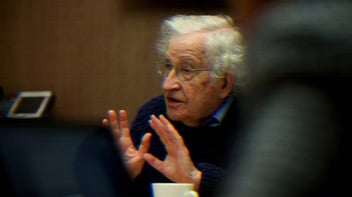

The Bear and the American Male Archetype.
Carmen Shrugged.
 Image Description: White text on a black background that reads, ‘Carmen Shrugged.’
The hit series The Bear has finally concluded. The final episode is so uplifting that most reviewers appear to believe the arc of the show’s main character follows suit with a redemptive arc. But the connection to Ayn Rand’s famous book The Fountainhead might reveal the opposite meaning. The show’s main character Carmen Berzatto, portrayed beautifully by Jeremy Allen White, shows us a prototypical Randian archetype who understands everything and learns nothing. The deeper subtext of the show is the tension between the upper and working class, the pursuit of both greatness and a paycheck, and whether individual accomplishments supersede collective success. It’s a uniquely modern American theme being played out in real time between two of the most famous men in America. Elon Musk is the avatar of Rand’s objectivist theory, while Zohran Mamdani leverages his fame and status for the collective.
This essay contains spoilers for The Bear.
There’s a moment in The Bear series finale when the character known simply as “Computer” (Brian Koppelman) utters what seems to be a throwaway line. Contained within this line is the timeless battle for the American male identity.
Reflecting on a suggestion to cut the page count of a business pitch, Computer says:
“Would you tell Ayn Rand to fucking trim The Fountainhead?”
Not War and Peace. Or the Bible. Not even Atlas Shrugged, Ayn Rand’s signature work—which also happens to be one of the longest novels ever written. The Fountainhead.
And like that, the series arc fell into place.
Most interpretations of The Bear series finale are that it offered a charmed Hollywood conclusion. Every character experiences a redemptive arc, or so it seems. Marcus Brooks (Lionel Boyce), the pastry chef who lost his mother and is estranged from his father, is the spotlight in a Food and Wine review and he reunites with his father on his own terms. Richie Jerimovich (Eben Moss-Bachrach), known as Cousin Richie (but not related) is the front-of-house manager and co-owner who finds both love and purpose.
This is not a rundown or review so I’ll leave it there. Just trust that everyone gets a payoff. It’s as satisfying as it is unrealistic.
The final episode is so uplifting that most reviewers appear to believe the arc of the show’s main character follows suit. But The Fountainhead connection reveals the opposite. It shows us a prototypical Randian archetype who understands everything and learns nothing.
At its core, The Bear is a story about trauma. Nearly everyone in the show is dealing from a place of pain and on a path toward redemption. Set in modern day Chicago, the hero’s journey belongs to world-renowned chef Carmen Berzatto (Jeremy Allen White), known to his friends and colleagues as “Carmy,” and “Bear” by his family. After working in the finest kitchens in the world, Carmen returns home to his dysfunctional family. A celebrated and highly respected chef, he sets out to face his demons and take over the family restaurant.
The Berzatto family is still gutted by the loss of the oldest child Michael (Jon Bernthal) who died by suicide, but makes several memorable appearances in flashbacks throughout the series. (For my money, the Bernthal episodes are a cut above the rest. He has a way of elevating tension like few actors working today.)
Perhaps one of the finest episodes in the history of television, titled “Napkins” comes midway through the third season. Bernthal’s Michael plays a small role, as it mostly follows line cook Tina Marrero (Liza Colón-Zayas) in her struggle to find meaningful work in a job market and world that has seemingly passed her by.
“Napkins,” delivers a visceral experience of inequality and hardship without being heavy-handed or preachy. Many of the human and social themes explored in The Bear are handled with the utmost delicacy in this way. To wit, the roles reflect the multicultural dimensions of Chicago without devolving into racial moralizing. Rather, it subtly portrays cultural differences between characters when they’re outside the walls of The Bear.
There are times when the show gets lost in itself, as though the writers became overly self-conscious about the show’s success. Misplaced cameos and frustrating dialogue often detract from otherwise superb cinematography, pitch-perfect music choices and career defining performances.
The show is at its best when it’s exploring mundane routines of life set against the harsh reality of work in the hospitality industry. The episodes truly hum when juxtaposition serves as the crucial framing, such as building a fine dining establishment that maintains the popular working class sandwich shop—The Original Beef of Chicagoland—attached to it and run by the extended Berzatto family. Or, how the entire crew is working paycheck-to-paycheck and constantly running low on supplies, while serving meals that run $190 per head.
The episodes themselves are expertly juxtaposed in pacing as well. Painfully slow moving episodes are suddenly interrupted by heart-pounding ones, placing the viewer in the front row of the rollercoaster.
It’s in the slow, brooding episodes that The Bear offers the most poignant glimpses into the struggle of life in America. The restaurant kitchen makes for the most dynamic set pieces, but the stillness of life outside brings us closer to the characters and what it means to pursue both a paycheck and a dream in the so-called land of opportunity. Which brings me to the throwaway line about The Fountainhead.
A consistent throughline in The Bear is the subplot of the sandwich shop. With the exception of Ayo Edebiri’s character Sydney Adamu who ends up as head chef and part owner of the restaurant, nearly every main character started their culinary journey in The Original Beef of Chicagoland. The back office, locker room and dishwashing station separate the cool, modern upscale restaurant in the front from the shop in the back where regulars gather at The Beef pickup window for hearty Chicago-style sandwiches.
Every Beef worker was given an opportunity to come along for the upscale ride of The Bear after Carmen discovers that his deceased brother had packed away $300,000 in cash hidden in tomato cans. To keep money coming in during construction of The Bear, several of the original employees keep the pickup window open, which proves to be a central part of the show’s denouement.
One such employee is Ebraheim, or Ebra, (Edwin Lee Gibson) a Somalian refugee with a cloudy backstory who tries his hand at fine dining, but retreats to the comfort of The Beef. Ebra is a scene stealer who quietly moves the subplot forward through the five seasons. His turn comes when he meets Albert Schnurr (Rob Reiner). Schnurr introduces the concept of franchising The Beef when he gets a look at the profitability of this little sandwich window. (The show handles Reiner’s death beautifully in a scene where Ebra is speaking to Schnurr on the phone and ends the conversation with “as you wish.”)
This is the first unspoken glimpse of the economic dichotomy on display in the series. The pursuit of individual greatness and star chef status lead the ensemble down a long, painful road littered with questions and obstacles. Family is cast aside. Ambition supersedes health and relationships. In the end, The Bear finds the right recipe to please its fickle upper class patrons but only because the journey was made possible by the working class regulars who line up each day at The Beef.
The middle of the series is punctuated by the end of another great chef’s journey with the closing of Ever, a three-Michelin-starred restaurant in Chicago where Richie stages (pronounced “stahj”—an industry term for interning at a restaurant, derived from the French word stagiaire) and finds both his calling and eventual love interest. In a quiet moment, the celebrated Ever chef played by Olivia Colman reveals to Carmen that she ended her run because she wanted to “sleep in more, go to London more, go to a party. I want to meet people.” Carmen replies, “live.” This is the very first hint that perhaps he understands.
The notion that one must summit a mountain alone only to realize there’s no one there to greet them is a time honored theme. The Bear doesn’t beat it to death, but it doesn’t hide from it either.
What it does hide is The Fountainhead connection, but it does so in plain sight in “Replicants,” episode five of season four. The episode opens with Carmen in a group therapy session listening intently to another participant’s story of family trauma. From here he visits and tours the Frank Lloyd Wright Home & Studio house in Oak Park. After looking intently at the public and private living areas of the home, he walks down the block and pauses in front of another Wright home known as the Heurtley House. Against the backdrop of the home, Carmen appears to have settled on something and found meaning. He smiles briefly, lost in thought as the scene fades to black.
While Carmen reveals toward the end of the fourth season that he intends to “retire” from cooking and promises to leave it in perfect condition, the audience is unaware of his post-retirement intentions. It’s not until the penultimate scene of the show that we learn he intends to intern at an architectural firm in downtown Chicago.
What most interpreted as a sign that Carmen is on a path to full realization is, in reality, a u-turn toward a familiar pattern. He nearly gets there during the interview at the firm when he delivers a monologue about his final service at the restaurant.
“It didn’t feel like one person trying to survive. It felt like a group of people supporting each other, trying to lift each other up…It was the most fun I’ve ever had.”
It’s unclear whether he realizes he has made a terrible mistake by forsaking his talent and profession, or if it’s merely nostalgic reflection. This ambiguity leaves us to wonder whether he does in fact manage to pursue a career in architecture despite no formal training, no discernible savings or the requisite applied mathematics skills that the field demands—it’s television so we can suspend disbelief, especially for a finale. That said, the final scene appears to show Citizen Carmen, not Chef Carmen, in a convivial birthday gathering for Cousin Richie’s daughter.
Nevertheless, it seems to be left deliberately ambiguous, but there’s no question that his arc mirrors that of The Fountainhead’s protagonist. As such, it’s reasonable to assume that he does indeed pursue a life outside of the kitchen and in search of a new kind of glory.
The Fountainhead follows Howard Roark, an uncompromising architect who battles a conformist society and rival architects to build according to his own vision and integrity, ultimately triumphing after being tried for dynamiting a housing project altered against his wishes.
At Roark’s trial for destroying the project, he delivers a long speech (an Ayn Rand specialty) about the moral primacy of creative individuals, the value of rational selfishness, and the corruption of collectivist society that feeds on creators while vilifying them. The jury acquits him, he wins the girls in the end, and he’s commissioned to design one last skyscraper as a testament to human achievement, symbolizing Roark’s ultimate victory in building on his own terms.
It’s so very Carmy. More to the point, it’s so very Ayn Rand.
Rand’s novels are built around her experience growing up in communist Russia. She believes in the American frontier spirit, capitalism and all it portends for the future of the human race. But upon moving to the United States, she becomes increasingly disillusioned with the bureaucracy and social welfare programs of the Roosevelt administration. To her, this is the top of the slippery slope to all she had left behind. And so she set out to affirm and celebrate the individual above the collective through the lens of her protagonists.
The Fountainhead established Rand as a major figure in American literature. But it was Atlas Shrugged that made her a global phenomenon, and led her to develop an entire philosophy called objectivism. This philosophy would inspire the modern libertarian movement, itself obsessed with promoting the virtue of capitalism and its industrialists. The alchemy of political libertarianism, social objectivism and neoclassical economics is what we know today as neoliberalism. And while John Galt, the main character of Atlas Shrugged endured as the avatar of these combined movements, it was architect Howard Roark who laid the foundation for what the modern American male should embody.
Once the parallel is established between Howard Roark and Carmen Berzatto, it’s chiseled into stone when one realizes that Roark was purportedly modeled after Frank Lloyd Wright. Throughout their lives, neither Rand nor Wright revealed this to be true, but they didn’t categorically deny it either. The consensus among their respective biographers is that it’s most likely the case because Rand was an early admirer of Wright and studied his work intensely.
One can argue that the success of The Bear, especially in its early seasons, was due almost entirely to the performance of Jeremy Allen White. His quiet intensity, the pursuit of perfection and the burn-it-all in search of greatness is an alluring trope. The aloof antihero. The stoic cowboy. The proverbial “strong, silent type.” American fiction and cinema has been obsessed with this archetype throughout their existence.
The fact that the libertarian movement in particular tapped into this persona is no accident. The frontier spirit of America is as American an ideal as baseball and apple pie. And it refuses to die, no matter how much evidence mounts in opposition to it.
That Carmen ultimately realizes that his best moment as a chef came during that final service when he was second-in-command and part of a team working toward a shared goal is enough to assume that the show’s creators understood the folly of the individual over the collective. The fact they allowed him to understand this and yet (perhaps) learn nothing tells us that they also know the power of the individual to the American consumer.
Earlier in The Bear it’s revealed that Carmen once received a three-Michelin-star review prior to starting over in Chicago. In one of the final sequences, he learns that The Bear earned a two-Michelin-star review. Again, a subtle implication that even the best efforts of the collective cannot quite achieve the greatest effort of the individual.
As much as we want the group to succeed, we remain hopelessly devoted to the uncompromising individual who summits the mountain. For the Carmen/Roark individual, it may very well be enough for them to know that while no one is there to greet and celebrate them, they are being worshipped and admired from afar. To this end, it’s entirely plausible that what Carmen seeks isn’t glory outside of the kitchen, but glory outside of collaboration entirely.
No one speaks of Frank Lloyd Wright’s employees or colleagues. They speak only of Wright. In The Bear, Marcus is recognized as a top chef by Food and Wine Magazine, and the Michelin stars are technically awarded to Sydney. So by retiring a three-Michelin-star chef, one reading of Carmen’s actions could be that he is the boxer who retires undefeated before taking on the next slate of opponents. Alone he achieved the pinnacle; as a mentor he could only help others get close.
Apart from clearly overanalyzing a television show, the point is to tease out tensions that are so internalized by both the creators and the audience we no longer see them. Because this exact tension is continually playing out in every aspect of our politics and culture today. Nowhere is this more apparent than the competing visions and accomplishments of the two most famous men in America right now. Ironically, neither was even born here.
One is leveraging his meteoric fame to fight for the many. The other is leveraging his personal wealth and political capital to accumulate more.
One is doing it by building the largest grassroots political movement since Bernie Sanders. The other is doing it by cheating investors, buying politicians and making false promises.
Both are loved and admired by very different constituencies, and for very different reasons.
While there are no direct parallels between Elon Musk and Zohran Mamdani to the characters in The Bear, the underlying sentiment that motivates their personas is the same. The idea that our society would not just allow, but organize around the naked ambition of a man like Elon Musk just to see if he can do it is a very American principle that is rooted in Rand’s objectivist ideology. She didn’t create it, mind you. She sensationalized it and then turned it both into dogma and doctrine.
Mamdani tapped into the harmony of The Bear’s team, but he harnessed the overlooked power of the working class cooks, servers and customers of The Beef. Mamdani’s New York City is already living proof that the working masses can co-exist with the monied elite who power the corporate engine of the nation’s business and finance capital. They just have to share. And he’s done so by making it clear that the city belongs to all of them in partnership. Just as The Bear could not exist without the sandwich window out back, the financial district and midtown cannot exist without the workers who build the edifices, clean the windows, run the street carts and take tickets at Madison Square Garden.
This is the beating heart of collectivism.
The more we celebrate a new vision of Mamdani as the American male archetype, the faster we can evolve to embrace the possibility of a non-gendered, non-demoninational American archetype. The individual who may rise to prominence for their particular talent in a given discipline, but who remains there for how many they bring with them along the way.
This is why Carmen almost got there. He even said it out loud. “To break patterns you have to break patterns.” Leaving one career behind to emulate Frank Lloyd Wright doesn’t break the pattern, it’s a capitulation to Rand’s Roark that doubles down on it.
Had it been made clear that he remained in second position as the most talented member of the team, and had the team earned that third star, the hero’s journey would have been complete. But old habits die hard, which is why we still allow for the possibility that the one can still achieve more than the many. That’s the pattern that needs to be broken.
 Max
Max
Max is a political commentator and essayist who focuses on the intersection of American socioeconomic theory and politics in the modern era. He is the publisher of UNFTR Media and host of the popular Unf*cking the Republic® podcast and YouTube channel. Prior to founding UNFTR, Max spent fifteen years as a publisher and columnist in the alternative newsweekly industry and a decade in terrestrial radio. Max is also a regular contributor to the MeidasTouch Network where he covers the U.S. economy.