
 Image Description: On The Record 08-04-26. The $72 Trillion Debt Problem. Japan Bailout. RFK Jr. Blow Out. Carville Burn Out. Iran Bombing In/Out. UNFTR.
One of our mantras around here is that the stock market is not the economy. Your personal situation is the economy. Your spending power. Your prospects for retirement. Whether you can comfortably manage the essentials of life without your stomach dropping when the card gets declined splitting a check with friends. Real-world shit.
But for the economically curious, there’s a better definition: the bond market is the economy. Or, more precisely, the debt market is the economy, because the world runs on debt. I want to talk about debt and bonds in a plain, practical way, because I got some genuinely interesting pushback on something I said in our last video, “Monsters Inc.,” about the unwinding of the AI trade.
Quick refresher: that episode used Situational Awareness—the hedge fund run by a 25-year-old former OpenAI researcher who went long on AI infrastructure plays like Micron and CoreWeave while shorting names like Nvidia and Broadcom as the canary in the coal mine for the entire AI trade. The fund’s public book got liquidated overnight in a single block trade after margin calls, and I used that to walk through how a three-quarters-of-a-trillion-dollar hyperscaler spending pledge is propping up U.S. GDP growth while the companies making those pledges post negative free cash flow. It closed with the 2008 parallel—mortgages stacked into CDOs stacked into swaps; then corporate bonds stacked into CLOs stacked into hedge-fund leverage and private credit now—with Treasuries as the eventual exit ramp when the unwind accelerates.
Here’s what got under people’s skin. I said that if this AI trade unwinds and investors flood into Treasuries as a safe haven, that demand won’t necessarily push yields down—not without the Fed stepping in with something called yield curve control. I get why that ruffled feathers, because it doesn’t track with how this is supposed to work. Demand for Treasuries spikes in a down market, yields fall, borrowing costs fall, and cheaper capital seeds the next wave of lending. That’s the boom-bust cycle as generations of economists have described it.
People took exception. Allow me to defend it.
Debt
There are three main buckets of debt in this country: household, corporate, and government. People love to add these up and treat them as apples to apples, and they’re not—particularly government debt, which plays by different rules entirely. But let’s start with the most familiar one so we can orient ourselves, and to keep this manageable, we’re sticking to the U.S. market only.
Household debt is the one everybody feels in their bones: mortgages, auto loans, credit cards, buy now, pay later, home equity lines of credit. Total household debt in the U.S. sits at roughly $18.8 trillion, an all-time high, with mortgages alone accounting for about $13.2 trillion of that pile.
Corporate debt is more complicated and, believe it or not, far less regulated. It’s commercial bank loans, equipment financing, lines of credit, corporate bonds, vendor financing, and private credit—the fastest-growing corner of the debt market since the Global Financial Crisis. All told, about $14.2 trillion. Sometimes venture and private credit deals blend a debt tranche with an equity kicker. Some loans are asset-based, some performance-based; some carry fixed rates, some float.
U.S. Government Debt: Short-term T-Bills, medium-term T-Notes and long-term Treasury bonds; Inflation protected Treasuries called TIPS and U.S. Savings Bonds. Put them together and you get a whopping $39 trillion.
The federal government is statutorily allowed to run deficits (i.e., spending more than it collects in taxes and tariffs) in a way states and municipalities can’t. It covers that gap by issuing Treasuries: bills for short-term borrowing, bonds for the long haul. It’s a genuine balancing act—borrow cheaply enough that the interest burden doesn’t spiral, but pay enough to make the debt worth buying. If inflation runs at 3%, the Treasury can’t offer paper below that and expect real demand, because you’d be handing investors a bill that loses money the moment they buy it. The U.S. Treasury market—the deepest, most liquid fixed-income market on the planet—has roughly $31 trillion in outstanding marketable debt, more than double what it was a decade ago.
Sometimes we can get lost in definitions, but a bond is simple at its core:
- A face value: what you get back at maturity;
- A coupon: the fixed interest payment along the way;
- And a duration: how long you’re locked in.
Once issued, bonds trade on a secondary market, and here’s the only mechanic that matters: prices and yields move in opposite directions. If a bond’s price falls, its yield rises, because that fixed coupon now represents a bigger percentage return on the lower price paid. If demand pushes price up, yield falls. That’s all there is to it.
Upside Down
Capitalism has been a rocky ride in its brief little history. It’s delivered wonders. It’s enriched a lot of people. I’m also pretty sure this audience is aware of the downside: it’s kill or be killed, and the system requires winners and losers. The problem is, the pool of winners keeps shrinking, and the pool of losers keeps expanding, here and abroad—the concentration of wealth is a critique left economists have been making for a century and a half.
But broadly, the U.S. trajectory has been up and to the right. A steady wealth arc, with periodic dips that wipe out real wealth for regular people along the way—the stagflation crisis of the ‘70s, the savings and loan crisis of the ‘80s, the Gulf War recession of the ‘90s, the dot-com bust of the aughts, the Global Financial Crisis, the COVID recession, and whatever we’re heading into now.
The setup is always the same. I was watching some guy on CNBC the other day telling everyone 2027 is going to be the best year ever for stocks. Right before every major correction, there’s some exuberant asshole on television telling grandma and grandpa to pile more money into equities. And historically, that’s been the right call—corrections have gotten shorter and shallower, and the upside has been historic. No market on earth has appreciated like the U.S. stock market. But that’s not because of the companies on the exchange or their earnings. It’s the debt market underneath them.
Debt drives all of it, and it’s why I think we’re heading toward the kind of correction very few people alive have actually lived through.
A couple of things make U.S. debt unique. We’re one-of-one here, because the entire world transacts in dollars—not for everything, but for most cross-border trade, and plenty of domestic activity elsewhere too. The dollar is the single most important thing the U.S. has ever produced, and for now it’s king, which means the market for our debt has no rival. That’s all a Treasury is—we’re the borrower, and the entire world is our lender. There’s a price for that privilege, and a cost too.
Two more concepts worth a quick refresher, since we’ve covered them before and they matter here. Financial repression is how this administration would prefer to handle the deficit; it happens when inflation runs hotter than the interest rate the government pays on its debt. It’s a quiet wealth transfer, away from private savers and bondholders, toward the state, which gets to pay down expensive old debt with cheapened dollars. No rational investor signs up for that voluntarily, which is why it requires leaning on captive buyers—insurers, pension funds, banks—compelled or incentivized to hold the paper anyway. That’s exactly why this White House wanted rates driven toward the floor: a temporary release valve on the deficit, and it doesn’t hurt that the man in charge is a commercial real estate guy, the one loan category still directly sensitive to the Fed’s policy rate.
The second concept is fiscal dominance: what happens when government debt gets so large that markets start questioning the state’s ability to service it at all. One camp says the U.S. can print without real limit because it holds the world’s reserve currency, and demand for dollars never disappears. So far, that’s held. The other camp says this is the generational time bomb we’re handing our kids, that we’ll end up like Weimar Germany burning currency to stay warm. The truth sits in the middle. As long as we defend the dollar’s position against rival currencies, we have far more runway than any other country. Our debt-to-GDP ratio just crossed roughly 122% on a gross basis—staggering, until you set it next to Japan, sitting around 230–250% depending on the measure. (We’ll talk more about Japan in Chart of the Week.)
Not apples to apples, but it proves the point: the whole developed world runs on debt, with more runway than the doom-scroll headlines suggest.
So here’s where we land as a recap: household debt at roughly $18.8 trillion, corporate debt at roughly $14.2 trillion, and total government debt at roughly $39 trillion—a combined pile north of $70 trillion. That’s more than twice the size of the entire U.S. GDP, which measures the sum total of everything this country produces in a year. Each pile is bad enough in isolation, but what’s important is how they all flow together.
This is exactly the setup economists like Steve Keen and Ann Pettifor—both of whom called the Global Financial Crisis years in advance—point to when they argue household debt is the most dangerous variable in the entire system. They’ve modeled their thinking on Hyman Minsky: once household debt crosses a certain threshold relative to the economy’s capacity to service it, you get widespread defaults and a systemic correction. Both have called for something called a “debt jubilee” in which the government wipes out large portions of household debt to stabilize demand without generating new debt. And it might be a good time to revisit this concept, considering our household debt levels relative to the economy sit close to where they were in 2007, which is why Keen and Pettifor are sounding the alarm again.
But I think there might be more than one alarm going off. Household debt is too high, yes. Defaults are climbing, but not yet at emergency levels. Bankruptcies too. What’s actually choking people day to day is the inflation and interest rate combination. It isn’t an amputation; it’s steadily losing oxygen in the room.
The corporate debt market looks stable on the surface, because bank lending is stable and well-capitalized. But that’s only the part we can actually see. Of that roughly $14.2 trillion corporate debt figure, most is corporate bonds, then around $2.8 trillion in commercial bank loans, roughly $1.5 trillion in commercial mortgages, and $1.5 to $2 trillion sitting in private credit.
That last piece is the one nobody can see clearly, and it’s what all the recent fuss has been about. Private credit barely existed before the Global Financial Crisis—it sprang up to fill the lending gap left by traditional banks once they could no longer justify the risk on certain business loans. We only get a look under the hood when these loans go bad, and what we’ve seen has been ugly: loose underwriting, punitive rates, lenders missing obvious fraud, revolving credit lines carrying double-digit rates, loans restructured over and over before finally blowing up.
So when people talk about “the U.S. debt problem,” it matters which debt problem they mean. The federal government can run this machine indefinitely, because its actual job is exporting dollars into the global system. It’s the commercial and household sectors that carry the real risk, because unlike Washington, they can’t simply create more money to make the problem go away.
Back to the Thesis
Now let’s close the loop. When I said a flood of demand into Treasuries during an AI-bubble correction wouldn’t necessarily push yields down, it’s because I believe we’re already living inside a period of fiscal dominance—and I’m not alone. Economists like Keen, Pettifor, and Lyn Alden have been making versions of this same argument.
Here’s how we know: the Fed’s own rate maneuvers have lost their grip on the real economy. This isn’t the Volcker era, or even the Greenspan era, when a rate decision produced a clean, predictable outcome downstream. The federal funds rate sits in a target range of 3.5% to 3.75%, effective around 3.63%. Meanwhile, the 2-Year Treasury trades north of 4%, the 10-Year sits around 4.5% to 4.7%, and the 30-Year is up near 5%.
The policy rate sits below nearly every point on the yield curve, short and long. That tells you who’s actually setting the price of money right now, and it isn’t the Fed.
It’s not that we’re struggling to find buyers. We’re still rolling over federal debt without a full-blown crisis. But the cracks are visible if you’re looking. Recent auctions have been bifurcated—strong demand at the short end, weak in the belly of the curve. Late July’s 5-Year Note auction posted its lowest bid-to-cover ratio in nearly five years, with foreign demand at its weakest since last summer, and primary dealers stuck holding the largest share of an auction since March. Not a collapse, but a sign of some nerves.
That’s why I’ve been saying we’re not collapsing, we’re crumbling. A mudslide, not an eruption. Subprime auto defaults. Private credit blowups. Mortgage delinquencies creeping up. Credit card defaults rising. And now, layered on top, the leverage baked into the AI trade. When the total debt stack is more than double the size of GDP, there’s a number and a date out there when the ground finally gives way.
The number that matters most, the one I agree with Keen on, is household debt—because once households stop spending, cut back hard, or default en masse, the commercial market goes next. That’s the reset. And when it comes, rate policy won’t save anyone, because the Fed will have to create new dollars to put the system back together—and the rate on those dollars won’t be decided by Kevin Warsh or Donald Trump, because if they can’t control this market now, why would they be able to control it once it actually breaks?
So what happens? A lot of pain, and a multi-year reset. I’m not going to tell you where to put your money. That’s a fool’s errand and not my job. But cash and Treasuries will likely be the most predictable, stable places to sit for a while, even if inflation makes them a quietly losing bet in the early innings. The ballsy speculators will pile back in after the crater forms, like they always do, and make a killing on the way back up, like they always do. And as long as the U.S. holds the exorbitant privilege of issuing the world’s reserve currency, we can probably run this cycle again—once, twice, maybe three more times. Each time, it just gets a little bigger, a little deeper.
We name-checked Hyman Minsky earlier, but it was another Hyman—Hyman Roth from The Godfather Part II, who said, “This is the business we’ve chosen.” Choose capitalism, and this is what you signed up for: a system that works brilliantly for fewer and fewer people over time, while extracting more and more from everyone else along the way.
Turning Japanese
So in Max Notes we talked about why the bond market (not the stock market) is the real economy, and I made the case that the U.S. gets to run up the tab again and again because of our “exorbitant privilege” of being the world’s reserve currency.
Well, here’s the live demo of what happens to a country that doesn’t have that privilege. Japan’s debt-to-GDP ratio is worse than ours—over 200%, and some measures put it north of 230%—and investors are punishing them for it in real time. The yen just hit its weakest level since 1986, a 40-year low, because the market is doing to Japan what it can’t do to us: pricing in a genuine loss of confidence in the currency itself. No amount of rate hikes or reserve-burning has fixed it, because the fundamentals—the debt load, the deficits, the energy dependence getting slammed by the Iran War—are all still there.
This is the cautionary tale. If the U.S. ever loses that reserve-currency shield, this is what it looks like: no Fed backstop big enough, no intervention that sticks, just a slow bleed of confidence that ends in your own citizens paying more for gas and groceries because your money isn’t worth what it used to be. So yeah, if you want to keep running the empire, keep the dollar on top. That’s not an endorsement, it’s a diagnosis. The whole system only works if everyone else keeps believing in the dollar more than they believe in their own currency, and Japan just showed you what happens the day they stop.
Even after the Bank of Japan hiked rates in June to the highest level in 31 years, Japanese rates remain low by global standards, so the trade of borrowing cheap yen to buy higher-yielding dollar assets never stopped making sense on paper. Layer on Japan’s own fiscal mess, which has been compounded by the energy shock from the Iran War, and you’ve got a currency getting squeezed from both the rate-differential side and the balance-sheet side. Japan imports almost all its energy, mostly from the Middle East, so every dollar of higher oil prices means more demand for dollars and less for yen—and the resulting global inflation shock flipped Fed expectations from cuts to hikes, making dollar assets even more attractive just as Japan needed relief.
On July 30 and 31, Japan and the U.S. ran what’s likely the largest coordinated currency intervention since 1998—bigger than the 2011 tsunami-response effort, in which the U.S. contribution never even topped $1 billion. Japan alone spent an estimated $53 billion on July 30, a likely single-day record, followed by another $34 billion the next day. The U.S. side worked through the New York Fed and dealers Goldman Sachs and Morgan Stanley, and reportedly sold euros, not dollars, to buy yen—an unusual funding choice for coordinated intervention.
It’s worth noting the political whiplash here: this is the same Trump administration that, as recently as last year, was threatening tariffs on Japan specifically because a weak yen gave its exporters an unfair edge. Now the White House is calling this a “sign of friendship.” The trade-fairness and friendship framing is the cover story.
Source: MacroMicro
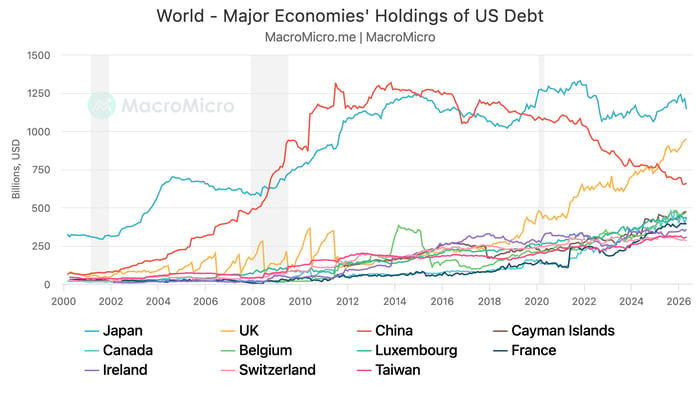
The real motive is that Japan is the largest foreign holder of U.S. Treasuries, and a country burning through reserves to defend its own currency eventually has to sell something to raise dollars—and Treasuries are the obvious lever. Japan already sold Treasuries to fund its 2024 intervention, and there are signs it drew down Treasury holdings again this April. So Washington had a direct interest in keeping Tokyo from being forced into unilateral dumping—that kind of selling would push bond prices down and yields up at the exact moment U.S. borrowing costs are already strained by Iran-War-driven inflation. Treasury Secretary Scott Bessent said as much in softer language, calling the move a matter of “orderly market functioning.” Fed-speak for “we need Japan to not torch our bond market on its way out the door.”
And yes, the carry trade is the unstated third rail. For years, hedge funds and institutions have run the play: borrow in near-free yen; convert to dollars; buy Treasuries, U.S. equities, and credit, and pocket the spread. BCA Research called this a “ticking time bomb” back in February, and short positioning against the yen had actually been rebuilding toward multi-year highs heading into this intervention—meaning the leverage in the system was growing, not shrinking, right before the snapback. One estimate puts total exposure tied to yen-funded leverage at roughly $1.2 trillion in Japanese-held Treasuries and $3.2 trillion in global assets—money that would need to unwind fast and messily if the yen kept moving against short positions, hitting Treasuries, U.S. equities, emerging markets, and crypto all at once.
So stack it up: defend the yen, defend the Treasury market, defuse the carry trade. It’s really one move serving three purposes, and all three come back to protecting the plumbing of the American financial system, not doing Japan a favor.
 Max
Max
Max is a political commentator and essayist who focuses on the intersection of American socioeconomic theory and politics in the modern era. He is the publisher of UNFTR Media and host of the popular Unf*cking the Republic® podcast and YouTube channel. Prior to founding UNFTR, Max spent fifteen years as a publisher and columnist in the alternative newsweekly industry and a decade in terrestrial radio. Max is also a regular contributor to the MeidasTouch Network where he covers the U.S. economy.