
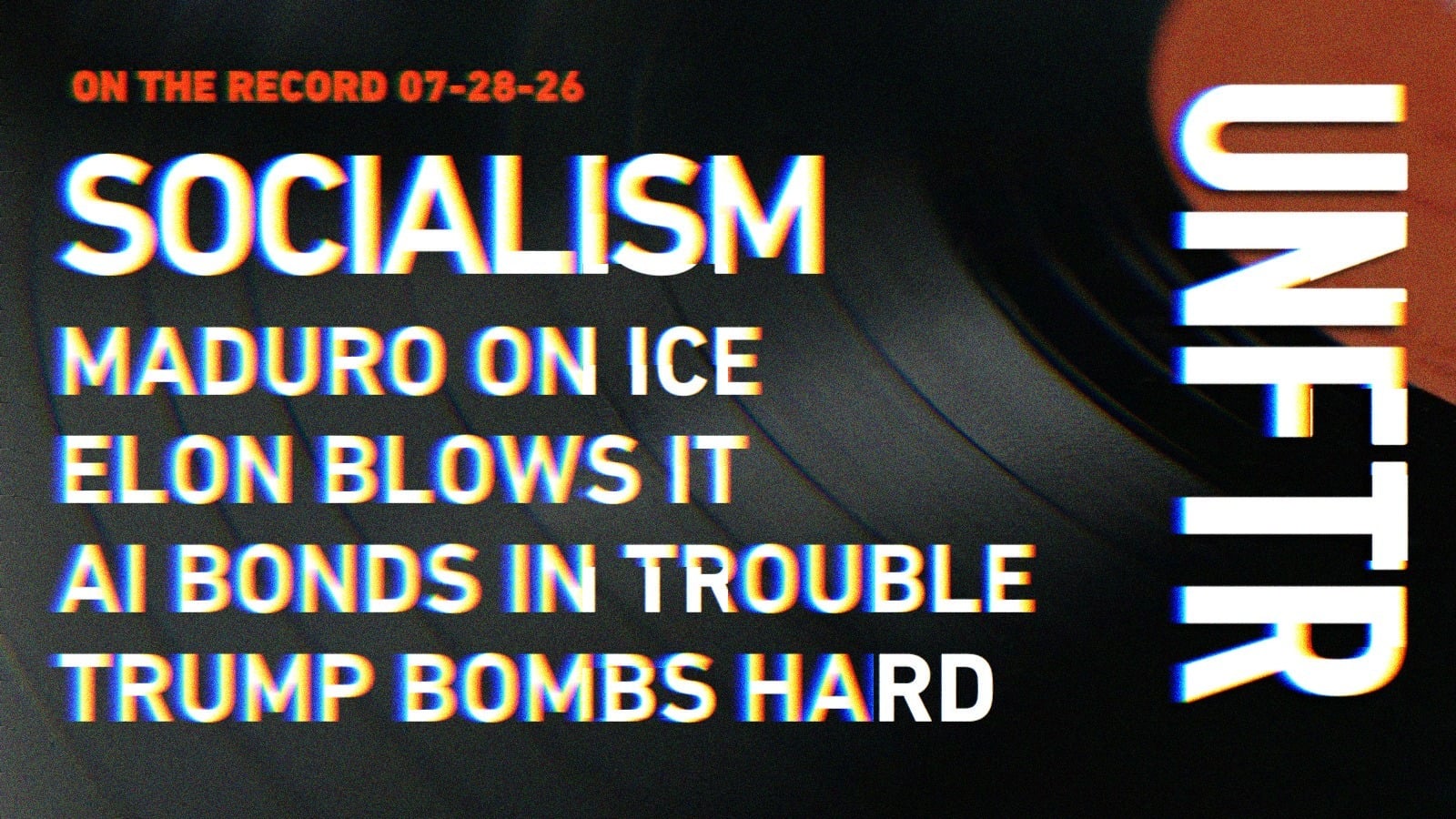
 Image Description: On The Record 07-28-26. Socialism. Maduro On Ice. Elon Blows It. AI Bonds In Trouble. Trump Bombs Hard. UNFTR.
Socialism, Cold War & Chavismo
Well, a trial date has been set for kidnapped leader Nicolás Maduro. June 1st, 2027.
A year away.
Just to recap, the United States government kidnapped the sitting president of a foreign nation off Venezuelan soil in a military operation, flew him to Brooklyn, threw him and his wife in a holding cell, and then told the world it would take almost a year and a half to get around to actually charging him in open court.
I’m talking about this now, talking it about it again, because we cannot talk about it enough. Not because Maduro is a swell guy. He isn’t. Not because he was doing a bang up job of running Venezuela. He wasn’t. But if that’s the criteria, then boy do I have a sitting president for you to capture. It’s more than the illegal nature of it. More than the fact that this is one of the most egregious international crimes committed against a sitting head of state short of assassination. But because it dredges up some demons we have yet to reckon with, and because it confuses our perception of what’s happening in our own politics. The war on socialism. The persistent blood soaked roots of racist paternalism. It’s all there and we are incapable of facing it head on.
Here’s the official story, or at least the one that’s been allowed to calcify into conventional wisdom: Venezuela had a beautiful democracy, a socialist strongman named Hugo Chávez came in and wrecked it, his flunky Maduro finished the job, the country collapsed into a humanitarian catastrophe, and America , reluctantly and virtuously rode in on a white horse to liberate the Venezuelan people from a narco-dictator.
Familiar? Unfamiliar? Maybe you’ve heard of this version.
America has been trying to strangle Venezuela economically since the moment Hugo Chávez won an election to liberate the Venezuelan people from the throes of neoliberalism and the clutches of foreign corporate interests. To build a welfare state that centered workers and lifted the poorest Venezuelans out of poverty. The sanctions escalated gradually through the Obama years, then Donald Trump, in his first term, turned the dial to 11: sweeping oil sanctions, secondary sanctions threatening anyone who did business with Caracas, an economy already gutted by mismanagement and corruption now getting the full “maximum pressure” treatment usually reserved for adversarial nuclear states. It worked exactly as intended and exactly as it always does—not by toppling the government, but by immiserating the population underneath it.
In the middle we have some sunlight with the Biden reprieve.
Joe Biden inherited that stranglehold and, for a few months, loosened it—not out of some late conversion to human rights, but because Vladimir Putin invaded Ukraine, global oil markets seized up, and suddenly the White House needed literally any barrel of crude it could find that wasn’t Russian. So Chevron got its license back. The taps opened a little. And then, once the election-fairness pretext Biden had attached to that relief evaporated—surprise, Maduro didn’t hold the free and fair election he’d vaguely promised— the sanctions snapped back into place within six months. That’s it. That’s the entire arc of “Biden was soft on Venezuela.” A brief, self-interested crack in the embargo to solve an oil price problem, slammed shut the second it stopped being useful.
So for basically the reductive view of the Chavismo era.
Nearly eight million Venezuelans have left the country over the last decade—something like a quarter of the entire population, one of the largest displacement events on the planet in this generation. COVID, sanctions, oil shocks, mismanagement, corruption. They all played a role.
And by the way, we’re so fucking narcissistic in this regard because the overwhelming majority of those people didn’t come here. Colombia alone absorbed something on the order of three million Venezuelan refugees. Peru took in over a million and a half. Add Ecuador, Chile, Brazil—you’re talking about neighboring economies far smaller and far poorer than ours swallowing the crisis at a scale that dwarfs, by orders of magnitude, whatever showed up at our southern border. Roughly nine out of every ten displaced Venezuelans stayed in Latin America. We got a fraction of the fraction.
But that fraction still hit us at the exact moment our political system was primed to treat any Brown face at the border as an existential threat rather than a symptom of a policy we ourselves helped author. Border encounters with Venezuelan nationals went from essentially nothing to hundreds of thousands a year in the space of two federal fiscal years. And we never—not once, not seriously—connected that number to the sanctions regime that had already been strangling the Venezuelan economy for the better part of a decade. We treated the migration crisis as a natural disaster instead of a foreseeable consequence of a policy we designed.
Joe Biden understood this dynamic just well enough to be scared of it and not well enough to fix it. He assigned Kamala Harris to work on “root causes” of migration from the Northern Triangle countries—a mostly Central American diplomatic portfolio that had nothing to do with Venezuela specifically—and let the right wing brand her the “border czar” anyway, a title she never actually held. By the time Biden realized the border was going to be the issue that ended his political career, it was too late to do anything but drop out of the race and hand Harris an unwinnable inheritance—a crisis with real causes that both parties had agreed, by mutual silence, never to name out loud. We know how that story ends.
But here’s what’s missing from the entire discourse, the thing that should embarrass everybody currently cheering this on: Maduro, in his final years in power, was already doing exactly what Washington claimed to want all along. He was reversing Chávez’s economic model, which we’ll talk about more in a moment.
He handed control of more than a dozen state-run food companies over to private operators. He started selling minority stakes in state-owned firms—telecom, steel, oil-adjacent industries—to raise capital. He relaxed currency and price controls, let dollars flow back into the economy, quietly privatized his way toward the exact kind of market liberalization the United States had spent two decades sanctioning Venezuela to force. He was corrupt enough, malleable enough, transactional enough that it is entirely plausible we could have gotten more out of him alive and in office than we ever got from a military kidnapping. Lift the sanctions. Cut the deal we always cut with strongmen we find useful—a golden parachute, a date certain to leave, maybe even a seat at the table for a U.S.-led privatization of the oil sector once he was out. That is, quite literally, the standard American playbook everywhere else on the planet.
Instead we did dollar diplomacy and gunboat diplomacy, the John Foster and Allen Dulles special, because the Cold War ghosts never actually left the building at Foggy Bottom. We generated the crisis, blamed it on socialism, and then arrived to play the hero in the fire we set ourselves.
And here’s the very American distinction underneath all of it, the part that should make you the most uncomfortable: we would never, in a hundred years, send special forces to kidnap the head of state of a white European nation and stick him in a Brooklyn jail cell to await trial on our own timeline. That idea is unthinkable, laughable, an act of war. But the president of a Latin American country? Sure. Grab him. He should have played ball sooner. We’re operating from an anachronistic, paternalistic, and viciously racist Cold War playbook.
Now let’s bring our very immature and narrow American lens into focus, because there’s an even bigger discussion to be had. Right now the Democratic Socialists of America (DSA) are having a bit of a moment and it’s scaring the shit out of establishment liberals and the bejesus out of conservatives, neither of which knows what the fuck they’re talking about.
The dominant framing in American politics is that this is a fight between freedom and democracy on one side and socialism/authoritarianism on the other. Venezuela and Cuba—very much tied at the hip in the spirit of the Bolivarian Revolution and anti-western capitalist sentiment—are held out as proxy for this fight. Cautionary tales used on both sides of the establishment aisle.
The actual fight, the one underneath all of it, is between capitalism and everything that isn’t capitalism. We are still operating with a Cold War brain, except this time—and this is the uncomfortable part—the threat was real. This wasn’t the domino theory dreamed up in a Georgetown seminar room to justify a war on the other side of the planet. Hugo Chávez actually did the thing. He built a genuine, home-grown, working-class revolution, in our hemisphere, funded by our number one import.
And that’s Chávez’s real sin, as far as Washington was concerned. A twofold sin. First, he thumbed his nose at the United States, rhetorically and literally, on the floor of the UN and everywhere else a microphone was pointed at him. Second, and far more dangerous, he actually succeeded. He redistributed income downward, funded his social missions with oil money, punished a domestic elite that had run the country for its own benefit for generations, and in doing so he became a domino in the other direction—Evo Morales in Bolivia, the Kirchners in Argentina, Lula in Brazil, Correa in Ecuador. A wave of leftist governments across Latin America that Chávez didn’t cause single-handedly but absolutely helped detonate.
But the line he crossed that Washington could never forgive was the oil. In 2007, Chávez nationalized the heavy-crude projects in the Orinoco Belt—the ones Exxon and ConocoPhillips had built—along with a wave of expropriations across food, steel, cement, electricity, telecom, construction. Some of those seizures were compensated at something resembling market rate through international arbitration—Exxon eventually collected roughly $900 million of the $10 billion it wanted— and some weren’t compensated fairly at all. But compensated or not, that’s the unforgivable act. In corporate America, nationalizing an oil field is treated the way the mafia treats an unpaid debt. It doesn’t matter how long it takes. It gets collected.
The kidnapping of Maduro was indeed a mafia move, with political cover and carried out by a military operation but make no mistake about what this was… It was a hostile corporate takeover, executed by the largest company in the world: USA Inc.
Every bit of the democracy-promotion language—the narco-terrorism indictment, the sham election disputes, the moral outrage—is packaging. The actual grievance is two decades old and it’s about money. Chávez nationalized American oil assets. That is, and has always been, the single greatest offense you can commit against corporate America. You can jail dissidents, rig elections, run death squads, and Washington will find a way to work with you if the oil keeps flowing to the right shareholders. Nationalize the oil, and you go on a list that never expires.
So look at what’s happening right now, in the open, without a hint of shame. Marco Rubio, the Secretary of State, is being described by The New York Times as the closest thing to a colonial viceroy America has installed anywhere since Paul Bremer ran occupied Iraq. The U.S. Treasury collects Venezuela’s oil export revenue directly, routes it through Treasury-controlled and Qatar-based accounts, and releases it back to the country in installments that Rubio personally signs off on—precisely a return to Dollar Diplomacy. Since January, somewhere in the range of eight billion dollars of Venezuelan oil money has flowed through Treasury-controlled channels. Trump himself bragged about the figure to reporters on Air Force One, putting it north of $13 billion total sold, and adding, unprompted, “We’ve paid for that war many times over”. Unreal.
And then, this summer, twin earthquakes killed thousands of Venezuelans and left tens of thousands more missing or homeless. And how much of that multi-billion-dollar pile of Venezuela’s own oil money did Washington release for earthquake relief? Around $300 million. Venezuela’s own foreign minister had to stand up at the United Nations and publicly beg Washington to release frozen funds for earthquake recovery.
Now let’s be intellectually honest about the Chávez administration.
Chávez never actually built socialism. He got partway there and stopped. He nationalized industries and funneled the proceeds into genuinely transformative social programs like health missions, literacy campaigns, subsidized food, and a rewritten constitution—and I want to quote this directly, because it’s important. Legal scholar Roberto López Sánchez, writing in Venezuela in Crisis, documents how the 1999 constitution ratified and expanded rights that dated back to the 1940s: “the right to unionize, union autonomy from both the employer and the state, collective bargaining, the right to strike, social security as a guaranteed public service, gender equality in labor law, formal recognition of household labor as economically valuable work entitled to its own social security protections, and a reduction of the standard workweek from forty-eight hours down to forty-four.”
This was the “Plan Guayana Socialista.”
But even those genuine wins existed in tension with the larger socialist project, because Chávez never did the one thing that would have actually made it socialism rather than a well-funded populist welfare state: he never handed control of production over to the workers themselves.
The state nationalized the means, but the state also kept the wheel. And this is a pattern, not a Venezuelan quirk. It’s the exact critique the anarchist Mikhail Bakunin leveled at Marx more than a century ago—that you cannot replace a centralized corporate or capitalist authority with a centralized state authority and expect a fundamentally different outcome, because the structure of top-down control is the disease. Swap “corporation” for “state” and you haven’t abolished hierarchy. You’ve just changed its letterhead.
Sánchez says it more precisely than I can. Chávez’s economic programs, he writes, “fit within a Keynesian model of state intervention in the economy. Socialism was always present in his rhetoric, but it was rarely reflected in the actual governance.”
That is the single most important thing anyone on the American left needs to understand about Venezuela, and about basically every other experiment we casually slap the word “socialist” on.
Because here’s my actual thesis, and it’s bigger than one country: there has never been a socialist government or a socialist nation anywhere on earth. Not the Soviet Union, not Cuba, not China, not Venezuela. What we’ve had, over and over, is state capitalism in socialist rhetoric, run by a centralized authority that claims to act on behalf of the working class while never actually transferring power to it. And even the American left throws the word “socialism” around loosely. It’s used interchangeably with social democracy, with a Nordic welfare state, with whatever Bernie wants.
In doing so, we’ve handed the right an enormous, undeserved gift. Because if we can’t tell the difference between socialism, democratic socialism, and Venezuelan-style state capitalism, you can be damn sure the right isn’t going to bother making that distinction either. They collapse all three into one boogeyman and use Caracas breadlines as the visual aid, and we let them, because we’ve never done the work of defining our own terms.
Venezuela should be the case study that forces that precision, not the cudgel that ends the conversation. Chávez succeeded in redistributing wealth and dignity at a scale most Western democracies have never attempted. He also fell victim to the resource curse, sometimes referred to as the “Dutch Disease”—a scenario where a country is so dependent on a single volatile commodity that its entire social project rises and falls on the price of it. This differs from an economy like China, which diversified its economic base while still keeping its hand on the wheel.
We owe it to ourselves to be honest that the socialist vision, the real one where production actually belongs to the people who do the producing, may not be achievable in our lifetimes, given how entrenched capital has become globally. But that’s not a reason to abandon the project. Economists and theorists from Marx to Schumpeter to Piketty have argued that socialism remains the inevitable heir to capitalism when it fails. But not if we don’t understand what it means. The planning starts the moment we decide it does.
And to that extent, DSA and figures like Mamdani are opening the conversation in a meaningful way through coordination and action. It’s out job to not fuck it up.
Concentrating on Concentration
The companies with the most cash and access to the equity markets are adding a new channel to the cash-sucking promise of AI. As mentioned above, Steve Eisman, an investor of Big Short fame, recently appeared on CNBC’s Squawk Box to talk about AI concentration risk and admitted that he is sitting mostly in cash at this point and that he even sold off his shares in Alphabet. He’s not the only one.
Alphabet (Google’s parent company) took a dip on the news that it will be increasing its investment into AI infrastructure and financing it mostly through corporate debt.
-Jul-28-2026-04-08-27-3700-PM.png?width=700&height=482&name=unnamed%20(1)-Jul-28-2026-04-08-27-3700-PM.png)
Source: Bloomberg via Barclays
Bloomberg notes that the issue isn’t necessarily with the amount of debt being issued by Big Tech, but that the duration of these bonds is longer than normal. Locking up capital for a longer term in a market filled with risky bets isn’t Wall Street’s favorite thing if you can believe it. As a result some of it is, “already trading at spreads close to BB rated junk bonds, despite the fact that most hyperscalers command some of the highest ratings in the investment-grade category.”
The hyperscaler long-dated bonds are outpacing even the big banks and people are starting to notice, as evidenced by the cool reception to recent issuances, most notably from SpaceX and Amazon.
To be clear, the hyperscalers don’t present a default risk. We’re talking about the biggest, most profitable companies on the planet (outside of SpaceX). But it presents a challenge to the wider market as big tech continues to hoover up cash from all available sources. We’re playing a dangerous long game by pinning our hopes on a technology that has yet to even be defined. So when you hear people talking about whether popping the AI bubble presents a systemic risk to the economy, this isn’t helping.
 Max
Max
Max is a political commentator and essayist who focuses on the intersection of American socioeconomic theory and politics in the modern era. He is the publisher of UNFTR Media and host of the popular Unf*cking the Republic® podcast and YouTube channel. Prior to founding UNFTR, Max spent fifteen years as a publisher and columnist in the alternative newsweekly industry and a decade in terrestrial radio. Max is also a regular contributor to the MeidasTouch Network where he covers the U.S. economy.