
Slow Moving Disasters.
Climate Change, Artificial Intelligence and The Democratic Party.
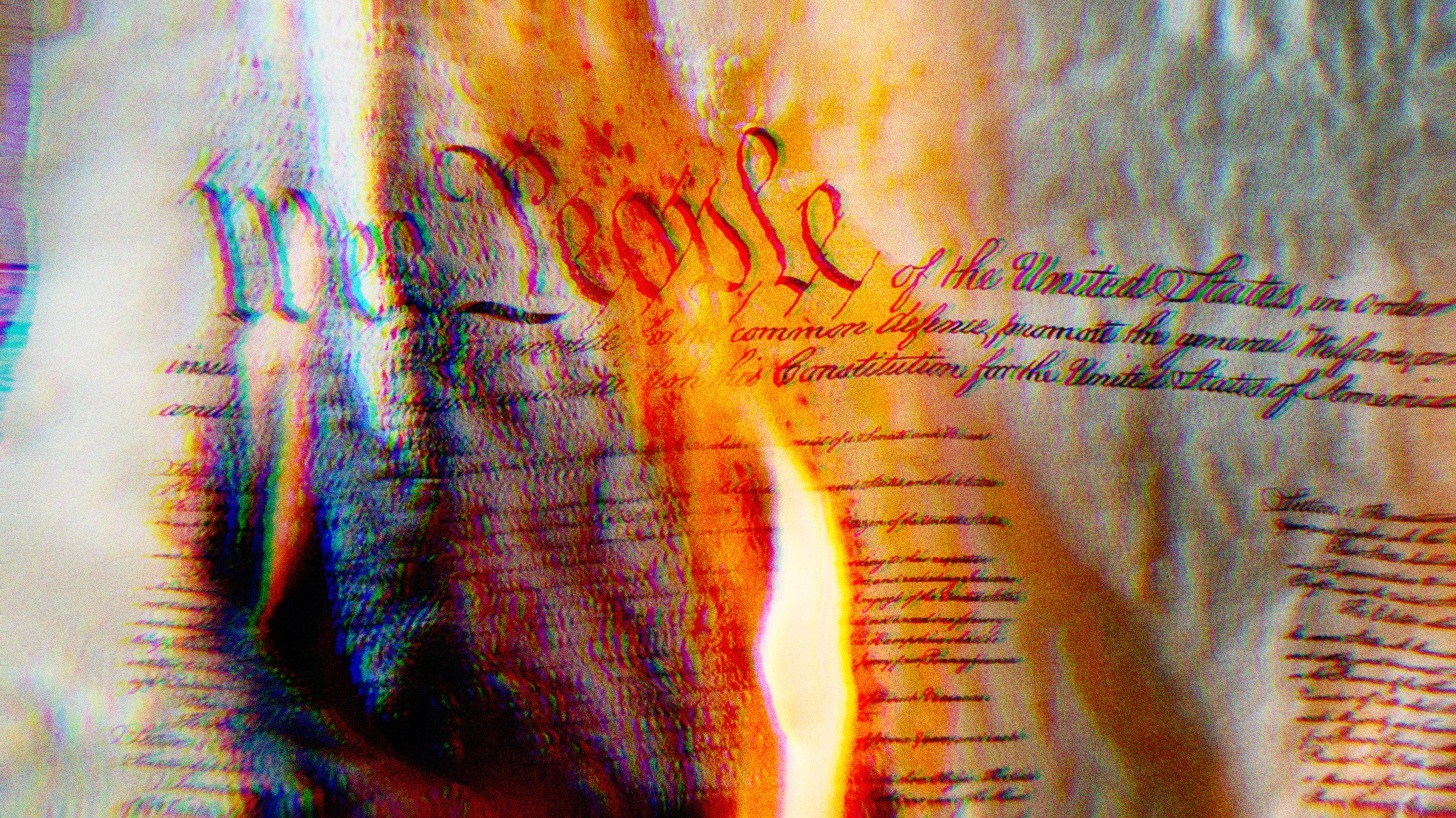 Image Description: The U.S. Constitution on fire, the words We The People are burning.
This is one of those, get it off the chest essays. A straightforward conversation about three slow moving disasters that threaten our way of life. Climate change, artificial intelligence and the Democratic Party. Obviously, that last one requires a bit of an explanation. This is that explanation.
Three slow moving disasters are threatening our way of life in the United States. Climate change, artificial intelligence and the Democratic Party. That last one might seem like the outlier of the triad, so the burden of the argument is on me.
I was born in 1973. Grew up in a Republican household during the Reagan era. I registered as a Republican when I came of voting age, and even ran unsuccessfully for a local office as a Republican in my 20s. When I encounter people who knew me back then who learn of my hard left trajectory it usually comes as a surprise and they’ll ask me, “what the hell happened to you?” Typically I brush it off and say something pithy like, “I started reading.” And, in fact, this is partially true.
Politics is open source. No matter how closed the system, its impact is universal and therefore we all have a stake in it or, at a minimum, an opinion. The most informed political citizen’s vote is equal to that of the least informed citizen. I offer this to convey that there is no special degree, no litmus test, no superpower that provides special access to knowledge of our political system.
Like I said, open source.
Being able to tap into the Republican part of my brain has in some ways freed me from wondering what the fuck is wrong with them. I was one. I know exactly what’s wrong with them and I’m not interested in fixing them. I’m far more interested in beating them.
Here’s what I’ve come to understand about the left/right divide. (Fair warning, it’s a totally reductive framing but it helps me sleep at night.) The right is motivated by self interest. The left is not. Even when it appears that the right is acting against its own interests, the perception of that particular interest matters.
Here’s an example. There is objectively no reason for billionaires to exist.
The left understands the inherent contradictions of capital concentration and how this phenomenon positions capital to control the political process to the detriment of the masses. That billionaire doesn’t have to be directly picking the pocket of a person on the left in an obvious way for us to understand the societal imbalance of inequality. The right, on the other hand, doesn’t just tolerate the billionaire, they root for them. Because they believe there’s a chance they might become one. Someday I’m gonna get mine. Get that bag.
Our shared distrust of elected officials ironically bolsters those sentiments. The left believes the political class can be bought, and therefore seeks to eradicate this possibility. The right believes the political class is in on the corruption and will steal their bag just like they’re coming for their guns.
And so we hold periodic charades of political participation known as elections to determine whose narrative is winning the tug of war.
That’s why the Republican Party doesn’t irritate me in the same way as the democratic establishment manages to do. Another example, the DNC is still evaluating the psychographic and demographic data from Obama’s election in 2008. ‘If we can just win back those Republicans in red states who went for Obama, we can swing the pendulum back toward center.’ This is the motivating mantra of the DNC and the monied interests that support it.
The reason those Republicans went for Obama is because the Global Financial Crisis fell on a Republican’s watch. That’s it. That’s the whole fucking story. Millions of Republicans voting in their own self interest because the neoliberal politics of deregulation and tax cuts for the wealthy failed at precisely the right moment for Obama to ascend to the throne. The failure to fix this same circumstance is also what led to Donald Trump.
Sadly, social issues don’t move politics in the way we like to think they do. Endless wars, civil rights, civil liberties, bodily autonomy, even democracy are not the principle dynamics in sea change elections. Good social policies are constructed during the most polarized economic periods. Catastrophe paved the way for Social Security and market regulation. Prosperity paved the way for the Civil Rights movement and Great Society programs. Eras of precarity lead to bad decision making and make us susceptible to the loudest voice in the bully pulpit with bumper sticker answers to complicated problems.
Right now we have a confluence of catastrophic issues on a collision course. Ignoring climate change doesn’t make it go away. As portrayed in David Sirota’s Don’t Look Up, the meteor is coming whether you look at the sky or not. But the right has won both the propaganda battle and the precarity battle when it comes to this issue.
They have sown doubt in the science and given equal weight to the uber minority of skeptics in the scientific community, leaving the ignorant masses to their own devices to determine who’s right or wrong. Moreover, they’ve dismantled the economic protections for the working class thereby leaving even the most interested and empathic parties too broke, too disillusioned and too goddamn tired to muster the effort to fight the tide of lies and disinformation.
The same holds for the promise of artificial intelligence. The concept of AI has been around for more than 70 years and the first glimpses of operational AI were supposedly, finally delivered within the past couple of years. If successful, AI will eliminate tens of millions of jobs. That’s the success narrative. If it fails, it will bring down the economy because of the volume of overinvestment into a narrow sector. Either way, it will also have devastating consequences to the environment.
Let’s dwell on that for a moment. In the past couple of years, more money has been invested into AI infrastructure than any public or private investment ever before. And the sales pitch was 50/50. Either we destroy the economy by eliminating the lower and middle parts of the workforce, or we flush the largest capital investment in history down the toilet. And in both cases, we’re going to rip apart communities to build data centers that require more energy and water than we currently produce or have access to.
Again, don’t look up.
In all the writing I’ve done as an admitted non-scientist and someone who relies on the expertise of experts, a few things have become clear regarding climate change. First, we’ve gone from reversible to resilience. The window is closed to reverse course now that warming trends have accelerated and are causing extreme weather events. Second, we will make it through as a species, but the way future generations exist will be fundamentally different. There will be mass migration events and population decline due to famines, droughts and displacement.
But here’s a fun fact that feeds the self interest of the Republican mindset—the United States will have one of the best climates for survival. Then again swaths of coastal regions will be under water and that’s according to the naval scientists who have been modeling this since the early 1990s. The military. You trust the military, right?
Another fun fact, we have examples of reversing damage to the environment and atmosphere. Back when science was a non-partisan affair. We did a piece on the Montreal Protocol from the 1970s, an international compact to phase out the use of hydrochlorofluorocarbons, because scientists figured out that they were responsible for the hole in the ozone layer. As a child of the ‘70s and ‘80s I can tell you that this was as much of a threat as quicksand. And guess what? It’s almost closed. We did it. Imagine that.
But we’re 50 years past the time when politicians built public policy around science.
This leaves us with the confluence of disasters that will open a new hole, not in the ozone but in our politics. We will once again have an opportunity to construct a new politics in the giant hole Donald Trump is blowing in the economy. To begin, the math on AI doesn’t math. The historic amount of capital being deployed into AI infrastructure is chasing something that we already know does not exist.
If you hold one truth in your head about AI, let it be this one: AI cannot achieve economies of scale. This is the one economic fundamental required within a capitalist economy to justify the pain and economic dislocation required to feed the insatiable growth beast. At some point, any technological or industrial advancement must achieve economies of scale. It must at some future date bend the cost curve.
One industry that significantly bent the cost curve was the fossil fuel industry. And as in the case of AI, we knew all along how detrimental it would be to humans and the planet. In the 1970s, internal scientists at Exxon proved that burning fossil fuels would increase the temperature of the atmosphere and heat the Earth’s surface. They knew it and they buried it. In the 1990s, the U.S. military published a report that predicted where and when U.S. military installations would be under water in various parts of the globe. They knew it and we all ignored it.
That’s not Al Gore saying it. Not Greenpeace or the Sierra Club. That’s the fossil fuel industry and the military. No tin foil hat required because the reports have been exposed and the science has only been refined since.
Don’t look up.
There’s no such cost benefit to AI in the long run, because we know that the current infrastructure will be obsolete, not within decades, but within a few years. The more it grows, the greater the cost. The exact opposite of economies of scale. In fact, it might be the most inefficient and unprofitable industrial revolution ever. And it too will damage the environment.
You need be neither an economist nor a scientist to understand how this all unravels in spectacular fashion and in short order. And therein lies the opportunity for the Democratic Party to fill the inevitable void that brings together voters who act in their own self interest and those who vote in the interest of the masses. Just like 2008.
But the only ones who are prepared for this eventuality, the only ones who have built resiliency in their models is the financial sector. Don’t get me wrong, there will be carnage. But our tax dollars and the power of our central banking authority are at their disposal and they will not hesitate to deploy them in order to salvage the system.
And what’s on offer in the Democratic Party? More centrism and a coordinated attack on the left flank of the party. If you do not stand for something, you stand for nothing. Or worse yet, you allow the opposition to define it for you.
The midterms are nigh. And everything you need to know about the Democratic Party is on display right now. Money is pouring into centrist Democratic campaigns with heavy coordination from dark money PACs tied to AIPAC and other outside interests. Look specifically at Michigan where more than $50 million dollars are being spent to prevent Abdul El-Sayed from taking the senate primary in a few days from now because he scares the shit out of the establishment. Not just because he’s a Muslim man but because he wrote the book on Medicare for All. Literally. He wrote a book titled Medicare for All.
There are a million and one reasons to pull for progressive victories across the country. But the one tentpole issue that could revitalize the Democratic Party and galvanize the population is Medicare for All. The economic case for it is as clear as the humanitarian case. Self interests and populist appeal alike, all wrapped up in a single policy that would set the Democrats on a path to victory and electoral success for a generation. And they won’t do it. They won’t touch it, even though Trump is dangling it on a silver platter by destroying the last vestiges of the insurance company crafted ACA. When the work requirements for Medicaid kick in next year, millions of Americans will lose access to healthcare coverage.
That’s on top of the millions that have already abandoned private insurance this year or downgraded to catastrophic coverage. The multi-decade trend of reducing bankruptcies has reversed, with the latest figures being released just yesterday showing that filings were up 12.2% over the 12-month period ending June 30 last year. Medical debt is one of the primary drivers on the personal side so which direction do you think this will continue to head as the economic crisis deepens?
But the DNC sees all this as an opening to reclaim power instead of delivering transformational politics. Make no mistake, they’ll win a lot. All over the place. They’ll win the midterms with the same “we’re not Trump” message that delivered Biden into the White House. And they might even win in 2028 when Americans simply cannot take Republican rule anymore. That’s how we got the neoliberal Clinton era that delivered the conservative Bush era that made us year for hope and change under Obama. And when change never came we got Trump.
The pattern recognition is fairly obvious at this point. What’s missing is the signal that lights the way out of this doom loop. That signal is Medicare for All. No matter where you are in the United States, if the option presented to you on the ballot does not enthusiastically support Medicare for All as much as the Republicans support tax cuts for the wealthy, they’re sending you a false signal.
Even that long dormant Republican part of my brain can tell the difference.
 Max
Max
Max is a political commentator and essayist who focuses on the intersection of American socioeconomic theory and politics in the modern era. He is the publisher of UNFTR Media and host of the popular Unf*cking the Republic® podcast and YouTube channel. Prior to founding UNFTR, Max spent fifteen years as a publisher and columnist in the alternative newsweekly industry and a decade in terrestrial radio. Max is also a regular contributor to the MeidasTouch Network where he covers the U.S. economy.