

 Image Description: On The Record 10-13-26. Russell Vought’s 7 Point Plan To Steal the Election. Guilfoyle “Honey Please.” Hegseth’s Firing Squad. Israel Is Destroying Lebanon. Francesca Fiorentini. UNFTR.
The “October Surprise” Coming in January
You’ve probably heard me say, “We don’t have to guess at this. They wrote it all down.” It’s a cousin of Occam’s razor: sometimes the most obvious explanation is the right one. I’m fairly certain I know what Trump’s so-called October surprise is, though I don’t believe it will happen in October, technically. What I believe is that the foundation has already been laid for what comes next. There’s a lot to explain here, so hang with me as I work this out in real time.
The reason I started reading conservative think-tank white papers and wrote so much about Project 2025 when it came out goes back to my time with a Holocaust studies organization I was part of for several years. I was speaking with a docent about Holocaust denialism and about how we were still learning about events that had unfolded decades earlier. It turns out we didn’t have access to a great deal of information after the Iron Curtain descended on Eastern Europe. That’s why Holocaust studies developed over time, through painstaking research and collaboration between scholars in the East and the West.
But there was one connection that was so obvious once I heard it, and it has stuck with me ever since. The docent explained the scale of it, and how scholars were able to piece the information together over time through ledgers, detailed accounts and photographic evidence, much of which was on display in the center where I was studying. In effect, she said, the burden of remembrance was in the collection of details. It wasn’t about piecing things together through lore and recollection. It was about reconciling a voluminous amount of evidence.
I remember distinctly looking at a photo of the Einsatzgruppen standing over a mass grave of Jewish families. “The reason we have this photograph,” she said, “isn’t an accident of history. They documented everything in such great detail because they were proud of this work. The reason we don’t have to approximate the Holocaust is because they wrote it all down.”
It was one of those transformative moments. This Trump administration has been the least surprising thing in all the years I’ve covered politics, because we don’t have to guess at or approximate their actions. Project 2025 is the lodestar of this Trump administration, but it’s far from the endgame. Project Esther is the blueprint for purging pro-Palestinian sympathies from the masses, though it too is subterfuge for the larger project of mass deportation and ending birthright citizenship.
As I’ve said many times, it’s important to take them at their word. What confuses things is when Trump goes rogue and just says shit like “I’ll give everyone five grand to vote Republican” or “everyone will get a tariff dividend.” But every so often he lets something slip from the playbook. The key is to separate the bluster from spilling the beans. So when he said this the other day…
“Director of the Office of Management and Budget, Russ Vought, who is fantastic. He’s done a job. We have some big surprises coming up in another few weeks, right, Russ? He’s going to be one of the very important people in the history of our country, in my opinion. He’s got some great things happening.”
…my spidey senses were tingling. You don’t just randomly invoke Russ Vought’s name four weeks before an election and say he’s going to be one of the most important people in the history of the country. That was a slip. It happened on October 6th at the Sparrows Point shipyard in Maryland, and I haven’t been able to stop thinking about it since. Three days later, Trump doubled down, saying Vought would be “even more important than Chris [Wright] if he pulls this off” and that “he’s working on something that’s going to be so good for our country.” Even The Wall Street Journal is now asking whether this is an October surprise or a November one.
For the life of me, though, I couldn’t piece together what the director of the OMB could do to disrupt our elections. Then two things happened.
First, I went to Brad Onishi’s book launch for American Caesar: How Theocrats and Tech Lords Are Turning America into a Monarchy, and then I read the book. It put me back in touch with the larger project to dismantle our democracy and install a theocratic monarchy, something that sounds absurd on its face until you see the body of evidence Brad presents. Then it becomes obvious.
Second, I went back to what the docent said. They’re proud of what they’re doing, and that’s why they write it all down. Well, it turns out that on October 6th, the same day Trump praised Vought, the think tank Vought founded after Trump lost to Biden, and the place from which he coordinated with the folks at Heritage on Project 2025, published a piece titled Can Congress Seat a Member-Elect Who Vows to Destroy our Constitution?
And then yesterday, Homeland Security agents searched Ilhan Omar’s home.
I think the two are very much connected. The October surprise isn’t happening in October. It’s happening in January. But the opening salvo was fired in October.
Let’s go back for a moment and review how much of Project 2025 this administration has accomplished in under two years.
When I did the Project 2025 episode in 2024, I read it so you didn’t have to. We went section by section through the 900-page Mandate for Leadership, and the whole point was to take them at their word. So let’s check their work.
Start with the federal workforce, because that’s where the whole machine begins. The book wanted civil servants converted into at-will employees who could be fired for not being loyal enough. That’s done. The Office of Personnel Management finalized the rule, now rebranded as “Schedule Policy/Career,” covering roughly 50,000 positions, and collective bargaining was stripped from workers across 18 departments. By the end of 2025, roughly 317,000 federal employees had been pushed out of government.
USAID? Gone. It officially closed on July 1, 2025, with its remaining functions absorbed by the State Department. Public broadcasting? Remember the passage we read about the president refusing to sign any bill that “contains a penny for the CPB”? Congress passed a rescission clawing back the Corporation for Public Broadcasting’s funding, with JD Vance casting two tie-breaking procedural votes to get it over the line.
The Department of Education, which the plan wanted wound down, has gone from about 4,200 employees to about 2,300, with more than 100 programs farmed out to other agencies and the student loan portfolio headed to Treasury.
On immigration—the most operational chapter in Mandate for Leadership—they got nearly everything. In 2024, I reported on this line: “ICE should be funded for a significant increase in detention space, raising the daily available number of beds to 100,000.” The reconciliation bill funded 100,000 beds, plus $45 billion for new detention facilities, inside a total enforcement allocation of about $170 billion. Temporary Protected Status was ended for Cubans, Haitians, Nicaraguans and Venezuelans.
Healthcare? We reviewed the passage about work requirements and lifetime caps on Medicaid. The same bill cut federal Medicaid spending by an estimated $911 billion over 10 years, with work requirements kicking in by the end of this year. The EPA finalized its repeal of the 2009 endangerment finding, the legal foundation of federal climate regulation.
So what’s the tally? The community-run Project 2025 Tracker follows 321 specific objectives across 34 agencies. As of this week, 141 are complete and 70 more are in progress. That’s two-thirds of the plan either finished or underway. Heritage itself bragged in a June fundraising email that 53% of Project 2025 is now federal policy.
For comparison, Reagan implemented about 49% of Heritage’s 1981 Mandate in his first year. And Trump told us he’d never read it.
The Shadow President
Lest you think this administration is asleep at the switch the way Trump sleeps through cabinet meetings, make no mistake: Russell Vought has been extremely busy. He spent the entire time between Trump administrations devising ways to make Project 2025 a reality, and his batting average would put him in Cooperstown.
Recall that he wrote the chapter of the Mandate that mattered most, Chapter 2, on the Executive Office of the President. That’s the one that turns the budget office into what he called “the president’s air-traffic control system,” and that calls for the “boldness to bend or break bureaucracy to the presidential will.” He chaired the transition operation and helped draft roughly 350 executive orders, regulations and plans before Trump ever took the oath.
He told us how he’d use the power, too. Remember when he said that he wanted to “traumatize the bureaucrats” so they didn’t even want to come to work? Safe to say he’s doing a great job there.
That’s why ProPublica calls him the shadow president and why insiders told the outlet they feel like “he is the commander in chief.” And the man himself calls Trump’s return “nothing more than a gift of God.”
The horror show isn’t over, so let’s turn to his think tank, which continues his work outside the White House.
The Center for Renewing America is Vought’s creation. He launched it in 2021 to keep the MAGA movement alive in exile, and it sat on Project 2025’s advisory board. Its October 6 primer, written by Benjamin Osborne, is filed under a category on the site called “Woke and Weaponized.” That’s the exact framing Vought described in a 2023 private speech, when he said defunding agencies and “woke and weaponized” had to be “indelibly linked.”
Read the primer and you’ll find that it isn’t an abstract legal musing. It’s an instruction manual.
It opens with a claim: The November election “could produce a member-elect of the House of Representatives who belongs to an organization and adheres to an ideology that has expressly advocated destroying significant components of the existing constitutional structure.” It names the organization: the Democratic Socialists of America.
Then it introduces a term the center has been building all year, the “Red-Green Alliance,” which it defines as “the growing political coalition between neo-Marxist progressives and anti-Western Muslims, each separately committed as ideologies to the demise of the American constitutional system.” The source for that term is a July CRA policy brief titled, on the website, “Assessing the Marxist-Muslim Alliance Aimed at America’s Heart.”
So they’ve done the work of fusing three things into one enemy: socialists, Marxists and Muslims. Of course, we’ve been here before as a nation, and there are laws on the books that prevent the government from barring individuals and groups from participating in the political process just because they’re out of step with the ruling class.
The primer concedes that the Supreme Court’s 1969 decision in Powell v. McCormack bars the House from inventing new qualifications beyond age, citizenship and residency. It concedes that Article VI forbids religious tests. Then it routes around both. Article VI also requires members to be “bound by Oath or Affirmation, to support this Constitution,” and the oath Congress wrote says you take it “without any mental reservation or purpose of evasion.” Powell, the primer notes, left open whether the oath itself counts as a qualification. So the argument goes: if the House decides your past words and associations show you can’t take the oath in good faith, it can refuse to give you the oath at all.
Then it lays out seven steps, and I want you to hear how specific they are:
-
Build a file on the member-elect before the new Congress convenes, and have it “complete before the 120th Congress convenes on January 3, 2027.”
-
Treat state certification as merely “the ordinary electoral claim to the seat, not the final constitutional right to serve.”
-
When the new Speaker calls members forward to be sworn in, a member objects.
-
The challenged member-elect is told to stand aside while everyone else takes the oath.
-
The oath is withheld while the House considers the objection.
-
The House votes on findings that the member-elect can’t take the oath in good faith.
-
The House excludes the member, declares the seat vacant and notifies the governor.
The primer says the center “welcomes” the litigation that follows. Of course it does. A case like that takes years to resolve, and the seat sits empty the whole time.
Get this. In the conclusion, after insisting there’s no religious test, they list “DSA and other Communist, Marxist, Muslim, or other anti-constitutional movements.” Muslim. In a list of movements. In the same document that swears it isn’t a religious test.
Consider who’s on the ballot. By my count, 13 Democrats running for the House or Senate this year are Muslim or DSA members, and if the Muslim candidates win, it would be a record number of Muslim individuals in Congress. Ten Democratic candidates are foreign-born Americans who became citizens through naturalization or through their parents. Three people fall into both groups: Ilhan Omar, Adam Hamawy in New Jersey and Melat Kiros in Colorado. Almost all of them are favored to win. That’s precisely why a tool for refusing to seat winners matters.
We’ve seen this play before, and it isn’t hypothetical. In 1919, the House refused to seat Victor Berger, the first Socialist ever elected to Congress and an immigrant born in Austria-Hungary. The vote was 309 to 1. The next day, the American Legion passed a resolution demanding that Berger be deported and his citizenship revoked. Milwaukee reelected him in a special election, and the House refused to seat him again. It took until 1921 for the Supreme Court to overturn his conviction, and he finally took his seat after winning in 1922.
That precedent isn’t buried in the archives, either. Today, a conservative writer published “The Constitutional Case for Keeping DSA Members Out of Office,” holding up Berger as the model. The right-wing ecosystem is thinking hard about this stuff.
There’s one hole in the plan, and it’s a big one. Excluding a member takes a majority vote of the new House. If Democrats win the House, Republicans won’t have the votes. So how does this work if they lose?
That’s where the purgatory between Congresses comes in, and where a man most of you have never heard of becomes very important.
At noon on January 3rd, the old Congress ends, and so does Mike Johnson’s speakership. When the new House convenes, there is no Speaker. The person running the floor is the Clerk of the House from the outgoing Congress. By law, the Clerk prepares the roll of members-elect, listing only those “whose credentials show that they were regularly elected.” That roll decides who’s in the room for the quorum and who votes for Speaker. And according to House precedent, judging whether credentials show someone was regularly elected is “a matter solely for the decision of the Clerk.”
The current Clerk is Kevin McCumber, a career House staffer who started as a page in 1996 and was sworn in by Johnson in January 2025. He has testified that his office “is a nonpartisan organization.” That’s a problem for anyone who wants to bend the rules.
Jeffrey Toobin laid out the scenario in The New York Times, relaying a warning from Rep. Joe Morelle, the top Democrat on the committee that oversees House administration. If Democrats win a narrow majority and Trump cries fraud, Johnson could fire McCumber and install a “MAGA ally who will compile a different roll” of members. The lame-duck House is still Republican until January 3rd, so a replacement Clerk could be put in place ahead of time. Toobin thinks it only works if the margin is under about 10 seats. A wave makes it moot. A squeaker makes it possible.
Now put the pieces together. A Clerk sympathetic to the cause doesn’t have to refuse to seat anyone outright. He only has to leave a few names off the roll because their credentials are supposedly in question. Maybe the member-elect is under federal investigation for immigration fraud. Maybe they’re a DSA member the House is reviewing. Maybe they’re just walking while Muslim. Shave enough names off a narrow Democratic majority, and Republicans elect the Speaker. Then that Speaker calls members forward for the oath, someone objects, and the CRA’s seven steps kick in, this time with a majority to carry them out.
I think it’s fair to say that most political observers are concerned about Election Day interference from Trump’s personal militia. It’s a valid concern. But maybe we’re on the right track but looking at the wrong dates.
Remember Greg Bovino, the Border Patrol commander who made himself the on-camera face of the crackdown? The administration pulled him out of Minneapolis in January after the killing of Alex Pretti, and handed the operation to Tom Homan. People took that as a retreat. It wasn’t. Twenty-four hours after Bovino left, local officials said nothing had changed on the ground. Homan’s ICE is quieter, but it’s busier than ever.
ICE broke its all-time monthly arrest record in June, again in July and again in August, with 50,925 arrests. The detention population is near 66,000, and about 70% of those detained have never been convicted of a crime. At least 27 people have died in ICE custody this year. And Homan told a Justice Department audience last week that ICE will “surge resources and flood the zone” in sanctuary cities, then told a Miami crowd to wait until they see what ICE does in 2027.
That’s a domestic force of enormous size, with $170 billion behind it, answerable to the White House. And this morning, its investigative arm went to a sitting member of Congress’s front door.
Homeland Security Investigations, ICE’s criminal investigative arm, executed a search warrant at Ilhan Omar’s Washington-area home before dawn today. The Justice Department called it “part of an ongoing federal criminal investigation.” Sources told CBS the investigation centers on Omar’s immigration paperwork, and Reuters reported it involves paperwork her late father filled out when she was a child. Homan has openly discussed stripping her citizenship. Trump announced back in January that DOJ was investigating her, complaining that she “left Somalia with NOTHING, and is now reportedly worth more than 44 Million Dollars.” No charges have been filed. Omar called it “the latest escalation” in a “campaign of political intimidation.”
The CRA doesn’t name Omar. It doesn’t have to. Look at what the raid does inside the framework they’ve built.
The oath theory is legally shaky. Even the CRA piece admits the Supreme Court ruled against Georgia when it tried this in 1966. But citizenship is different. Being a citizen for seven years is one of the few qualifications the Constitution actually sets for the House. A challenge to a member-elect’s citizenship doesn’t need the CRA’s creative reading of Article VI. It fits squarely inside Powell. And under the House’s own procedure, nobody needs a conviction or a final denaturalization ruling to get there. An objection at the oath, an active federal investigation into immigration fraud, a member told to stand aside pending review. That’s all it takes to open the door.
Omar is Muslim, Somali-born and naturalized, and one of Trump’s most frequent targets. She’s the only sitting member of Congress on the ballot who falls into both groups: the ones their oath theory is built to catch and the ones a citizenship challenge can reach. If you were designing a test case, you couldn’t build a better one.
This is how Joseph McCarthy worked. He never needed proof. He needed an accusation, a hearing and a list, and the panic did the rest. The CRA primer even reaches back to the Communist Control Act of 1954, passed at the height of the McCarthy era, praising a Congress that “understood that a constitutional republic has a legitimate interest” in separating people who seek change within the system from those it decides are out to destroy it.
Here’s the order of operations as I see it. In October, they publish the playbook and execute the raid. In November, if the result is close, Trump cries fraud. In December, the lame-duck House swaps out the Clerk. And on January 3rd, the roll gets shaved, the Speaker gets elected, and the oath gets withheld. They’ll call it a constitutional emergency, and they’ll have written every word of it in advance.
Am I certain this is Vought’s surprise? No. Nothing ties the primer to Trump’s remarks except the date and the man who founded the think tank. But the burden of remembrance is in the collection of details. A playbook for refusing to seat members-elect, published by Vought’s think tank the same day the president promises Vought is about to make history. A raid on the one sitting member who fits nearly every category they’ve spent the year fusing together. An enforcement apparatus bigger than anything this country has ever seen ready to lock down dissent upon the commander in chief’s say-so.
The docent was right. They were proud of what they were doing, so they wrote it all down. The least we can do is read it before January 3rd. So for all of the election integrity groups and civil liberties organizations preparing legal arguments for Election Day interference actions, open your aperture to consider that the election interference might not happen on Election Day.
French Fried
You might have heard some chatter about what’s happening in France. Seems the French are on a collision course with a Greek-style debt crisis. Sovereign debt rates are increasing the world over and exposing fragile budgets. After running years of near-zero rates while maintaining exorbitant spending, advanced economies are coming face to face with reality. What might be confusing is that the interest rate crisis that threatens to crush the French economy still doesn’t approach the U.S. levels.
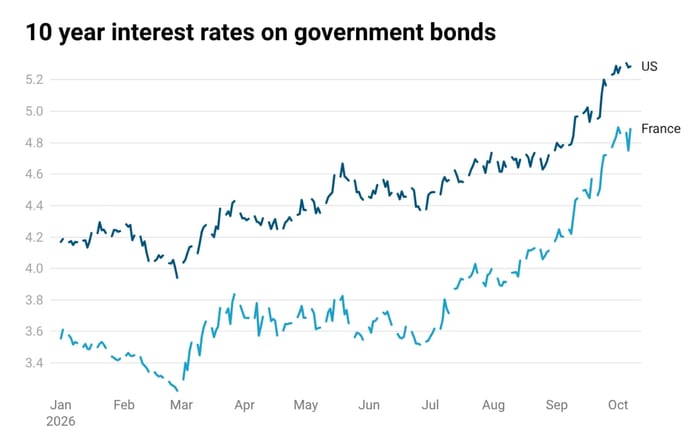
Sources: Paul Krugman
Welcome to the benefit of having a sovereign currency. As part of the eurozone, France can’t print its way out of its budget deficits in quite the same way. As for why France is experiencing a bit of a crisis, Paul Krugman blames the retirement age in his recent post. An aging workforce that insists on a dignified retirement has the government looking for places to cut. So the kids are on the street protesting cuts to education. Of course, the war in Iran has fucked energy and food prices all over the world, so that’s not helping much.
The kids want too much. The old people want too much, too soon. Investors want a risk premium to invest in France’s debt. Everyone wants to get paid. Typical France.
Whatever happens, make sure no one touches that $60 billion defense budget.
 Max
Max
Max is a political commentator and essayist who focuses on the intersection of American socioeconomic theory and politics in the modern era. He is the publisher of UNFTR Media and host of the popular Unf*cking the Republic® podcast and YouTube channel. Prior to founding UNFTR, Max spent fifteen years as a publisher and columnist in the alternative newsweekly industry and a decade in terrestrial radio. Max is also a regular contributor to the MeidasTouch Network where he covers the U.S. economy.