
Progressive Spotlight: Michelle Wu.
Elizabeth Warren’s protege proved the left can win—and deliver.
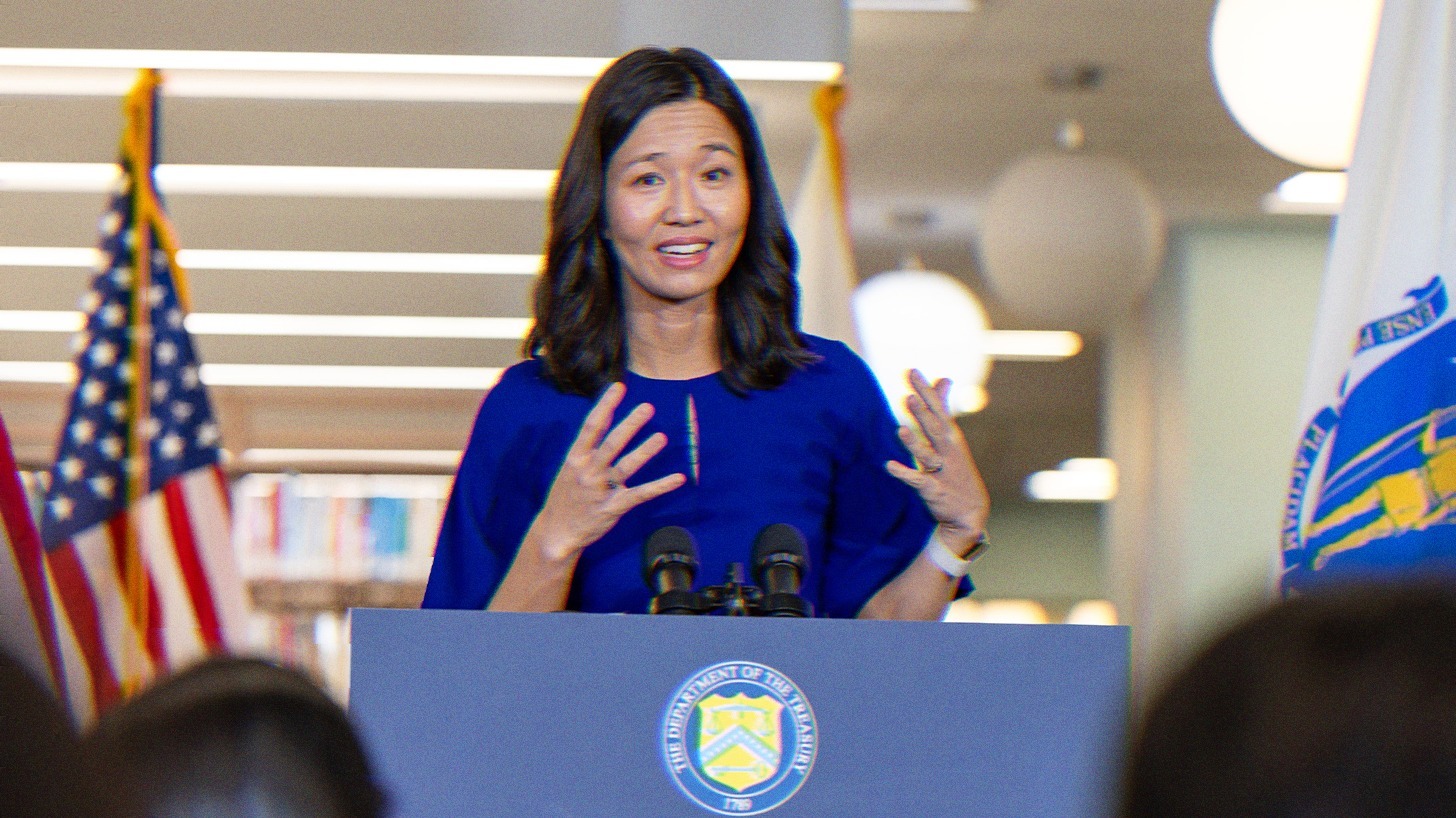 Image Description: Boston Mayor Michelle Wu speaking to a crowd, standing at a podium with American flags behind her.
While corporate Democrats and much of the establishment media began writing off progressive candidates—effectively declaring insurgent victories, such as that of Rep. Alexandria Ocasio-Cortez, outliers—in 2021, Michelle Wu was committed to sending a very different message to the political elites.
Wu’s Boston mayoral bid didn’t receive nearly the attention it deserved, especially with so much focus on what was happening in New York City, where Eric Adams ran a staunchly corporatist campaign—one he’d ride all the way to victory. That same year, India Walton, who had won the Democratic primary in the Buffalo mayoral race, was felled by a write-in challenger (the incumbent mayor she had defeated months earlier) as the Democratic Party establishment pooled considerable resources to support her challenger.
It was open season on progressives, politically speaking, as the rise of The Squad sent the Democratic establishment’s antibodies into high gear.
Yet Wu proved up for the challenge, winning her race with 64% of the vote and proving that progressives can win, even when they’re up against a well-funded duopoly.
In claiming City Hall, Wu became the first person of color and first woman elected mayor of Boston—a hugely consequential victory in its own right. But she did it as an unapologetic progressive: campaigning on affordable housing, free transit, rent control, and bringing the Green New Deal to one of America’s oldest cities.
“We are ready for every Bostonian to know that we don’t have to choose between generational change and keeping the streetlights on; between tackling big problems with bold solutions and filling our potholes; to make change at scale and at street level,” Wu said in her victory speech. “We need, we deserve, both. All of this is possible. These things are possible. And today, the voters of Boston said all these things are possible, too.”
“This will be a huge team effort and we’re not going to get this done by sitting in a corner office at City Hall, but by bringing City Hall to every block, every street, every neighborhood,” she added. “Because if we truly want to deliver change, we need every one of us shaping our future.”
In recent history, so many of the Democratic Party’s biggest critics have lamented its unwillingness to be audacious—or put another way, appearing too afraid of big ideas.
Wu has never been afraid to dream big—and try.
“In nearly a decade in city government, I have learned that the easiest thing to do in government is nothing,” Wu, who was first elected to the Boston City Council in 2013 at 28 years old, told The New York Times. “And in trying to deliver change, there will be those who are invested in the status quo who will be disrupted, or uncomfortable, or even lose out.”
Born to Taiwanese immigrant parents in Chicago, Wu and her sisters were raised to do big things in life. Wu studied at Harvard and was getting her career off the ground in Boston when she returned home to Chicago to support her family amid her mother’s battle with mental illness. At 22, she filed for legal guardianship of her 11-year-old sister.
Following her mother’s schizophrenia diagnosis, Wu returned to Harvard—this time to Harvard Law School—and brought her mom and younger sister with her.
Wu persevered and found a mentor in U.S. Sen. Elizabeth Warren, later developing relationships across Boston’s political scene.
In 2013, she became the first Asian American woman on the city council and, in 2016, was elected council president—another historic first for a woman of color. What’s more, she was effective in pushing forward policies with tangible benefits.
Here’s how the American Prospect described her run as a member of the city council:
“Her impressive work on the city council—securing paid paternal leave for city employees, advocating for unarmed community safety crisis responders, and taking aim at trying to moderate the city’s historically high rents—raised her profile and demonstrated her policy chops. These experiences contributed to her first-term successes, particularly on the housing front.”
Among her early accomplishments: divesting city funds from fossil fuels and private prisons, expanding a fare-free pilot program for three bus routes, leveraging $349.5 million in federal pandemic relief funds for affordable housing, increasing the share of income-restricted units in large new developments from 13% to 17–20%, expanding universal pre-K, and starting an initiative to electrify the city’s school buses.
Wu cruised to a second term, winning the preliminary election last September in a landslide and then running unopposed in November. She proved in 2021 that progressives can win, and proved four years later that they can turn promises into reality.
Image Source
- Joshua Qualls (Office of the Governor of Massachusetts), Public domain, via Wikimedia Commons. Changes were made.
 Rashed Mian
Rashed Mian is the managing editor of the award-winning News Beat podcast and co-founder of the newly launched Free The Press (FTP) Substack newsletter. Throughout his career, he has reported on a wide range of issues, with a particular focus on civil liberties, systemic injustice and U.S. hegemony. You can find Rashed on X @rashedmian and on Bluesky @rashedmian.bsky.social.