
Progressive Spotlight: Abdul El-Sayed.
Ready To Write the Prescription.
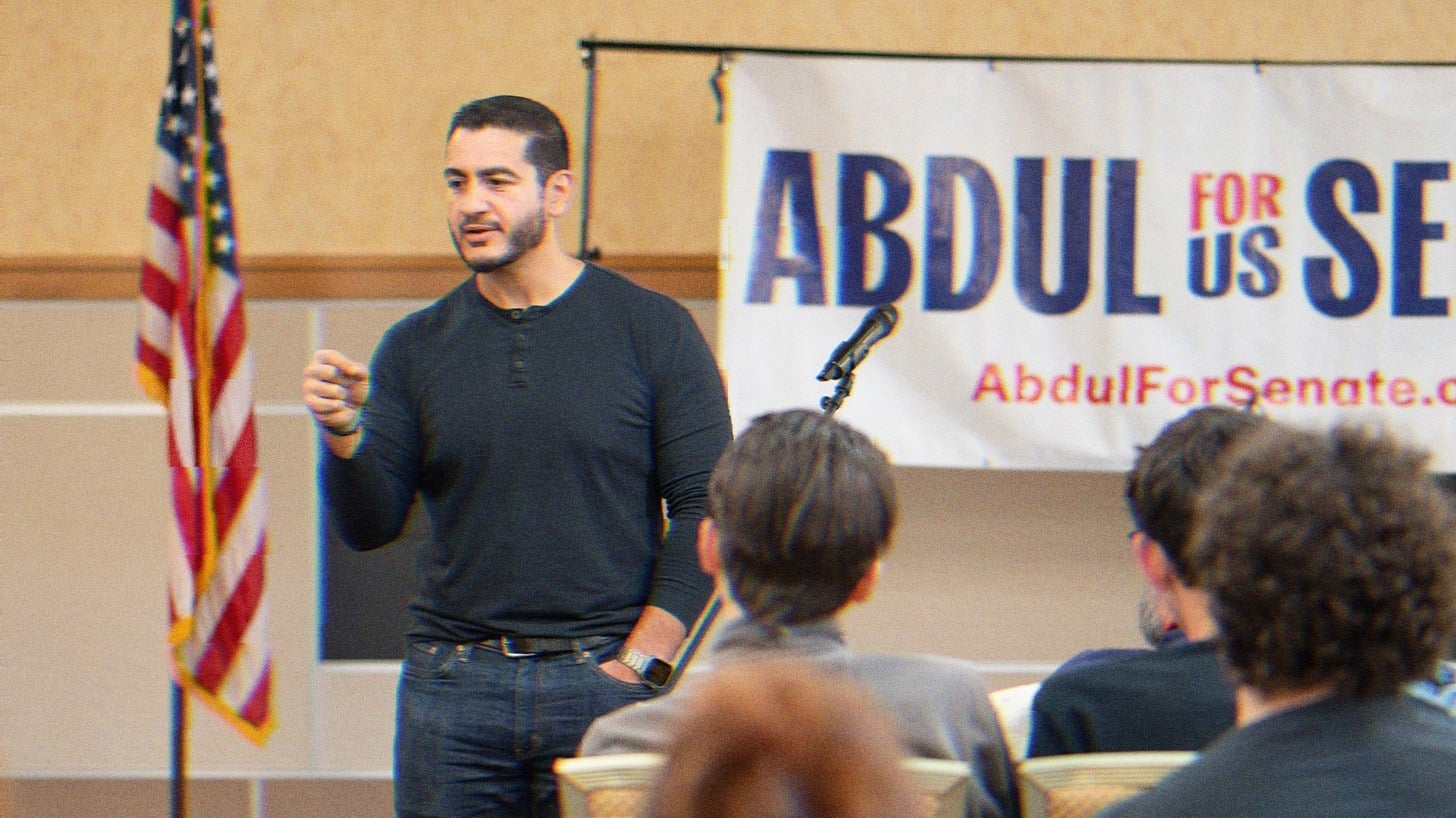 Image Description: U.S. Senate candidate for Michigan Abdul El-Sayed talks to a crowd. An ‘Abdul for U.S. Senate’ banner appears behind him, as well as an American flag.
Abdul El-Sayed knows the policy prescription—he just needs a way to inject it into America’s body politic.
The decorated public health official has been among the most recognized progressives campaigning for a U.S. Senate seat this election cycle. With a primary election only weeks away, El-Sayed is likely most recognizable for his criticisms of Israel’s genocide in Gaza and monied interest in politics, most notably by AIPAC, which has turned to creative new ways to fund corporatist Democratic challengers amid rising public disapproval of Israel’s war of annihilation against Palestinians and attacks throughout the region.
While the genocide in Gaza has put related issues front and center, the one through-line for El-Sayed (and other progressives) is money in politics.
“I’ve got three goals: Get money out of politics, put money in your pocket, pass Medicare for All. And I will use this seat…to [build] a broad public narrative and a broad public conversation about what we can do,” El-Sayed said during a primary debate in May that included two other contenders, Rep. Haley Stevens and Mallory McMorrow, a Michigan state senator.
El-Sayed is vying for the U.S. Senate seat being vacated by Gary Peters, who announced his retirement last year. With control of the upper chamber up for grabs, the race instantly became one of the most hotly contested primary battles in the country, with the Bernie Sanders-endorsed El-Sayed grabbing the progressive mantle.
For El-Sayed, it starts with health—not just of the people he’s hoping to represent but the state of the country. And his prognosis is one we’ve heard repeatedly but remains stubbornly elusive. For a candidate who was only 30 years old when he was appointed health director of Detroit, and who served as director of Wayne County’s Department of Health, Human, and Veterans Services, healthcare is often foremost on El-Sayed’s mind.
To be sure, he’s the author of two books based on his medical background: Healing Politics: A Doctor’s Journey Into the Heart of Our Political Epidemic and Medicare for All: A Citizen’s Guide.
“I will fight to expand Medicare to cover all necessary healthcare, including vision, dental, and hearing, and extend it to every single American from cradle to grave without premiums, copays, or deductibles,” El-Sayed says on his campaign site.
During the May debate, El-Sayed lamented how moderators effectively ignored healthcare altogether, despite the economic burden it has on families generally in the United States, not to mention the experience of Michiganders, two-thirds of whom in one survey said they delayed or went without healthcare in the previous 12 months because of associated costs.
“Too many people in this country are going without the healthcare they need and deserve,” El-Sayed said at the debate, noting the astronomical level of medical debt Americans owe, which currently stands at around $220 billion.
Along with the economy and healthcare, the genocide in Gaza has become a defining issue, something that should surprise no one given the impact it had on the presidential election two years ago. After Harris lost, an IMEU Policy Project poll found that nearly a third of people who voted for Joe Biden in 2020 cast a ballot for someone other than Kamala Harris, the Democratic nominee, in 2024. It all but confirmed what many people on the ground had already suspected, that voters would balk at supporting a party and candidate that helped prosecute a genocide militarily, financially and through political support globally.
In an interview with Michigan Advance last year, El-Sayed made his position clear:
“I think there’s a particular kind of shock and horror that folks should have about the idea that our political system can’t countenance the murder of 20,000 kids by our own tax dollars, and call it what it is,” he said. “And at the same time, I’m grateful that we seem to be at least headed in the direction where we can turn the page. I’m not running for Senate to obfuscate things. I’m not running for Senate to lie to myself or the people that I represent about what’s happening in the world and what’s being done with their tax dollars. I’m running for U.S. Senate to clarify what’s happening and to try to do something about it.”
El-Sayed, along with others who vehemently oppose the genocidal slaughter of Palestinians, has had to bear the brunt of bad-faith attacks accusing him of being anti-Semitic. That rhetoric ratcheted up during the campaign as the corporate media tried to weaponize his connection to Hasan Piker, an ultra-popular political streamer.
“Abdul El-Sayed’s continued pandering to known antisemites and terrorist sympathizers is not only deeply disturbing, but is disqualifying for anyone seeking to be a United States Senator,” the National Republican Senatorial Committee said in a statement at the time.
Through it all, El-Sayed has remained committed to what he views as the antidote for political change: eliminating money from politics and redistributing wealth, which remains heavily concentrated among America’s one percent.
“I would like to see us tax billionaires at 7% of their wealth,” El-Sayed said back in May when asked by a moderator. “Because here’s the thing, you tax a billionaire 7, 8%, you know what they still are…Still a billionaire.”
Image Source
- Conlan Houston, CC BY-SA 4.0, via Wikimedia Commons. Changes were made.
 Rashed Mian
Rashed Mian is the managing editor of the award-winning News Beat podcast and co-founder of the newly launched Free The Press (FTP) Substack newsletter. Throughout his career, he has reported on a wide range of issues, with a particular focus on civil liberties, systemic injustice and U.S. hegemony. You can find Rashed on X @rashedmian and on Bluesky @rashedmian.bsky.social.