

Phone A Friend: Lee Camp.
Comedian, Host of Moment of Clarity.
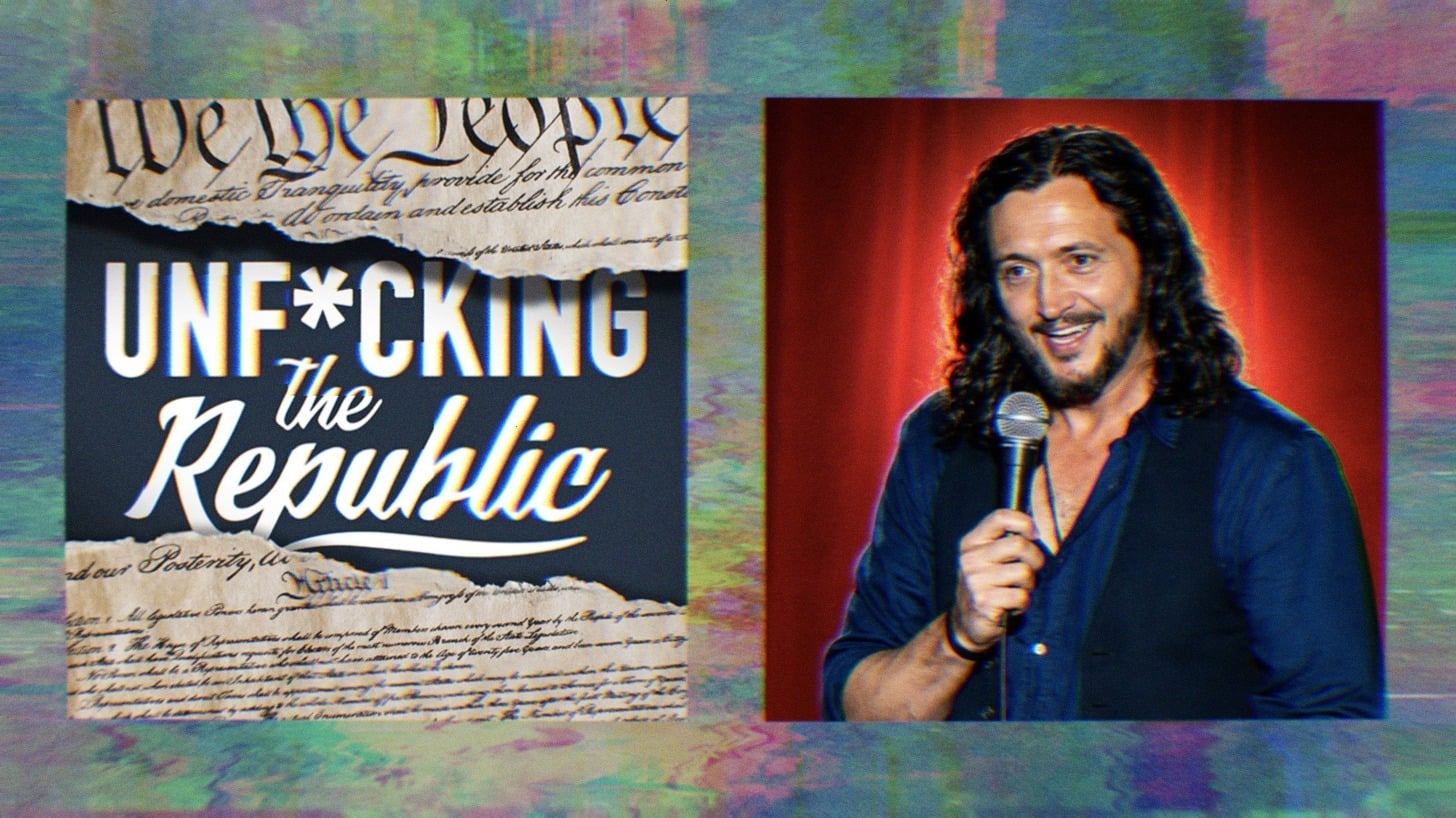 Image Description: Unf*cking The Republic Logo and a photo Lee Camp holding a microphone on a rainbow background.
Max sits down with friend of the show Lee Camp to talk Trump, Lula, Midterms, Democrats and what it’s like to have a puppet version of yourself star in a Strokes video. That’s a thing that really happened. All that and more on this edition of UNFTR’s Phone A Friend.
Max: Hey, Unfckers, we are back with another Phone A Friend. Thankfully, we have time to catch up with an old friend of the show, and somebody that I’ve collaborated with in the past and look to collaborate with more and more in the future, because everything old is new again. This is somebody who was very good to me at the very beginning of my next chapter, Max of UNFTR career, and is always open to a good hang. He’s a friend, but he is known to everybody else as an author. Maybe you know him as a comedian. You might know him as an activist or a political commentator. You could know him as the host of the Moment of Clarity podcast. My gateway drug to this person was the Moment of Clarity podcast before podcasts even existed, on Facebook—a grainy version of the person you’re about to see—and the co-host of Common Censored. You might know him from that. You could know him from a million different places, but today you’re going to know him from Unf*cking the Republic, and it is Lee Motherfucking Camp. What’s up, man?
Lee Camp: Thanks for having me. I appreciate it. Yeah, it’s good to see you again. I got out of the shower for you. I’m sorry about the wet hair. I know I look like a professional wrestler or something with their permanently wet hair.
Max: I admire it. And listen, as we get older, just even having hair.
Lee: Yeah, I mean, you get it in a lot of odd places, so that’s exciting.
Max: Hey, man, I have to start with something that kind of broke my brain. I talked about it a little bit in our On The Record at the beginning of last week, where I missed that you were on stage with the Strokes, and so I didn’t know that there was any sort of relationship there. And then, you know, obviously I’m subscribed to all your shit, and I got your email, and it was like, “Hey, check me out in this new Strokes video.” I’m like, “What is he even talking about?” It wasn’t just like a featured pan. They worked hard to work you and Hedges in as fucking full characters in this animated thing, dude. How did this come about?
Lee: Oh, I’ve been friends with Julian Casablancas, who’s the lead of the Strokes, if people don’t know, and I’ve been friends with him for years. He was a fan of Redacted Tonight initially, and he’s just an awesome human being, but he’s also really trying to find new and inventive ways to create change and create awareness through art. It’s just really cool to work with him. But I didn’t know anything—very little—about this video. He just said to me, “Hey, you’re gonna be in our next video, but it’s gonna be a puppet.” And I’m like, I don’t know what that means, but all right. And then I had no idea that I’d be as featured as I am. And yeah, it’s just a really fucking cool thing.
Max: When you first saw it, were you like, “What the fuck is even happening? This is incredible.”
Lee: Yeah. And the puppets are made by—if there’s such a thing as a famous puppet studio, Spitting Image Puppets is that, and they’re incredibly well known in Britain and they’re somewhat known in the U.S. But yeah, to have your own Spitting Image puppet is pretty rare in this life. So yeah, it’s pretty awesome.
Max: Well, I want to get into some of the intersectionality between media culture and political activism, because it’s a place that you have occupied for, I’m gonna say, at least 15 years that I am aware of, because you came onto my radar at the beginning of Occupy. But you had already been working comedy circuits, and you had been working in media before that, and you’ve sort of lived on this edge of culture, always at the bleeding edge of culture, obviously, and sometimes falling in and out of favor with each side, and everybody trying to pick what they want you to represent for them. But you’ve been incredibly consistent your whole career as a real outspoken voice of what I would call the pure left. So we’re going to get into some of that stuff. But the political season that’s upon us—I actually wanted to talk to you about not America for one second, and use it as a counterbalance.
Lee: Oh, I love not America. One of my favorite places. I have a beach house there.
Max: You had recently done something on Lula’s—what I think people would consider a surprising reelection victory in Brazil. And it’s somebody that you’ve followed for many, many years, and you’ve done a lot of commentary on Brazil over the years. My specific question for you: Well, first of all, kind of bring everybody up to speed on how seismic that actually wound up being, this reelection, and how the polls really didn’t get it right down there. And then I want to talk to you a little bit about what new Lula looks like as compared to old Lula, and the circumstances that he faces.
Lee: Well, yeah, for those who don’t know, it was a giant shock. They gave him a 20% chance of winning that election. Even the prediction markets all got it wrong. They were saying 80% likely to lose, and then he pulls off this shocking upset. But I think it wouldn’t have been as stunning if it hadn’t had to do with who he was up against, which is the Bolsonaro family. The Bolsonaro family, just, like, straight-up fascists. The father should be—well, is in prison, right? I think they did catch him.
Yeah, he’s in prison in Brazil for trying to create an insurrection. And the way he won the presidency—the first one, you know, Jair Bolsonaro won the presidency—was by a coordinated effort, the U.S. was involved in it, to trump up fake, forgive the term, fake charges against Lula, get him in prison so that it would be hard or impossible for him to run for president. And it worked, until all the documents and texts and everything were leaked out showing the corruption, showing it was a sham trial. So Lula gets out of prison, Bolsonaro loses the election, ends up in prison, and his son, Flávio Bolsonaro—you know, fascism is a family business—then runs against Lula, is almost definitely going to win, and then he loses.
And the other aspect of it that is just massive is how hard the U.S. empire, but Trump, Biden, the oligarchy, has worked to gut the leftist—you know, people call it the pink tide—but the at least leftish turn of Latin America, where you see socialism, you see the resources in Latin America no longer just being handed to oligarchs, handed to corporations that are often funneling the money back to the United States and our oligarchs. And so the U.S. has worked hard to turn these countries far right and has succeeded in so many of them, really in a horrible way. And of course, this has horrible ramifications for the people that live in these countries. But they were not succeeding in Venezuela. So Trump—well, first he blew up 200 fishermen off the coast, but then he went in and, in a matter of an hour, killed 100 people and kidnapped Maduro and his wife, and they’re being tortured in one of your fine New York prisons. I commend you on those.
Max: Very proud of that. Thank you. Shout out.
Lee: Wonderful prisons. Shout out. So it’s like, if we can’t do it by rigging elections, lawfare, which was done to Lula, then we’ll do it with just a straight-up gun to their head, arrest, kidnap the president. And anyway, Lula won, which—Brazil is one of the largest economies in the world, largest economy in Latin America, some of the most important resources in the world, and so this is hugely important for the future of humankind, that Lula will help protect those more so than Bolsonaro. This doesn’t mean Lula is perfect. He’s not left enough for many leftists. So this is not to say he’s perfect, but compared to the absolute catastrophic fascism of Bolsonaro, it’s certainly better.
Max: Sure. So, speaking of this governing moment, one of the things that I think most people have observed about this term of Lula, the second turn of Lula, is that the governing conditions are markedly different than what he walked into in his first term. Because in his first term, he was truly a radical in terms of the social policies that he was able to enact, and the conditions that he came in allowed for a massive turn of events, similar to, I would say—although certainly different in tone and in scope—but similar to what I would imagine it was like when Chávez first came in in Venezuela. A turnaround is sometimes, I think, easier on the first run than the second bite at the apple. And I think this is where you and I can kind of blend the analysis into what’s next for Democrats here in the United States. So Lula, second-term Lula, has been criticized for being a bit more centrist and a bit more corporate friendly, giving up some things in order to retain the rights to save the Amazon, for example, but giving up more rights to corporations in order to get some other things and get some social policies. Governing, I would say, slightly left of center rather than the leftist that we had expected. Do you think that’s a fair characterization? And do you think, upon the heels of this win, he will have the chance to take this, and the energy to take this thing, a bit further to the left again?
Lee: Yeah, it’s a good question. I mean, I think it’s a fair characterization. I don’t claim to be a Brazilian or live there or anything, so, I do see a lot of leftists that rather dislike Lula from the left, so I think what you’re saying is true. But this is obviously his last term. I think he was feeling he was almost too old for even this one, but he decided the nation couldn’t be put in the hands of a Bolsonaro. And so, I guess the question is: at that age, will he swing for the fences a little more than he has in the past? It’s tough to know. But at the same time, you do have this unhinged U.S. imperial guard breathing down your neck, and they’ve shown that they will just go into a country and kidnap the president. So will he do deals in order to avoid that type of thing?
Something else they did that was very much similar to the path they’ve taken in Venezuela is declaring that either real drug cartels—you know, drug cartels exist kind of everywhere—but either real drug cartels, or made-up ones that the CIA has just created, are narco-terror groups, and they’re connected to the presidency, like they’re connected to Maduro. Even though the one they made up, the Cartel de los Soles or whatever it was, was not even a real thing in Venezuela. They just made it up, and then they use that to then characterize the presidency of Brazil, or Brazil in general, as a terror state, and then they use that as a predicate to then attack, bomb, kidnap the president. So they have already done part of that in Brazil, announcing that these drug cartels are terror cartels or whatever they are. It’s just a complete bullshit fabrication to allow us to commit our terrorism on these countries. So hopefully that’s not where the U.S. decides to head next.
Max: The De La Souls—that’s the sister cartel to the A Tribe Called Quest cartel that exists down there, right?
Lee: Yeah, absolutely.
Max: I’ve read a lot about them. Yeah, very dangerous. Very dangerous.
Lee: Yeah, second album was the best.
Max: When the whole cartel nonsense—like, in the United States we give them fancy names and trademark protections, and we allow them to advertise on every sports game. But in other countries, we actually fabricate their existence, or give them seed money and arms to get them going, and then we use that as the pretense, of course, to launch an invasion. I got to tell you, if you just don’t have a horse in this race, and/or a heart or empathy, it’s a pretty good strategy.
Lee: It’s not bad, right? I’ve just found things are so much easier when you don’t have a heart or empathy. Your day is easier from the get-go. The moment you step out of bed, it’s just an easier day. You kick that dog out of the way and you get to work.
Max: So let’s use this. I feel like Lula is a good jumping-off point for us, because it’s almost like—I call it a syncopated parallel to what we experienced here. Because we had Biden. I would argue that old-school Biden, the angry, very right-wing Biden that existed in the Democratic Party when he was a senator, wound up being more of a policy maven in the Obama administration than I think people gave him credit for at the time. And if we consider the Obama and Biden years in parallel with Lula, and then Trump coming in, and then on the heels of that you’ve got Bolsonaro, it’s like we have this stutter step where every couple of years we’re going through this sort of parallel universe with them. And now here we go again, where Lula reasserts his dominance there with the left, and we have these sweeping midterms that portend perhaps good things about 2028. We’ll talk about that. Do you feel like we now have, coming out of these midterms, some sort of larger political momentum, à la what we just saw in Brazil, to kind of continue this momentum forward through 2028?
Lee: Well, I will say, in terms of the analogy with Lula in Brazil, I would say the difference is in Brazil you had two different people and parties running. In the United States, you just got one. You just got the war party, the capitalist war party. And so, whereas Lula is genuinely left wing—there are certainly issues where people want him to be more left, or he’s not left enough—he is genuinely left wing. There is no one in the presidency now or previously that has been left wing. There’s no one in Congress, with maybe the exception of a handful, that are genuinely left wing. You basically have right and righter. And Lula has never bombed another country, whereas every president in recent memory in the U.S. has bombed other countries. That’s all we do.
Max: That’s all we do.
Lee: Yeah, that’s much of all we do. And so while I think there are things to celebrate in the so-called blue tide, I think a lot of the actual change you might see is more statewide. And this is what I often say about voting in general: you should vote because you can change things in your area. Ballot initiatives—you can change things in your state. Having a far-right governor versus someone who’s more centrist or slightly left wing as a governor can make big differences. So I think there’s differences there. In terms of Congress, I don’t think we’re going to see an end to genocide in Gaza. I don’t think we’re going to see an end to ongoing war games around the world, the Cold War against China. So much of it is going to maintain exactly the same. Now, you might see some investigations into Trump, which is what they’ve already started talking about, and I would like to see that. But that’s not change. That’s just kind of slightly slowing the Trump dump truck that’s running over everything.
The other aspect of it is that most of what Trump’s done—I don’t know, to give it a random percentage, 80% or something—never goes through Congress. Either he finds ways that are legal to go around Congress, or he does something that’s illegal and waits for someone to try and stop him and see what happens. The bombing of Iran is a good example. Now, Congress is supposed to declare war; they no longer do that, but they usually vote on the authorization for use of military force, like we did for Iraq, and Trump didn’t even do that. And how did he get around it? Well, every 60 days he pretends it’s a new war against Iran, because he’s allowed to commit war for 60 days. So it’s a bunch of shit like that. If he wants anything to be passed by Congress, he’s going to shove it into a giant bill that has the entire Defense Department in it, and then Democrats aren’t allowed to vote against the Defense Department, right? Sorry, Department of War.
So, yeah, in terms of grand change, I do not see it at the federal level. I certainly hope people see change in their states. I hope states start revoking some of the ways they cooperate with ICE. I hope they start making it so people are less persecuted, whether it be LGBT or so many people that are persecuted across our country, immigrants. But yeah, not at the federal level.
Max: So if we stay in this moment and you look at the opening salvo of the—even though they’re not yet seated, the momentum was certainly there on the side of the Democrats, and they couldn’t even whip their caucus into voting against Hegseth, right?
Lee: Hegseth. Eleven of them didn’t show up.
Max: Which is wild. One of them is the district next to where I am right now, and so she’s going to force me to drive over there or something like that. I don’t even know how to, you know—
Lee: Bag of dog shit on the front step?
Max: I guess I don’t know how else to get her attention. But when we think about their inability to even capture this political moment, started by a Republican no less, to just do the easy, most basic thing... I’ve had a lot of pushback on a take that I had recently on—
Lee: Taylor Swift.
Max: Oh yeah, you heard about it, right?
Lee: [Laughing] I heard what you said.
Max: Swifties are just—they’re fucking brutal [laughing]. The take that I have for the next couple of years, without fully unpacking it right now, is essentially it almost doesn’t matter who’s in the leadership positions, simply because of what you just said: that Trump has spent the first two years, at the behest and design of Russell Vought, to effectively create the unitary executive theory in practice. We’re seeing it unfold in real time, and now we understand what they’re capable of in that respect. So even appropriations, those really aren’t anything that Congress can sort of control once a budget is set. They will have to literally shut the entire federal government down in order to bring this administration to heel, because otherwise they can still operate with impunity. So my question is—and this is one of the things I wanted to talk through with you: Do you think it’s better to just let Jeffries and Schumer kind of hang out in the breeze right now to show how ineffective they are, to build a better case for 2028 to completely replace leadership? Or do you try it now, so that the Democrats can just sort of go bananas with investigations and things that, in my opinion, aren’t going to change the calculus for how this administration governs? Like, what do we do at this point?
Lee: Yeah, that’s a fair question, because the truth is, the Speaker of the House is not going to matter that much. But I will say that if I see someone voting for Hakeem Jeffries, one of the top recipients of all AIPAC money, Mr. Genocide himself, then to me that says a lot about them. Whether it changes anything or not, it says a lot about the person voting for him.
But yeah, you make a great point, and it furthers my point about how Trump doesn’t even go through Congress for a lot of these things. And when the Democrats did get some kind of priority—I don’t know, it could be something as simple as money for public broadcasting or something—then, if Trump doesn’t want to give it out, Russell Vought just doesn’t send the money out. So it’s kind of like, you can pass whatever you want, I ain’t doing it. It really teaches you how shit our system is.
But yeah, when you brought up the Hegseth vote, I like to look at things as kind of layers of reality, and this is what our media does such a terrible job of, our mainstream media. They’ll look at the surface level. So surface level would be, should we get Hegseth out as the head of the Department of War? And it’s not that you can’t debate that. I am willing to sit here and say Hegseth is a complete fucking lunatic. He’s an alcoholic. He’s a warmonger, bloodthirsty. Part of the reason we got into the war in Iran was that he told Trump it was a great idea. Just an absolute psychopath of a human being, 100%. Get rid of him. The next layer of reality is: who do you think replaces Hegseth? Whoever’s going to be voted by all of our Congress to be the next head of the Department of War is going to be another psychopath. He might be better at it. He might not say things that are as lunaticky, to craft a new word.
Max: Do you think it’s Stephen Miller now being like, “I can do that too, boss”?
Lee: Yeah, he might. He might be a little swifter with his propaganda. Whoever they replace Hegseth with, he might have a better theory on how to collapse Iran that did nothing to us. So the deeper layer of reality is: we should remove all of those assholes. You should not have a Department of War with a trillion dollars, maybe soon to be $1.5 trillion, dropping bombs on children. And yet our mainstream media won’t have that debate. They’ll just have the Hegseth debate. And so, in a way, getting rid of Hegseth is just a release valve for us not to be discussing that we are one of the biggest terror nations in the world.
Max: So, was there any point during the election and the blue wave that came over—or, I guess, it could be the bluenami, the bluekaki; there’s all sorts of—
Lee: The bluekaki.
Max: Really great aphorism. Was there any point where you looked at it and you were like, damn, it’s actually better than I thought it was going to be?
Lee: Just in some state—you know, and I haven’t seen how the ballot initiatives went, but just in terms of some state stuff mainly. And look, it’s not that I don’t have a moment of like, I hope they’re able to at least slow some of Trump’s progress. I mean, he wouldn’t be coping so bad right now if he didn’t think they were going to slow him a little bit.
Max: Yeah.
Lee: So I certainly hope it slows him a little bit. But here’s another thing that I think people need to think about: no one has done a better job of just collapsing the U.S. empire than Donald Trump. So, you know, the U.S. empire is a fucking horror show. Maybe I should be celebrating Donald Trump. He’s done such an amazing job of just collapsing the entire U.S. empire. I mean, he has shown that a country that spends one one-hundredth of what we spend on their military can beat us. That is an impressive gambit he has.
Max: Do you know how many times I looked up and fact-checked, and looked up and fact-checked, their budget of seven and a half billion dollars? I’m like, this can’t be fucking right. This can’t be right.
Lee: One one-hundredth, and showing the world that it’s possible. Like, thank you, Donald Trump, for showing the world that. So maybe I should be cheering for him. But anyway, to go back to your question, I think it can matter to people’s lives on more of the local stuff. There are many things that are voted for on a ballot that are not just your representative in the completely ineffectual Congress. There’s so much else going on. And also, I wouldn’t do what I do if I didn’t think words were important. So if we had congresspeople, or the president when it was Obama or something, speaking every day on an issue that I think is really important—like, let’s say, the prison industrial complex. We have the largest prison state in the world. We lock up more per capita of our people than anyone. If a president or a bunch of Congress were giving speeches every single day on the prison industrial complex, it would have an impact, a big impact, on what our nation cares about, where people stand, how they view it. I mean, a lot of people don’t even know that we have the largest prison state in the world.
Max: Yeah.
Lee: So words can have an impact. So to see congresspeople speaking about shit that’s important, I think that can have an impact as well.
Max: So how much credit do you give a figure like Bernie Sanders, who’s been beating the same drum for, ostensibly, we’ll say 40 years in public service, but for the last 15 years on a national level in a way that people can actually hear it? How much credit do you give him for building the language of dissent that sort of has allowed us to enter a moment where we could even be considering Muslim senators, or actual true socialists running different cities across this country? How much of that credit should we give to a figure like Bernie?
Lee: Yeah, I give a lot of credit to him for, especially, what I’ll call the early years. I know he was doing it for 40 years or whatever, but starting with Occupy, moving forward, those years where he got everybody using the expression “Medicare for All.” And some of these ideas he stole from the Green Party, but he put them on a national platform. And he certainly helped us—he didn’t create it, but he helped us popularize the idea of the 99% versus the 1%. I give him a lot of credit for those things, in those years up to 2016. And then I think it really was a betrayal to a lot of us who fought for him, in a variety of ways, to then see him running around the country saying, “Vote Hillary, vote Hillary, vote Hillary.” It was like, we know she’s a warmonger. We know that she and her husband threw the working class absolutely under the bus with NAFTA. There’s a lot of things that were passed—back to the prison industrial complex, the crime bill under Clinton. I’m not saying she came up with all that, but she certainly didn’t talk out against any of these things. And so to see him doing that, to me at that point, he’s no longer someone that I listen to as a leading thought, as a thought leader, I guess I’d put it.
Max: Sure.
Lee: But yeah, in those earlier years, I give him lots of credit, and it doesn’t undo the earlier work he did. It just means that I’m not gonna endlessly play clips of Bernie Sanders and say we love you. It’s just too much. Like, I know they asked him to go around promoting Hillary Clinton, but he did more than even needed to. He was doing more campaign stops for her than I think she was doing for herself. I mean, she couldn’t even attract like 12 people into an auditorium. They all came to see him.
Max: He’s like, fine, I’ll do it.
Lee: And they started putting—as I recall, I think they initially had him going before her, and then they switched it, because too many people—the cheers dropped off precipitously the moment she got on stage.
Max: So let me ask you, as somebody who’s been just, like—if Bernie is a gateway drug for so many centrists to discover left principles, if we just say, at a minimum, he accomplished that for a period of time leading into 2016, whereas people who didn’t even know, as you say, like, oh, the 99—fuck, the 1% really is pulling away. Or, wait, we can have Medicare for All, that’s a thing. There’s a lot of stuff that Americans never really contemplated. They just don’t allow themselves to think we can have nice things. But you, as a gateway drug for people like me around the time of Occupy, doing Moment of Clarity and being, you know, just basically knocking on social media doors and being like, you know what, everything you thought is completely fucked up, right? As you have progressed through your career, how do you maintain a level of optimism? And do you think we’ve actually made any demonstrable gains in terms of that thought leadership? Do you think that there are more doors that are open now for left principles than when you started your career in this level of activism?
Lee: Yeah, yeah. I think the Overton window has gotten bigger,
Max: That’s interesting.
Lee: And I give all of us credit for that. And of course, some of it had to do with the gatekeepers for a while disappearing, because you and I could have shows, whereas if you had the mainstream media deciding, you and I would not have shows. But the Overton window has gotten bigger, and we can talk about these—like, I can talk about the U.S. empire and people know what that means. I mean, I feel like there was a time you say “U.S. empire” and they’re like, the what? And you can talk about the harm of capitalism, and most younger people are like, yeah, capitalism’s fucking brutal. And you could go down the list. But I mean, look at Israel. The number of people, the percentage of Americans supporting Israel versus now the ones that support Palestinians and Palestine more than Israel—it’s done a complete reversal over the past few years. And that would not have happened, even with the genocide, without so many of us banging those drums and talking about it and covering it on a day-by-day-by-day basis in a way that the mainstream media, of course, refuses to.
So yeah, I think we’ve had a big impact, and that’s where I see some hope. You asked what gives me hope. I think there is a lot of danger in the changes, especially the technological changes we’re seeing. AI is going to keep increasing exponentially. It’s going to change all of our lives, if it hasn’t already. Whether you want to use it or not, it’s coming for you. But it can also be used in a much different way. It can be used in a positive, and it can be used to save lives. And it is a tool. It is a hammer. It can build a house for someone who’s homeless, or it can beat your neighbor to death. And if you knew my neighbor, you’d understand why. But it is a tool, and we can craft AI to do amazing things that could create a much better future. I mean, you could go right now and type into ChatGPT, “design a post-capitalist economic system,” and it’ll give you something to think about. Whether it’s right or wrong, you’ll go, well, those are some ideas I never really processed before.
So there is a lot of benefit there, and that gives me hope. At the same time, I also understand the incredible risks of all this if you allow the psychopaths at the top—and let’s be clear, they are psychopaths—to decide everything about AI or any other technological tool that is coming our way. Then it’s going to be used to extract our wealth, extract everyday Americans’ wealth, extract our life force, extract our lives, to feed their rapacious greed. That is how they’re always going to set it up. They have no interest in setting it up any other way. So it needs to be put in the hands of the people.
Max: I want to talk to you about the foundation of your career in comedy and how you’ve stayed with that for—I mean, shit, how many years have you been doing comedy now?
Lee: It’s about 25. I started at 18.
Max: Wow. Okay. All right, I want to think about that for one second, but let me set it up this way. In the last election cycle, one of the big holy-shit moments was watching guys 20 years our junior, let’s say, that were becoming politically sentient. So, guys, men that look a lot like us, coming of age, right, and leaning pretty hard into right-wing narratives and voting. Like, being vociferous and being enthusiastic about a Trump vote, like these guys coming of age. And I feel like a lot of that, at the time at least, was ascribed to your profession of comedy, and these comedy assassins from the right opening up the window for these kids to see what life is really like. But then it reversed. It reversed in this midterm election, where young people—I mean, one of the maps that I saw was that white guys, white girls, and then people of color, as long as they were part of this Gen Z that is of a voting age now, they went blue in every single state. There was not one that they didn’t go blue. So the biggest swing that we have seen.
So I set it up that way to say that if the buzz was around the so-called right-wing comedy assassins and the Austin comedy scene being sort of the way that young people, young guys in particular, were learning about politics—what changed? Like, what happened? Have they really fallen that far out of favor? Their numbers are still pretty good, even though they might be, you know, on people’s shit list right now. But what changed in just the last couple of years, where young dudes that look like us, 20 years, 25 years our junior, were suddenly like, actually, that was pretty fucked up, what I did a couple years ago. I don’t like that anymore. I’m going to do this.
Lee: I think they went to fill up their truck, and they saw the cost.
Max: Yeah, I mean, could it be that simple? It kind of is, isn’t it?
Lee: I mean, in a lot of ways, it is. So much of it does come down to economics. It’s like, no one can fucking survive out there. And I think that there were a lot of people—and, you know, I think the Rogan sphere did have an influence, but obviously there’s a million talk show hosts, et cetera, that are not comedians, but who had a lot of impact, the Tucker Carlsons of the world and everything else. But I think that they voted for Trump thinking somehow that it would be some kind of change. Now, my joke about that is, yeah, if only we’d had four years of Trump to know what he’d do in this second term. If only we knew how this guy would behave if you gave him all the power in the world. But so they thought it would create some kind of change. Now things have gotten worse, but they’re no closer to paying their rent and paying their grocery bills without slaving at two jobs now than they were two years ago. So I think they just started to realize, hey, I think I was sold a bum deal here. I don’t think this guy is actually out to protect me and help me.
But yeah, it is kind of amazing. Like, the Rogan sphere is kind of crazy, because I know several of those guys from my years in New York City as a stand-up comic. And Rogan—I was on Rogan’s show twice back when he was a Bernie Sanders voter and kind of left wing. He also had me open for him at a couple of his comedy shows. And it’s like, his shift, and the 180 he did, and so many of those other guys—I don’t know if they’re just riding his coattails or what. Suddenly we’re like, yeah, yeah, Trump. I think Trump’s gonna—this is pretty good, Trump’s second term is gonna be completely different. And just watching them, it’s just like, you guys are so fucking pathetic. I never understood how these guys keep fans. Of their comedy is one thing, but of their political stances, when they become a different human being every two to four years. You know, or even not just comedians, but fucking Tulsi Gabbard or any of these people. When they make a sudden switch and they’re like, “Oh, I just realized I’m a right-wing Christian evangelical,” even though before I was a left-wing atheist. I don’t understand how they keep—you think everybody watching them would go, “I think he might be a grifter.”
Max: Right? Yeah. This time. This time, this time—not the first time, this time.
Lee: Yeah.
Max: So now that everybody’s sort of living on this high of the midterms, and we’re having different conversations—and, oh, should we throw the leadership out? And oh, we’re going to impeach everybody—you were on stage at the Strokes concert with Chris Smalls, somebody who is no stranger to true political activism, organizing movements moving forward. One of the things that I have a very hard time wrapping my head around is how to build cohesive national movements. And the reason I have a hard time wrapping my head around it is that that is, and has always been, at least in the capitalist system, the role of organized labor. But unions only have about, I think it’s 11%, density, and of that density, we’re talking about like teachers and, you know, people that aren’t necessarily going to go out and fight the Pinkertons. You know what I mean?
Lee: Yeah, I mean, it’s a tiny percentage.
Max: Yeah, yeah. And a lot of them, again, they’re service unions. Like the trades, yes, they have bigger, more representation than normal. But manufacturing is only 10% of U.S. GDP now. We are a fundamentally different society as a result of that, and our organizing principles are therefore not cohesive in the way that they might have been in a capitalist structure in the past, whether that’s here or that’s in Europe or what have you. So when you spend time with boots on the ground in a way that a lot of others don’t, when you see somebody like Chris Smalls galvanize the population, he can only do it with a certain segment of that population. How do we bring other people into this fold as “on-the-ground activists” that can really disrupt the political process to a degree that the establishment has no other avenue but to at least consider listening and working with them? Because that’s what unions really were able to do.
Lee: I don’t know. You got any ideas? How do we get people in there? How do we get people in there? Yeah. You know, obviously, to create a larger-scale change, you need to have leverage, and unions have leverage, and that’s why they’re so fucking important. Now, this doesn’t mean unions always live up to everything you want them to do. Some of them have some pretty old-school leadership that is just vote blue no matter who, and then go home. So yeah, you have to also hold those unions accountable as you try and create change. But yeah, that’s why unions are so incredibly important. It actually gives the workers power. And the workers—you don’t have a union, you’ve got essentially zero power in the workplace.
But in terms of how to bring people into a larger-scale movement, I don’t know. I do think we’ve kind of got to throw everything at the wall, and you hope different things bring different people in. And I have tried to do it with creative art, you know, using comedy to inform people on these issues. And the Strokes, Julian, is doing it with music. And I think there’s a million ways to try to make people more informed about these issues and understand correctly the world that is exploiting them and making them unhappy and uncomfortable and unstable, all those things. But yeah, while I have been at plenty of protests over the years and worked with countless organizations and things like that, I’ve never really called myself an organizer, because an organizer is an incredibly difficult job, and I don’t think it’s one that I’m great at. But there are amazing organizers out there. You know, Chris Smalls, I know, does a lot of work on that front. But there are many whose names are never known, because their job in the revolution, we’ll call it—their job in the revolution is not one that’s on camera. It’s going door to door and talking to people and explaining to them how to join a group, and sitting through long meetings. But there are many positions open for the revolution. It’s got a lot of jobs available. You don’t have to just sit in boring meetings.
Max: You know, you bring up an interesting point about the difference between activism and organizing. Because when I’m presented with this similar type of question, I always say, you know, everybody has a different role—pretty much saying what you said, which is like there have to be people that open people’s minds and shift the narrative. Because politics, to me, is just a reflection of sentiment, and sentiment is driven by narratives. And if we don’t create the right narrative, then none of those activating features can ever actually, you know, take hold. Organizers—what gave me a little bit of hope, because I’ve thought a lot over the years about organizing principles in unions, what gave me a lot of hope was actually seeing that DSA membership, 120,000 out of a population of 350 million people, and the establishment couldn’t fucking stop talking about them, because they couldn’t believe that they were making these type of inroads. And it’s like, I think a lot of people have said, like, God, we just fucking need an example. And so I think that’s why Zohran was so seismic. I see a lot of leftists already beginning to criticize Zohran, but I don’t want to take away from the connective tissue between a politician who tapped into the sentiment that was driven by narrative. So we’ve got that thread there, and then the DSA is organizing boots on the ground, taking on—I mean, Cuomo. You remember from living in New York. This is a name. This was a big fucking name, and the guy occupied a lot of mind share.
Lee: And the money dumped into that.
Max: Oh, tremendous amount of money. So for them to finally fuse the activism piece driven by sentiment and narrative, and then the organizing piece driven by the DSA, I think that really struck fear into the establishment. It gave me hope for the first time that, like, okay, if we’re not a nation of trade union members and service union members that can organize and bring the economy to a halt, maybe there is a way that shifting the narrative and just opening people’s minds and hearts to this can be politically effective.
Lee: Yeah, and again, I think a lot of that comes down to ideas. It’s like, Zohran was and is speaking to certain kinds of ideas that other people are not. And I saw a chart that showed the Democratic Party using the term “affordability,” and basically Mamdani wins his primary, and the Democratic Party in general is using that term like 5% or whatever, like a tiny amount, and then if you watch this chart, the amount “affordability” appears in their speeches shoots up as Mamdani continues to have success. Because he was speaking to the real needs of the people, the lived experience of New Yorkers.
Max: Which is a strategy. I mean, it’s fine, you know. For what it’s worth.
Lee: Actually talking to people about what they care about seems to have some kind of impact!
Max: Yeah, let me—god, let me write that down! Ridiculous.
Lee: But again, you know, if you haven’t done the groundwork of enlarging the Overton window, then just the word, you know, socialism, and within the DSA title, would scare the shit out of a lot more people. Instead—and Bernie, again, to go back to Bernie Sanders, he gets some credit for this—instead, it’s no longer a scary term to a large percentage of the country.
Max: Right.
Lee: And now, we could have a longer discussion about how the term socialism as an end goal is problematic, because it means 1,000 different things to 1,000 different people. But it is enlarging what people think is possible, enlarging what people think they deserve. I mean, you deserve healthcare. You deserve, honestly, to have a roof over your head. This should be part of living in one of the richest countries, if not the richest country, in the world. It should be that you just get those things. And a lot of countries, even though they aren’t the richest in the world, they do get those things. They get healthcare. They get daycare. They get paid holidays, just as a member of the society. And the fact that the United States has somehow convinced a lot of people that they shouldn’t deserve these things as a part of our society—like, you’ve got to undo that brain parasite, that virus that’s in there. And I think it took a lot of work. It took years of work to get us to that place. But now most Americans, as we see with this blue wave, I don’t think they’re afraid of these terms anymore. You know, these ideas, really.
Max: Hell of a start. It’s amazing to say after, like, a life of activism, right? Yeah, it’s good. This is a heck of a start. This is just—it’s like fucking decades.
Lee: I know. We’ll be saying it’s a heck of a start our whole lives, won’t we?
Max: Yeah. What are you working on right now, and what do you want the people to know about?
Lee: Well, I still do my live streams three days a week over at YouTube.com/MomentOfClarity, and I also write columns on Substack @RealLeeCamp. I mean, I’m working on the same things I’ve always been working on, which is trying to get people to understand what the U.S. empire is, get people to understand that capitalism is essentially a cancer, in that it is infinite growth on a planet with finite resources, which means it ultimately ends in the host’s death. And unfortunately, we’re the host. The planet’s the host. And, you know, getting people to see that Israel is a genocidal apartheid ethnostate. So I’d say those are the big three.
Max: So your message is breaking through, man. I just want to encourage you to keep at it. Not bad.
Lee: Thanks, man. Appreciate it.
Max: Thanks for coming on. I appreciate you spending the time with us today, and let’s do it again soon.
Lee: Absolutely. And I taped two stand-up comedy specials in New York this past year, and I give those out to members, and I’m hoping to do another one in March. So, I know you came to one of those. So hopefully we can hang out again.
Max: I hope my laugh is in there. I was sitting dead center, and I was pretty strategically—I think for the soundboard, I think I was pretty strategically positioned, so hopefully everybody can hear that.
Lee: I think we put in a lot of work to edit out just your laugh. We just removed yours.
Max: It happened again! Thanks, Lee. I appreciate you, and we’ll catch you soon.
Lee: Thanks, man.
 Max
Max is a political commentator and essayist who focuses on the intersection of American socioeconomic theory and politics in the modern era. He is the publisher of UNFTR Media and host of the popular Unf*cking the Republic® podcast and YouTube channel. Prior to founding UNFTR, Max spent fifteen years as a publisher and columnist in the alternative newsweekly industry and a decade in terrestrial radio. Max is also a regular contributor to the MeidasTouch Network where he covers the U.S. economy.