

Battle Over GOP Redistricted Seats Tell The Story of Midterms
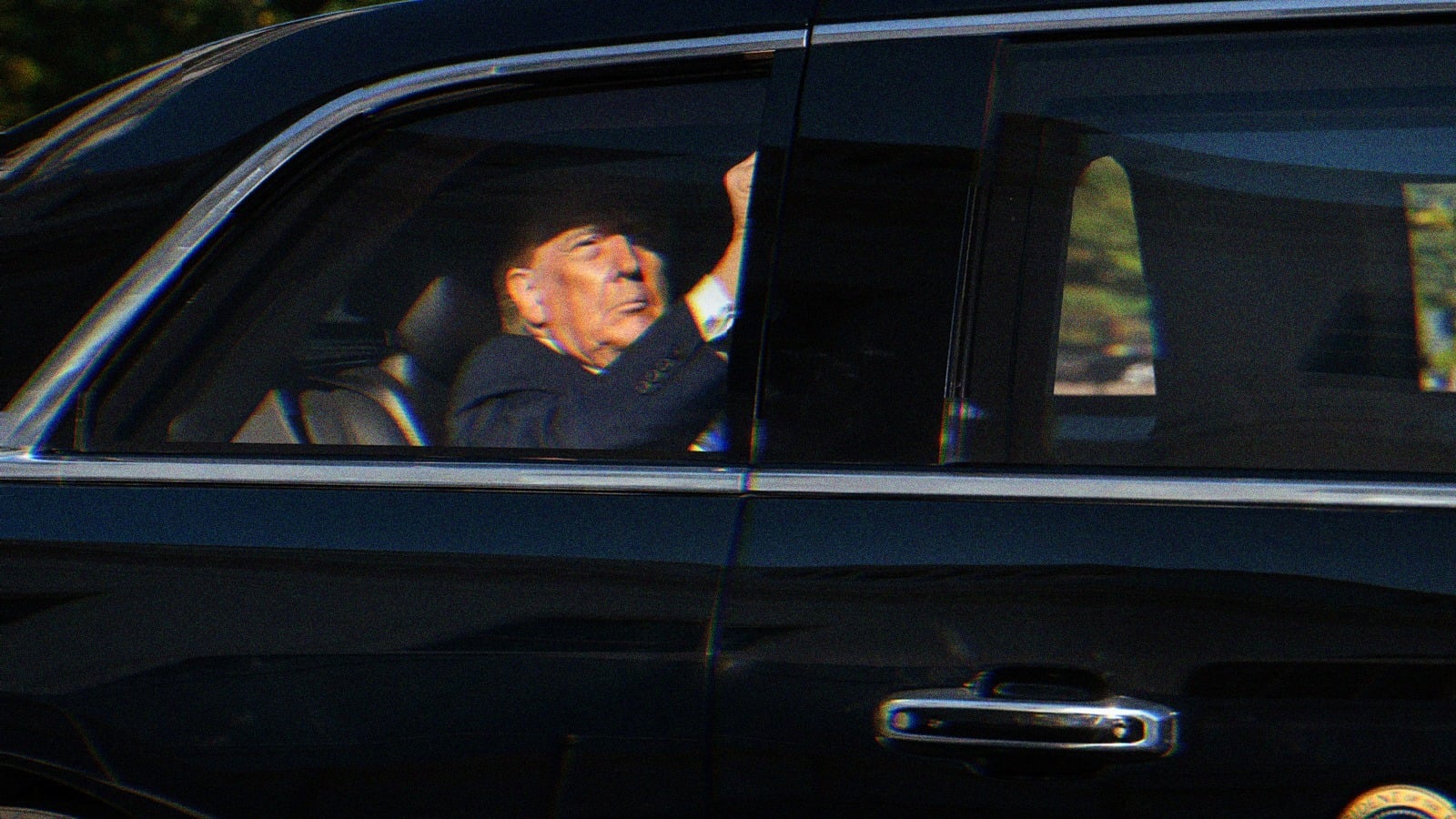 Image Description: Trump sitting in a Presidential black car. The top of his face is covered by shadow; he is frowning.
This essay appeared in the Oct. 29, 2026 edition of UNFTR’s premium newsletter. Become a UNFTR member to receive our bonus newsletter each week and for other perks.
With the midterms still 16 months out, the Trump GOP last year pressed ahead with a nakedly partisan strategy to forestall a political inevitability: Democrats seizing control of Congress on the backs of the president’s rising unpopularity and increasingly higher cost of living.
With elections at the halfway point of any presidential term historically serve as an indictment of the party in power, the GOP sought to redraw congressional maps, potentially manufacturing a potential GOP advantage, better known as gerrymandering (something both parties engage in).
Texas was the tip of the spear, with the GOP eyeing up to five new seats. In July 2025, Trump’s Department of Justice sent a letter to Texas officials calling into question the legality of four House districts, urging the state to “rectify” the ostensible violation.
Two days later, Texas Gov. Greg Abbott obliged. He called for a special session in the state’s legislature, effectively igniting a multi-state campaign to tilt districts across America in the GOP’s favor. Trump himself did little to dispute accusations that this was purely political, telling CNBC in August that Republicans were “entitled to five more seats” in Texas.
To be sure, mid-decade redistricting is exceedingly rare. In the last five decades, only two states attempted such a feat: Texas (again) in 2003 and Georgia in 2025, according to the Pew Research Center. On the occasion that mid-decade redistricting occurred—in a little more than three dozen cases—such changes were in response to court rulings or mandates, Pew found. Traditionally, redistricting occurs following the once-in-a-decade U.S. Census.
Texas adopted its new map in August 2025, with Missouri, North Carolina and Ohio following suit. Florida, which began its efforts in the summer of 2025, adopted its new map in May 2026, with the goal of gaining four additional GOP seats.
With the 2026 midterms only a day away—and with millions already having cast ballots—it appears Trump has done the unthinkable: become so deeply unpopular that even presumed-safe redrawn seats are now in play.
In some cases, including in South Texas, the GOP strategy may work against them.
According to an NPR analysis, nine out of 15 House races in which districts were redrawn are considered a “toss-up” or “lean D” or “likely D.” While Republicans have scoffed at polls predicting massive losses in the House and potentially even the U.S. Senate, the money being thrown at these races provides all the clarity we need.
In the 15 districts analyzed by NPR, more than a quarter of a billion dollars has been spent as of Oct. 23. The most expensive battles are happening in North Carolina’s First Congressional District, where Democrats have reportedly outspent the GOP.
NC-1 is one of several House races where Democrats appear to have at least a shot—speculation confirmed by the sheer amount of money being spent on the race. Both parties have poured in $52 million combined, according to AdImpact, making it one of the most expensive House races this cycle. Compared to Joe Biden’s 2022 midterms, ad spending has increased by a whopping 676 percent.
The other redrawn seats considered potentially in play include at least three Florida districts, three in Texas (remember Trump’s GOP thought they could gain five) and a pair in Ohio. Among the most hotly contested belongs to embattled and repugnant GOP Rep. Max Miller’s seat in Ohio’s 7th District.
Re-elected in 2024 by a 15-point margin, Miller, facing horrific domestic abuse allegations from his ex-wife, is in danger of losing his seat to Democrat Brian Poindexter, an ironworker endorsed by Sen. Bernie Sanders. A similar story is playing out across the country in districts redrawn over the last year.
Consider Ohio. While no longer considered a presidential battleground, polls out of the state can help inform how the rest of the electorate is feeling.
- In a recent Marist poll, 40 percent of likely voters said their vote for Congress is mainly a vote against Trump, as did 41 percent of independents. Just 11 percent of independents called it a vote for him.
- Registered voters said they’d back the Democratic candidate over the Republican 51 percent to 46 percent. Independents favored the Democrat 54 percent to 41 percent.
The political landscape out of Texas, long considered the Democrats’ white whale, is perhaps less confounding than it would seem. While Trump performed well in the borderlands in 2024, there were few signs that such support would hold, especially among Latino voters, a plurality of whom pulled the lever for the president over Kamala Harris, the Democratic nominee. Curiously, Republicans appeared to make the same miscalculation as Democrats did during the Obama era, who learned the hard way that demographics are indeed not destiny.
As they sought to prevail politically through map chicanery, national Republicans turned to a so-called “redistricting expert” out of Virginia, who relied on 2024 presidential election data, among other recent contests, to identify districts in which Trump would have defeated Harris by at least 10 points.
Now, those five seats Trump felt entitled to may be outside his grasp.
Among those significantly redrawn is TX-35. The incumbent, progressive Rep. Greg Casar, is instead running in the redrawn 37th district, making the 35th an open-seat race. House Democrats’ super PAC, House Majority PAC, has poured more than $3.2 million to keep the seat Blue, while No Going Back PAC, reportedly linked to MAGA Inc., has thrown $7.2 million at the seat, which is no longer anchored in the Democratic stronghold of Austin, which Republicans likely assumed would increase their odds of winning.
While specific House races rarely receive extensive polling, the substantial financial investment in these races serves as the most reliable indicator that the GOP thinks it’s unlikely to secure victory in a district that it heavily redrew. The two candidates—Johnny Garcia, the Democrat, and Carlos De La Cruz, the Republican—are locked in a close race. A recent Emerson College poll has given Garcia a narrow 2-point lead.
Groups are also pouring assets into TX-34, pitting Democratic incumbent Vicente Gonzalez against Republican Eric Flores. Outside spending for this South Texas seat has even dwarfed the aforementioned TX-35, with nearly $36 million already thrown at the contest. In its analysis of Texas’ redrawn maps, Inside Elections adjusted its rating of the district from “tilt Democratic” to “toss-up.”
TX-28, home to Democratic incumbent Henry Cuellar, beset by corruption allegations, also appears to be slipping away from Republicans, who have been forced to reallocate funds they initially earmarked to defeat Cuellar to two other redrawn districts.
In Florida, which has morphed into a GOP bastion, the news must be similarly unsettling after spending considerable time redrawing districts.
According to NPR’s analysis, more than $47 million has been spent in FL-25 alone, which pits incumbent Democrat Jared Moskowitz against Republican Scott Singer. And take it for what it’s worth, but House Majority PAC’s poll has Moskowitz up 6 points. As for other redrawn areas, at least two are listed now as toss-ups, and that’s to say nothing of the apparently tightening U.S. Senate race (unrelated to redistricting) featuring progressive firebrand Angie Nixon, who has done enough to make the GOP sweat.
This is all to say the 2026 midterms could be an unmitigated disaster for Republicans, being dragged by a historically unpopular president who bristles at Obama’s jokes and acts erratically (more so than ever) on the campaign trail.
Of course, both parties are well aware that nothing is promised in politics. Known to fumble the bag, you can see a scenario in which Democrats retain or shockingly win redistricted seats, only to take for granted the voters who elected them. Time will tell, but for now, voters are sending a clear message to Trump: He’s not entitled to anything.
Image Source
- The White House, Public domain, via Wikimedia Commons. Changes were made.
 Rashed Mian
 is the managing editor of the award-winning News Beat podcast and co-founder of the newly launched Free The Press (FTP) Substack newsletter. Throughout his career, he has reported on a wide range of issues, with a particular focus on civil liberties, systemic injustice and U.S. hegemony. You can find Rashed on X @rashedmian and on Bluesky @rashedmian.bsky.social.