

Gerrymandering Through History.
How Politicians Choose Their Voters.
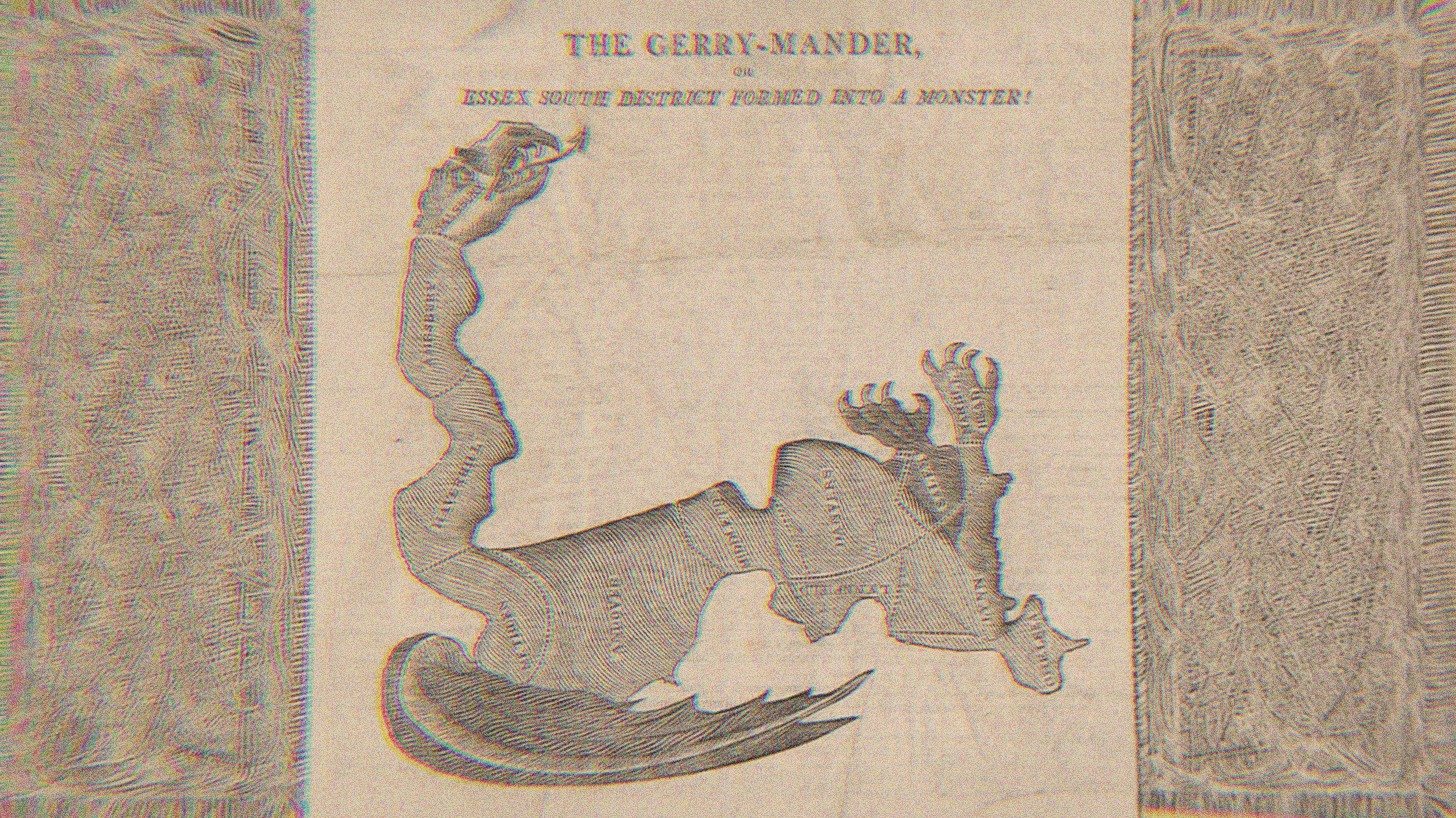 Image Description: This satirical map reflects the origin of the word ‘gerrymander,’ by Elkanah Tisdale in 1813. It depicts districts shaped into an odd form with text that reads ‘The Gerry-Mander or Essex South District Formed Into a Monster!’
In North Carolina’s 2016 congressional elections, Republicans received 53% of the statewide vote, yet they captured 77% of the seats—10 of 13 districts.
One might think this represents some kind of geographic quirk, an unfortunate consequence of how Democratic voters cluster in cities while Republican voters spread across rural areas, but they would be wrong. This has been deliberate. Republican State Rep. David Lewis said as much when explaining the redistricting process: “I propose that we draw the maps to give a partisan advantage to 10 Republicans and three Democrats because I do not believe it’s possible to draw a map with 11 Republicans and two Democrats.”
This is no outlier, but a frightening embodiment of what has become of the American political system today, once a model of democracy whose founding documents and basis for government have inspired more than 150 international constitutions.
Here’s what makes gerrymandering the ultimate democracy killer: it reverses the entire premise of representative government. In a functioning democracy, voters choose their representatives. In our gerrymandered system—like many voters in the South, Midwest, and Sun Belt states can attest—politicians choose their voters.
And thanks to a 2019 U.S. Supreme Court decision, there’s essentially nothing the federal judiciary will do to stop it.
The Mechanics of Democratic Theft
Gerrymandering operates through two primary techniques.
Packing crams voters of the opposing party into as few districts as possible. They win those districts by overwhelming margins, but those excess votes are wasted.
Alternatively, cracking splits opposing voters across multiple districts where they’re always in the minority. They lose everywhere, their votes rendered permanently irrelevant.
Political scientists Nicholas Stephanopoulos and Eric McGhee developed the “efficiency gap” metric to measure this manipulation mathematically. An efficiency gap exceeding 7–8% indicates unconstitutional partisan gerrymandering. For reference, Wisconsin’s 2011 Assembly map showed an efficiency gap between 11.69% and 13%, heavily favoring Republicans.
But here’s what should worry American citizens: modern technology has made gerrymandering exponentially more effective.
Justice Elena Kagan explained in her Rucho v. Common Cause dissent in 2019: “Big data and modern technology—of just the kind that the mapmakers in North Carolina and Maryland used—make today’s gerrymandering altogether different from the crude linedrawing of the past…While bygone mapmakers may have drafted three or four alternative plans, today’s mapmakers can generate thousands of possibilities at the touch of a key—and then choose the one giving their party maximum advantage.”
Algorithms can now generate millions of possible district maps, permitting map-drawers to prove mathematically which configurations maximize partisan advantage. The old excuse that partisan skews were accidental? Computer analysis has killed it.
A Brief History of Choosing Your Voters
Gerrymandering has been in practice since the beginning of American democracy.
When the U.S. Constitution was ratified in 1788, it left redistricting to state legislatures with minimal federal oversight—a decision that immediately created opportunities for manipulation. In fact, anti-federalist Patrick Henry, furious at James Madison’s role in drafting the Constitution, used his control of Virginia’s legislature to draw congressional districts designed to prevent Madison, a federalist, from winning a House seat.
Madison won anyway, but Henry’s intent was clear: control the maps, control the outcomes.
The Original Gerrymander (1812)
Manipulation of district boundaries took root early in the United States. However, the word comes from Massachusetts Gov. Elbridge Gerry. In 1812, he signed off on a redistricting plan so partisan in favor of his Democratic-Republicans, the party of Thomas Jefferson, James Madison, and James Monroe, that the Boston Gazette published a cartoon depicting one voting district as a salamander, spawning the portmanteau “gerrymandering.”
In the early 1800s, partisan manipulation of representation was pervasive, but during this time, gerrymandering was just one anti-democratic tactic among several, including at-large elections, malapportionment, and manipulating election rules and timing. This singular menace, among many undercutting the democratic spirit, was let loose upon the American experiment, multiplying throughout the subsequent centuries, growing more pernicious as powerful interests have concentrated around Washington, D.C.
The Jacksonian Era Through Reconstruction: Partisan Tool Becomes Racial Weapon (1820s–1900s)
As American democracy expanded, so did gerrymandering’s scope. The rise of mass political parties in the 1820s and 1830s intensified partisan competition over district lines. State legislatures regularly redrew maps to benefit whichever party controlled the statehouse, a practice that both major parties embraced as part of normal politics.
After the Civil War, the 15th Amendment guaranteed Black men the right to vote. What followed was Reconstruction—that brief window when Black political participation actually happened.
During this time, federal agents were charged with preserving the newly gained rights afforded to Black Americans. But once they abandoned the South in 1877, under the direction of U.S. President Rutherford B. Hayes, who secured the presidency by agreeing with Southern Democrats to remove federal troops, white supremacy rallied back with a vengeance. White Southerners figured out they could gerrymander their way back to power, and it became a forceful tool for violent white supremacy.
The tactics were brutal and effective. And quite sophisticated for their time.
Southern states combined district manipulation with literacy tests, grandfather clauses, poll taxes, and targeted violence to systematically disenfranchise Black voters. Mississippi’s Black voter registration collapsed from 57% in 1868 to less than 6% by 1892. Louisiana had 130,344 registered Black voters in 1896; by 1904, that number collapsed to a mere 5,320—a roughly 94% decrease in eight years. Alabama, Arkansas, Florida, Georgia, North Carolina, South Carolina, Tennessee, Texas, and Virginia all followed similar patterns.
But these efforts weren’t just about keeping Black people from voting. It was about ensuring that when they did vote, those votes counted for nothing. Districts were drawn to pack Black voters into as few districts as possible or crack them across multiple districts where they’d always be outvoted by white majorities.
It would be 27 years after George Henry White left Congress in 1901 before another Black person was elected to that body.
This era established a crucial precedent: gerrymandering could be used to effectively nullify constitutional rights, maintain minority rule despite universal suffrage, and make democracy itself optional for those who controlled the mapmaking machinery.
The Civil Rights Era (1960s–1970s)
For nearly a century, the federal courts largely ignored this systematic disenfranchisement. Then came the Civil Rights Movement, and suddenly the judiciary began to take voting rights seriously.
The Civil Rights Movement forced courts to act. Baker v. Carr (1962) established that federal courts could hear redistricting challenges. The Voting Rights Act of 1965 added teeth; Section 5 required certain jurisdictions—mostly Southern states with histories of discrimination—to get federal approval before changing voting laws or district lines.
Reynolds v. Sims (1964) applied the “one person, one vote” principle to state legislative districts, requiring roughly equal population. And Gomillion v. Lightfoot (1960) struck down a 28-sided district in Tuskegee, Alabama—drawn specifically to exclude Black voters while including all white voters.
As a result, the Black registration gap in the South shrank rapidly from nearly 30 percentage points in the early 1960s to about eight by the 1970s.
From Hand-Drawn Maps to Algorithms (1980s–present)
Then came the technological revolution. The late 1980s TIGER (Topologically Integrated Geographic Encoding and Referencing) mapping database and PL 94‑171, the federal law that creates Census redistricting data, made it possible to draw districts on computers with block-by-block demographic data.
By the 1990s, both parties were using computer analysis to draw precise partisan maps.
Texas Republicans in 2003 executed a mid-decade redistricting, at the behest of Gov. Rick Perry and U.S. House Majority Leader Tom DeLay—unusual because redistricting typically happens only after Census years—specifically to gerrymander Democrats out of congressional seats they’d won under the previous maps. And it worked. Democrats lost six seats, giving Texas’ U.S. House delegation a Republican majority, 21–11.
After the 2000 census, California’s Democratic‑led legislature, with Republican cooperation, drew a bipartisan incumbent‑protection map using detailed voter data and computer modeling. In the five congressional elections from 2002 through 2010, only one of California’s 53 U.S. House seats changed party hands, meaning nearly every race was effectively decided when the lines were drawn rather than by voters on Election Day. This earned it the name the Incumbent Protection Plan.
The U.S. Supreme Court’s 2004 decision in Vieth v. Jubelirer further emboldened partisan gerrymandering. Conservative Justice Antonin Scalia’s plurality opinion, in the 4–3 decision, held that no “judicially discernible and manageable standards” existed for determining when partisan gerrymandering became unconstitutional. And while conservative Chief Justice Kennedy’s concurrence left the door slightly ajar—maybe such standards could be developed—the practical effect was to tell state legislatures that partisan gerrymandering was essentially legal.
Both major parties had been guilty numerous times during the previous century and a half. But expert report‑card projects and simulations of the 21st century, such as Princeton’s Gerrymandering Project, Michigan State’s Partisan Advantage Tracker, and New York University’s Brennan Center’s “Extreme Maps,” consistently show more radical or more numerous pro‑Republican maps, especially in large Sun Belt, Southern, and Midwestern states.
This is due, in part, to Republicans developing a coordinated national strategy, while Democrats have mostly played defense state by state. Much of the current rotting core of this undemocratic politicking stems from REDMAP.
REDMAP: the Decade-Long Heist by the GOP
In 2010, Republican strategist Chris Jankowski masterminded an audacious plan: spend $30 million to flip state legislatures in census years when redistricting happens, then gerrymander districts to lock in Republican control for a decade regardless of how Americans actually vote.
Karl Rove announced the strategy in a Wall Street Journal column headlined ”He Who Controls Redistricting Can Control Congress.” They weren’t subtle. They told America exactly what they were doing, and then they did it.
REDMAP (Redistricting Majority Project) targeted state legislative races in Pennsylvania, Ohio, Michigan, North Carolina, Wisconsin, and Florida. The investment dwarfed Democratic spending by 3-to-1. Republicans netted 675+ state legislative seats, flipped 20+ state legislatures, and gained control over redistricting affecting more than 40% of congressional seats. That included the total capture of 12 state legislatures.
The payoff: In 2012, Democratic House candidates won 1.4 million more votes nationwide, while Republicans maintained a 33-seat majority. In Pennsylvania alone, Democrats won 51% of statewide congressional votes but captured only 28% of seats—five of 18.
This was the REDMAP strategy working exactly as designed.
Rucho v. Common Cause: The Supreme Court Washes Its Hands
On June 27, 2019, the Supreme Court’s 5-4 decision in Rucho v. Common Cause fundamentally reshaped American democracy—deciding that extreme partisan gerrymandering was beyond the Court’s authority to address. Conservative Chief Justice Roberts’ majority opinion held that “partisan gerrymandering claims present political questions beyond the reach of the federal courts.”
Let’s be clear: the Supreme Court looked at districts drawn with surgical precision to deny voters meaningful representation, examined maps so skewed they could only have been created through deliberate manipulation, considered evidence from multiple states showing systematic democratic theft—and said “sounds like a political problem, not our department.”
Justice Kagan’s dissent cuts to the bone: “For the first time ever, this Court refuses to remedy a constitutional violation because it thinks the task beyond judicial capabilities.” Her central challenge: “Is that how American democracy is supposed to work? I have yet to meet the person who thinks so.”
The effects were immediate. Brennan Center analysis found that maps used in 2024 have “on average a net 16 fewer Democratic or Democratic-leaning districts” than maps complying with proposed anti-gerrymandering standards. Furthermore, Republicans drew 191 congressional districts (44% of the total) compared to Democrats’ 75.
The Supreme Court didn’t just wash its hands of gerrymandering. It gave every Republican-controlled state legislature a green light to gerrymander as aggressively as possible, secure in the knowledge that federal courts would never intervene.
Take Wisconsin. In the 2018 midterms, Democrats won 53–54% of statewide Assembly votes but captured only 36% of seats—36 of 99. That same year, Democrats swept every statewide executive office. The voters clearly preferred Democrats.
The gerrymandered maps kept Republicans in control of the Wisconsin Legislature for more than a decade, even in years when Democrats won more votes statewide. That continued until Dec. 22, 2023, when the Wisconsin Supreme Court struck down the legislative maps as unconstitutional and barred their use in future elections; voting‑rights groups have called Wisconsin “home to the most extreme partisan gerrymander in the country.”
Pennsylvania’s story provides an earlier success. The state Supreme Court’s 2018 decision found the 2011 congressional map “clearly, plainly and palpably violates the Constitution.” Under that map, Republicans won 72% of seats despite receiving only 49–55% of votes across three election cycles. The court-ordered remedy demonstrated that different maps produce dramatically different outcomes.
Now to be clear: Democrats gerrymander, too, albeit to a lesser degree. Maryland’s congressional map, for instance, based on the 2010 census, was designed to eliminate Republican representation. The difference, however, resides in scale and systematization. REDMAP was a coordinated, well-funded, multi-state strategy executed with military precision. Democratic gerrymandering tends to be opportunistic and state-specific rather than part of a national plan.
Gerrymandering Prevents Passage of Progressive Policies That Are Widely Popular
Here’s where gerrymandering stops being abstract and starts directly affecting whether you can afford healthcare, whether your kids attend schools with lead-free water, and whether you make enough money to pay rent.
In recent years, multiple national polls have found majority support for a Medicare for All–style national health plan, with support often ranging from the mid‑50s to around 70. But the policy gets no floor votes. 84–94% support universal background checks, yet legislation consistently dies. The federal minimum wage has been stuck at $7.25 since 2009, even though roughly two‑thirds of Americans support raising it to $15 an hour.
When voters bypass gerrymandered legislatures through ballot initiatives, progressive policies win—even in deep red states. Missouri voters approved a $15 minimum wage in 2024 despite Trump winning the state by 18 points. From 1996 through 2024, voters approved 28 of 32 statewide ballot measures related to raising the minimum wage, an approval rate of about 88%.
This pattern confirms what we already know: gerrymandering, not public opinion, blocks popular policies. When citizens vote directly on these issues, progressive policies win. When gerrymandered legislatures control the process, popular policies die in committee.
This directly undermines UNFTR’s 5 Non-Negotiables. Housing First? Good luck passing that through a legislature where suburban and rural Republicans control supermajorities despite representing a minority of voters. A Civilian Labor Corps to address AI-driven job displacement? Not happening when politicians can ignore voter preferences without consequence. Medicare for All? Polling consistently shows majority support, but gerrymandered districts ensure the votes aren’t there.
Climate Action—our fifth non-negotiable—faces similar blockades. Progressive taxation, campaign finance reform, and investment in renewable energy all poll well. None of it passes because politicians blocking these policies don’t have to worry about voter backlash. They’ve drawn their districts to be safe regardless of how constituents feel about policy.
This is why gerrymandering belongs in the same conversation as getting money out of politics, UNFTR’s fourth non-negotiable. Both are structural problems that prevent democracy from functioning even when public support for progressive policies is overwhelming.
A Path Forward
Nearly nine in 10 North Carolinians oppose gerrymandering—including 89% of Trump voters. Michigan’s Voters Not Politicians initiative passed with 61% support. Ohio voters approved redistricting reforms with 71% in 2015 and 75% margin in 2018. The public wants reform, but gerrymandered legislatures refuse to implement it.
The irony is disheartening, to say the least: the primary barrier to ending gerrymandering is gerrymandering itself. Legislators who owe their seats to rigged maps won’t voluntarily unrig those maps. Courts in Republican-controlled states won’t strike down Republican gerrymanders. And the Supreme Court has explicitly said federal courts can’t help.
The path forward requires either federal legislation establishing independent redistricting commissions—something like the Freedom to Vote Act, currently stalled in Congress—or state-by-state reform through ballot initiatives and constitutional amendments. The latter strategy has worked in Michigan, Arizona, California, and Colorado, where citizens largely bypassed legislatures to create independent commissions.
Canada, the UK, and Australia all rely on independent boundary commissions—typically chaired by judges or other non‑partisan experts—with tight population‑equality rules and no power for elected politicians to rewrite the commissions’ final maps.
A 2023 study of U.S. House elections finds that districts drawn by independent redistricting commissions are 2.25 times more likely to be competitive than those drawn by state legislatures, and they significantly reduce incumbent‑party lock‑in. It works. And versions of this model are used in many other democracies, where non‑partisan boundary commissions, not self‑interested politicians, are responsible for drawing electoral maps.
This is why UNFTR’s fourth Non-Negotiable—getting money out of politics and restoring election integrity—is so crucial. Gerrymandering and campaign finance corruption are two sides of the same coin. Both allow politicians to ignore voter preferences. Both entrench minority rule. Both make it impossible to enact popular progressive policies even when overwhelming majorities support them.
Until we fix the structural problems preventing democracy from functioning, we can’t accomplish any of the other non-negotiables. You can have the best policy proposals in the world—guaranteed housing, meaningful work, universal healthcare, climate action—but if politicians can choose their voters instead of voters choosing their politicians, those policies will never become law, no matter how popular they are.
As plaintiff and University of Wisconsin law professor William Whitford observed in Gill v. Whitford: “In a democracy citizens are supposed to choose their legislators. In Wisconsin, legislators have chosen their voters.” That’s the fundamental question facing American democracy: Will we reclaim that choice, or will we accept that our votes only matter when politicians decide to let them matter?
Image Source
- Cornell University Library, Public domain, via Wikimedia Commons. Changes were made.
 Team UNFTR
Updates from the collective UNFTR team.