Genocidal Deluge
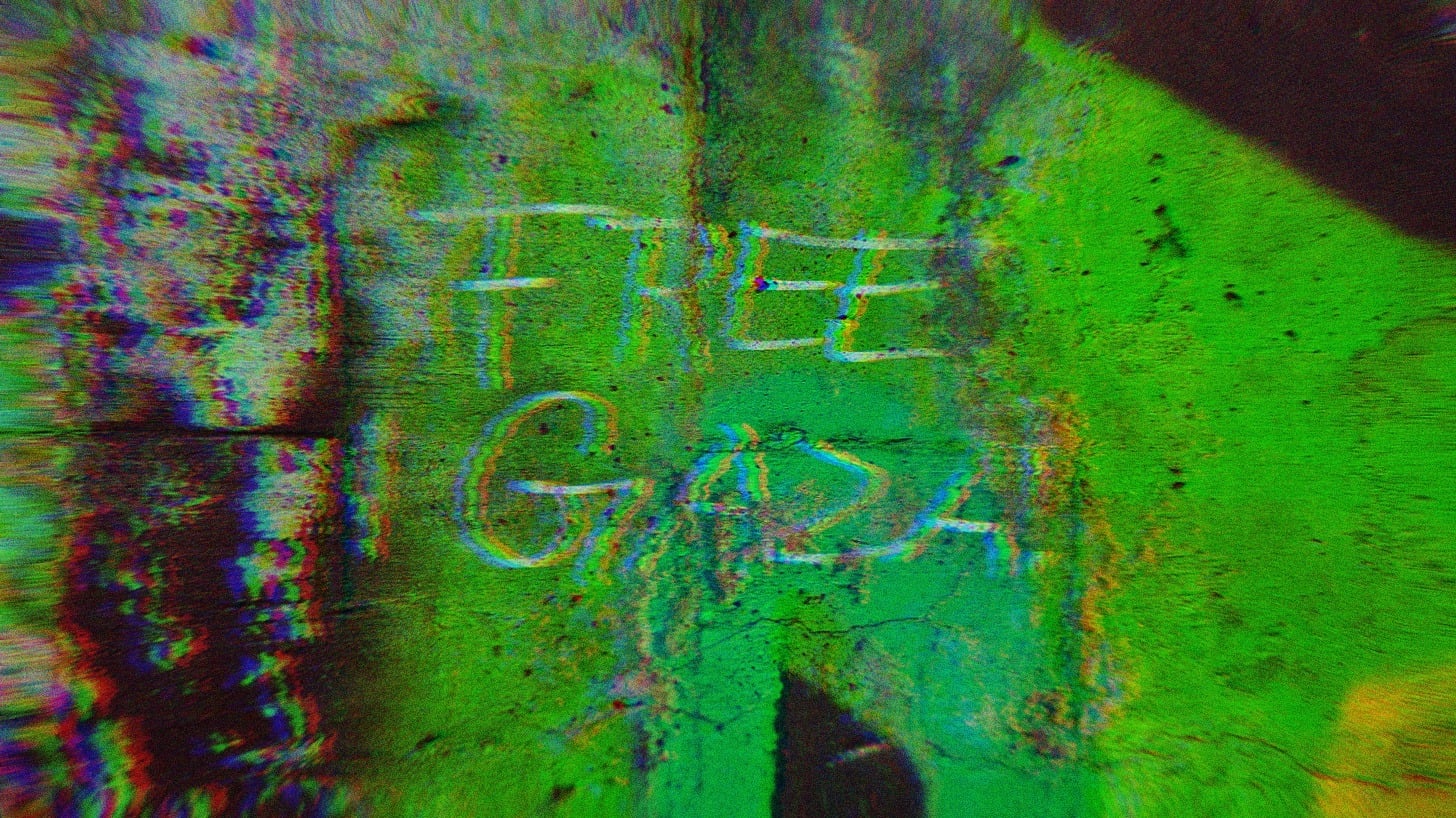 Image Description: Graffiti that reads ‘Free Gaza.’
This essay appeared in the Nov. 12 2026 edition of UNFTR’s premium newsletter. Become a UNFTR member to receive our bonus newsletter each week and for other perks.
With the corporate media fixated on Nvidia’s now-former CEO’s philandering and apparent (unwitting) role in an alleged honeypot scheme, the Israeli-induced devastation in Gaza yet again became one of the most criminally under-covered stories in recent days as winter floods added to the misery for Palestinians living through multiple dimensions of hell.
The inundation was particularly crushing to the estimated 1.4 million people in Gaza (about 65 percent of the population) that remain displaced as a result of Israel’s genocidal war of annihilation.
For Gazans, not only are they forced to contend with Mother Nature’s wrath, but also continued attacks by Israeli forces, which haven’t stopped despite a so-called ceasefire that took effect on Oct. 11, 2025.
Since then, Israel has killed more than 1,600 people. As recently as this week, Israeli attacks on Nasser Hospital, located in the southern city of Khan Younis, killed six people. Nasser, Drop Site reported, was reportedly the last hospital still performing special surgeries. It’s wave after wave of physical and psychological mutilation for the forgotten people of Gaza.
Amid the news of the Nasser Hospital attack, Philippe Lazzarini, the former UN Under-Secretary-General, aptly posted: “How can this still be called a ceasefire?”
According to a data analysis shared by Lazzarini, there have been at least 3,508 attacks on healthcare since the genocide started in October 2023. Between the date of the ostensible ceasefire and this September, there have been more than 157 attacks on healthcare, according to Insecurity Insight.
For Palestinians, the indignities continue to pile up, along with the body count. Among those killed in the Nasser Hospital attack was Dr. Rizk Abu Shaira, a widely respected surgeon featured in the documentary, “American Doctor.”
“Dr. Rizk’s shocking murder is yet another reminder of why we must get control of our country,” said Feroze Sidhwa, a surgeon who has volunteered in Gaza multiple times since the genocide started. “Our government has no right to force us to subsidize the mass murder of doctors and children, not in Palestine and not anywhere.”
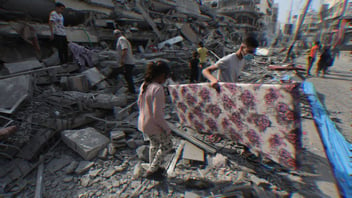
The hospital attacks come as winter has arrived in Gaza, bringing with it high winds and downpours that have caused frightening floods. Already living in unsanitary and squalid conditions, worn tents and makeshift shelters are no match for the elements. Aid groups have reported that 70,000 tents have already been flooded by the torrential rain, which began on Nov. 6.
While many in the West celebrate seasonal transitions as a change of pace and for the joys holidays and other occasions bring, people in Gaza are caught in some sort of annual genocidal doom loop exacerbated by the changing calendar. Indeed, Mother Nature can’t be stopped—but the real harm to Palestinians comes in the form of an ultra-right-wing government in Israel that repeatedly violates a so-called ceasefire and has prohibited the full allotment of aid from reaching the Strip (also a violation of the purported ceasefire).
In the case of Gaza, it’s easy to say the weather is making a horrific situation somehow even worse. In reality, the war of annihilation—which has completely devastated the Strip’s infrastructure and reduced large swaths to rubble—has effectively made the weather something of a weapon of genocide. Israel likes to say they don’t control the weather, a sadistically unfunny retort. But they do control the aid and the ability for Palestinians to rebuild with what little they have left. They just refuse. And the United States continues to provide diplomatic cover, while funding the brutalization of Palestinians.
“As part of the preparedness efforts, more than 150,000 tents, 300,000 tarpaulins and 500,000 blankets were outside Gaza ready for dispatch,” reported the United Nations agency that coordinates humanitarian affairs. “However, humanitarian efforts to prepare were constrained by Israeli restrictions on the entry of supplies and equipment and funding shortfalls, limiting the stocks available inside Gaza when the rains began.”
When South Africa launched its genocide case against Israel at the International Court of Justice (ICJ) in December 2023, it prophetically described the war’s impact on Gaza’s general infrastructure. Among the likely scenarios, its prosecutors said, was how the damage caused by the Israeli bombardment would “prevent adequate water treatment and distribution, and sewage management, with flooding exponentially increasing the risks of the spread of infectious diseases amongst displaced Palestinians.”
In its filing before the ICJ, it quoted the director general of the World Health Organization, who said, “Everywhere you look, is congested with makeshift shelters. Everywhere you go, people are desperate, hungry and terrified.”
“These conditions—deliberately inflicted by Israel—are calculated to bring about the destruction of the Palestinian group in Gaza,” South Africa argued just months after the genocide commenced.
Its analysis of the healthcare situation was also tragically spot on: “Almost above all else, Israel’s military assault on Gaza has been an attack on Gaza’s medical healthcare system, indispensable to the life and survival of the Palestinians in Gaza.”
Attacks on hospitals and other medical facilities are a war crime under international law. Yet, such attacks have been a steady theme, including after the so-called ceasefire.
As for the aid situation, Israel remains in violation of the laughable “ceasefire.” As recently as last month the WHO said only one aid entry point is open, severely limiting the amount that can enter the Strip.
“Our ask is simple and has not changed: we need the unimpeded and predictable entry of humanitarian and health supplies into Gaza at scale,” the WHO said. “We also need a multi-crossing model so that aid isn’t forced to trickle down through a limited number of crossings.”
This is what a continued tragedy looks like—one all so predictable and yet unavoidable all the same. When it comes to Palestinians, it’s easier for the world to turn the page.
Image Source
- PantheraLeo1359531, CC BY-SA 4.0, via Wikimedia Commons. Changes were made.
 Rashed Mian
 is the managing editor of the award-winning News Beat podcast and co-founder of the newly launched Free The Press (FTP) Substack newsletter. Throughout his career, he has reported on a wide range of issues, with a particular focus on civil liberties, systemic injustice and U.S. hegemony. You can find Rashed on X @rashedmian and on Bluesky @rashedmian.bsky.social.