
Don’t Tax the Rich. Cut Them Off.
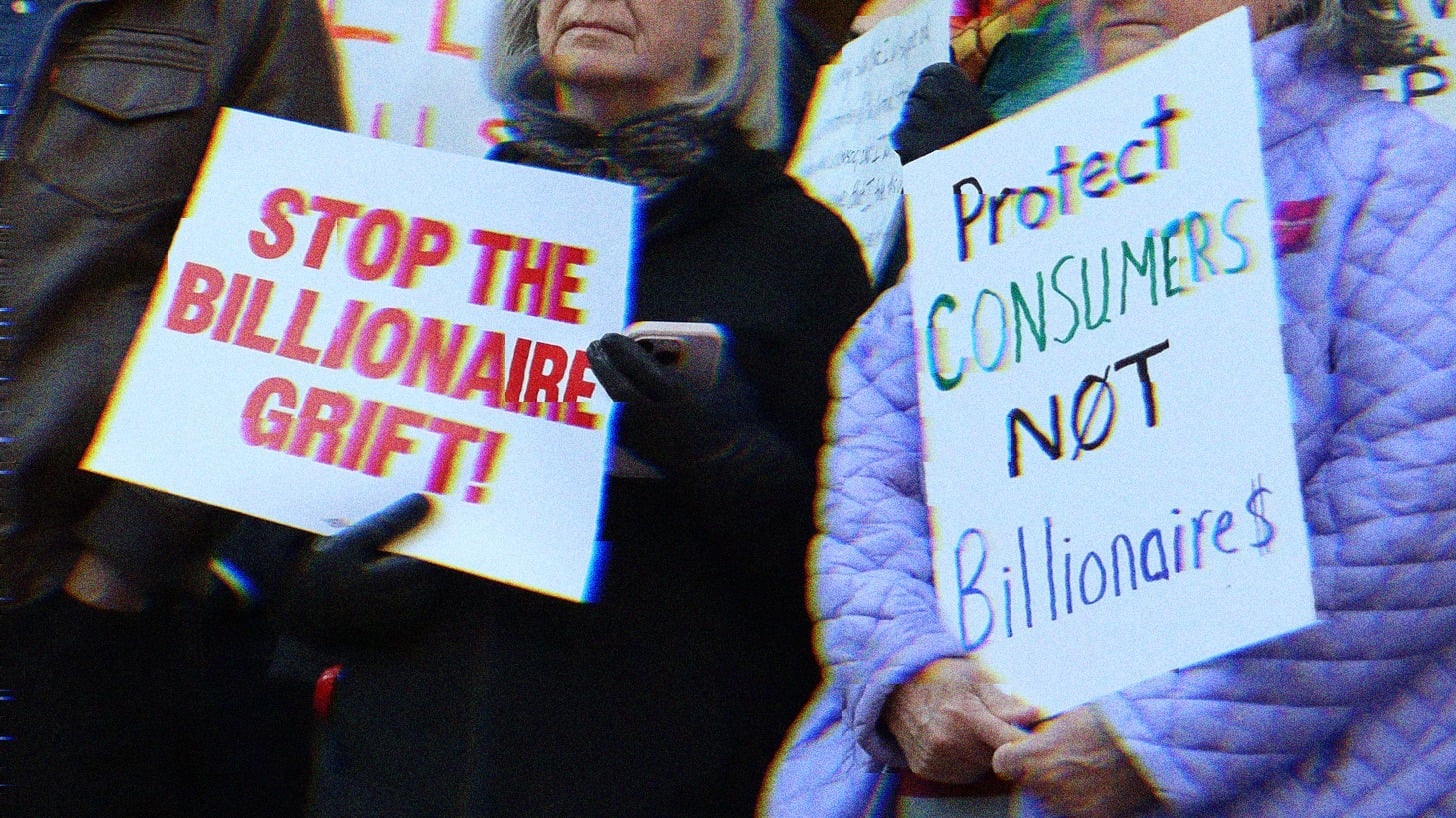 Image Description: Two protestors, one holds a sign reading ‘stop the billionaire grift,’ the other reads ‘protect consumers not billionaires.’
Billionaires are easy to hate. And there are several efforts underway to get them to pay their “fair share.” In this essay, Max argues that focusing on taxing billionaires is the wrong discussion and distracts from attaining the tax policy we truly need. Instead of focusing on the individual billionaires, focus on preventing individuals from becoming billionaires. The real story is corporate taxes.
I’m going to make the case today that the movement to tax the rich is the wrong one if the goal is to reduce inequality. By the time we talk about taxing the individuals themselves, the game is over and they know it. It actually plays into their hands.
The solution isn’t to tax the individual billionaire, it’s to prevent the individual from becoming one.
The economy is more fragile than most pundits let on, and the inequality gap is widening even as we mint millionaires and billionaires at an unprecedented clip. Meanwhile the public falls further behind—rent, mortgages, credit cards, car payments. Food insecurity is rising. There are roughly 750,000 unhoused Americans at any given time. Incomes aren’t keeping pace with inflation. And we’ve got a set of looming crises stacking up from cuts to SNAP, Medicaid, and other income-assistance programs.
The pundit class, the Wall Street class, the lawmaker class, they live in the upper income brackets, where things are, frankly, fucking amazing. The stock market keeps setting records. Fixed-income yields are high enough that wealthy retirees don’t have to choose between equities and safety. Normally when yields rise, stocks decline, and vice versa. Right now, every asset class is showing historic appreciation simultaneously. Yes, it’s a bubble and it’s all going to end soon, but I’m making a different argument. Not to mention, the government has been taking less from high-net-worth income across multiple administrations—this is a bipartisan project.
Money protects money, and Congress is made of money.
Now pivot to corporate earnings. They’ve been off the charts—almost double-digit increases every single year over the past decade, save for COVID. The stock market is still overvalued against long-term historical trends, but corporations are killing it. Since the Global Financial Crisis, most public corporations have also deleveraged significantly by taking advantage of low-interest-rate arbitrage courtesy of the federal government. Corporate America is sitting with healthy balance sheets, lots of cash, reasonable leverage, fantastic earnings, and share prices boosting shareholder wealth and stock-option holders.
The vast majority of businesses in the United States are small. But it’s the large ones that soak up the advantages and offer a vehicle to obscene individual wealth that buys power and influence.
Safe Havens
Did you know that the Trump Organization is made up of more than 500 entities that act as pass-through entities for tax purposes? In other words, they exist to take in revenue from company to company that will ultimately pass through to the Trump family as shareholders—partially for tax avoidance purposes, (we can’t be sure where they’re all domiciled and what the activities are) and partially to reduce any theoretical tax burden. Welcome to Rube Goldberg tax avoidance strategies of the rich and famous.
This is just a slice of the bigger issue. A couple of years ago we did a piece on offshore tax havens and how the National Bureau of Economic Research built on findings from the Panama Papers to uncover trillions of dollars hiding in offshore tax havens; the estimate from wealthy Americans and U.S. corporations was somewhere in the neighborhood of $4 trillion in offshore accounts. There are legal entities that exist for the purposes of avoidance, and we know about those accounts. It’s shitty, but it is what it is. Those make up about half, and are mostly shell companies that don’t do any real business in places like the Cayman Islands. But the Bureau believes there’s another roughly $2 trillion that is just hiding. This is from shady corporations to an extent, but mostly tied to the billionaire class, since there are only about 1.5 million Americans who even have offshore accounts. So there’s that.
Attempts to repatriate these funds have mostly fallen flat. Trump actually made the most serious attempt in his first term, believe it or not, and it barely yielded anything relative to the scale of the problem. But it did work to a limited extent, because his sales pitch was pretty irresistible. That brings us to our next building block.
Bring it back home, he said. And a few people did, because he was dangling favorable tax rates in front of them, and promising not to punish them for revealing the funds. And here’s where he came through in spades. The 2017 Tax Cuts and Jobs Act took the top marginal rate from 39.6% down to 37%, and—this is the part people forget—it doubled the estate tax exemption from about $5.5 million to over $11 million per person, north of $22 million for a married couple, indexed to inflation every year after. That’s dynastic wealth protection at its finest.
The Tax Policy Center found the top 20% of earners pocketed roughly two-thirds of the total savings from the bill, while the bottom 80% split around a third—and by 2027, once you strip out the temporary stuff, some of those lower brackets were actually projected to come out worse off, net-net. The Center on Budget and Policy Priorities ran the 2025 numbers: the top 1% got an average tax cut of $61,090. The bottom 60% of the country got less than $500.
Importantly, all of the individual rate cuts have been temporary. But the corporate rate cut, down from 35% to 21%, was made permanent from day one. And even on the offshore money—remember, he told everybody to bring it home—the deal was so generous that companies paid a one-time transition tax of just 15.5% on cash they’d stashed abroad, 8% on the illiquid stuff, spread out over eight years if you wanted. Companies did bring back about $777 billion in 2018 alone. It was an impressive figure. But you’ll never guess what they did with most of it.
According to Brookings:
“The one-time spike in repatriated funds after TCJA repealed the repatriation tax did not boost investment or wages. Instead, it generated a wave of corporate stock repurchases (‘buybacks’).”
Yeah. They did that. Because, of course they did.
In terms of corporations, the Biden administration added a bit of a wrinkle by passing the Corporate Alternative Minimum Tax (CAMT) as part of its signature legislation, which we’ll talk more about in a minute. And honestly, this was pretty significant, because for years the big companies—especially the big tech firms that claimed multinational domiciles—were able to effectively practice tax avoidance. If you’ve heard even one Bernie Sanders speech, you’re aware of how obscene this practice has become. But then Trump was re-elected. Shocking, I know. I’m sorry to break the news to you if you haven’t been paying attention. And Trump 2.0 has been even more favorable to corporate America.
In our last On The Record I spoke about the infamous Powell Memorandum from 1971, which was the clarion call to capitalists and corporate America to get out of a defensive posture and start using its might and public relations know-how to fight back against the state. The memo outlined how corporations needed to band together to take over colleges, break unions, fill the legal profession with ideologues, get people elected who would work for corporations, and finally break the back of the social safety net, the civil rights agenda, and general liberalism. So this has been a long time in the making. But even Powell might be surprised at just how far this has gone.
Start with deregulation. The White House says its deregulation push saved $211.8 billion in 2025 alone—more than the entire first Trump term combined—built on a 129-to-1 ratio of rules repealed to rules issued. The independent scorekeepers at the American Action Forum put actual finalized net savings at about $129.7 billion for the year—and they note two rules alone account for the bulk of it: gutting the beneficial-ownership reporting requirement and somehow killing the TSA shoe-removal rule (which was objectively awesome). Either number you use, it’s real cost relief, and it’s flowing almost entirely to the businesses community, not to households.
Now onto the tariffs, because this is where it gets absurd. Trump slapped tariffs on the country all through 2025, and the research is not ambiguous about who paid for it. The New York Fed found that close to 90% of the economic burden of the 2025 tariffs landed on American firms and consumers, not on foreign exporters eating the cost like the administration promised. The Fed’s research staff found the tariff pass-through into core goods prices was “effectively complete,” and it explained the entirety of the excess inflation in that category relative to pre-pandemic norms. So the debate is over. We paid for the tariffs. But we’re not getting the refunds.
When the Supreme Court stepped in this past February and ruled the administration’s IEEPA tariffs were never legally authorized in the first place—it set off a refund wave that is still washing through corporate earnings calls as we speak. We’re talking about $166 billion owed, with roughly $100 billion of it already paid out to corporations as of early August. Apple got about $2.2 billion back. Walmart is in line for up to $10.2 billion. Target, up to $2.2 billion. Nike, roughly $986 million. FedEx, about $800 million. General Motors, half a billion. But there is no legal mechanism for you—the person who actually paid the higher price at checkout for 18 months—to get a dime of that back. Only the importer of record, meaning the corporation, can file for the refund. Elizabeth Warren has been publicly leaning on all of these companies to voluntarily pass some of it back to customers, but most of them haven’t committed to anything.
Nintendo, to its credit for honesty if nothing else, straight up said they have no legal obligation and no plans to refund consumers on its $300 million. So you paid the tariff, the corporation gets the refund.
Now, tucked into the Big Beautiful Bill was another interesting provision that, save for a Biden-era protection, could have been a lot worse. But it’s an important thing to understand because it partially explains the level of investment we’re seeing into the AI space. Depreciation.
Congress passed a permanent restoration of 100% bonus depreciation and the new permanent full expensing of domestic R&D, including a retroactive catch-up election letting companies deduct years of previously amortized R&D costs all at once. In plain terms, when companies made capital investments in the past for anything from equipment to furniture, they could write them off over a period of years to reduce their tax burden. It’s a great feature. This new provision allows companies to do it all at once, which is a massive win.
That’s exactly the mechanism that can create a book-tax gap large enough to actually trigger the Biden-era minimum tax. So Meta, for example, booked a $15.9 billion tax charge in Q3 2025 tied to Trump’s new retroactive R&D true-up. That’s not a small business deducting a laptop. That’s how a trillion-dollar company restructures its tax exposure in a single filing.
Which brings us to the CAMT fight. Corporate lobbyists spent a good chunk of 2025 trying to get the 15% alternative minimum tax repealed outright as part of the broader bill. It didn’t happen—Congress held the line, mostly because the Joint Committee on Taxation scored a repeal at roughly $200 billion in lost revenue over ten years. So CAMT survived. But it almost doesn’t matter that it survived, because between the depreciation write-offs, the R&D expensing, the tariff refunds, and every other loophole still standing, corporate America is paying less in taxes than it has in years, even as earnings sit at record highs.
The CBO’s February monthly review found corporate income tax receipts down 23%, about $33 billion, in just the first five months of fiscal 2026 versus the year before—while customs duties over that same stretch came in four times higher. We covered this when we went through the last Treasury statement and the numbers are corroborated. And zoom out to the full picture: in the fourth quarter of 2025, the tail end of the calendar year, the federal government actually collected more in tariffs than it did in corporate income taxes—$91 billion in tariffs against $81 billion in corporate tax receipts.
We taxed imports more than we taxed the most profitable corporations in the history of the world, and then we handed a good chunk of those import taxes right back to those same corporations.
An Ounce of Prevention
Let’s take it back to where we started. There are all these efforts underway to tax billionaires in creative ways to claw back both money and influence. New York’s pied-à-terre tax, California’s one-time billionaire tax. In every case, the billionaires are fighting back vigorously. Ken Griffin, Elon Musk, Jeff Bezos, Sergey Brin—even man-of-the-people Mark Cuban have publicly denounced these efforts and are expending more in lobbying fees than they would be taxed. Their arguments don’t matter here. What matters is that they have the means to bend the political system to their will.
Just as the Powell Memo was the clarion call to capitalists everywhere and to the business community to rise up and stomp out social welfare, higher education and anything in the public interest, we need to exercise our own power to call for a bureaucratic end to the creation of billionaires.
Before we talk mechanics, I want to be clear about something. It’s not about the money. I don’t care if you have a hundred bucks or a billion, make it and spend it as you see fit. Wanna buy a second or third home? Knock yourself out. Ferrari, Bugatti? Whatever floats your yacht. The problem with today’s billionaires is that they’ve worked behind the scenes with political scumbags for decades to unravel public protections through moves like Citizens United. They’ve used their money to accumulate political power to extract power from the working class. And they’ve bent the rules and deregulated the structures that were designed to protect us all from ourselves. So now we have to flip the script to prevent future douchebags.
First off, when these fuckers die—and they all will—we need an estate tax that siphons the money from the labyrinth of trusts they have in place to pass it along to their douchebag offspring. The carried-interest loophole that allows vulture capitalists to pay taxes on their income as though they actually earned it, has got to go. Even Trump campaigned on that in 2016. The stock buybacks that Reagan legalized? Buh-bye. The Clinton-era rules that capped wages for executives while carving out the ability for them to just pay themselves with exorbitant options at suppressed valuations, which is what made stock buybacks so lucrative for the shareholder class? See ya.
And the coup de grâce is a that minimum corporate tax shouldn’t be 15%, it should be around 40%, and here’s why. Those record corporate earnings Wall Street loves to crow about? Those are profits. It means the money that was made after they bought or made their stuff and paid their people. It’s what’s left over. The piece of the pie that goes to the shareholders who did nothing to earn that money. Money that sits in bank accounts and investment vehicles and circulates around and around the monied class instead of filtering down to the people who actually made that money.
When you tax corporate profits and eliminate the benefits for short-term shareholder gains you completely change the incentive structure. Corporations are making these historic profits because they pay low wages and reduce investments in research and development. If they want to avoid paying taxes so badly then make the primary avoidance mechanism the reduction of taxable income. Incentivize them to put money into wages and research. Let them make a killing on individual taxable income because it helps level the playing field.
One by one we need representatives who understand how to legislate these kinds of policies. The corporate lobbyists and conservative think tanks will put out a torrent of misinformation about how high corporate taxes kill innovation and reduce incentives and threaten the viability of companies. So let’s take those one at a time.
First off, the billionaire class in Silicon Valley has been crying for decades now that innovation is dead. Look up Peter Thiel’s thoughts on the matter. That’s why they’re so excited about AI. They think they’re really onto something here. But as the viability of AI as a game-changing innovation dwindles by the day we’re faced with the same reality that corporations don’t innovate—they iterate.
I’ve made this case many times before. Show me an innovation—an authentic, culture-shifting, game-changing innovation—and I’ll draw you a straight line to where it started to prove how companies don’t innovate. Pharmaceuticals, pesticides and fertilizers? World War II. The internet was originally ARPANET, a government-funded satellite program. Space exploration? Hello?
Every major innovation in our nation’s history started in a government agency, through a government grant, in a university setting, or by a corporate department with the title R&D. And that R&D was either funded by a government grant or because the company was incentivized to pour money into research to reduce its liability to the government.
In terms of reducing incentives, I offer into evidence…China. Today. Or perhaps the United States from the 1950s to the 1970s, the period with the greatest prosperity and employment in our history when the top corporate tax rates were between—wait for it—40–50%. Would you like to tell the remaining members of the Greatest Generation that they lacked incentive in their day?
And lastly, the threat to the viability of corporations. That’s not how this works. We’re talking about taxing profits. We’re not talking fees or slices of revenue. Profits. If you want to talk about thresholds on absolute dollar terms, let’s do it. Small businesses should pay less because there’s less left over and it typically belongs to the founders or mom-and pop-enterprises. Those are the ones who become billionaires and buy our public officials.
Obviously, tax code changes can’t balance the equation in the U.S. That’s why we talk about our 5 Non-Negotiables as an example. Housing First, a Civilian Labor Corps, Medicare for All, Election Integrity and Climate Action. But taxation is a critical step to achieving those other things because it steadily reduces the ability of the monied class to wield political power. When Powell suggested that corporate America as a whole take up the challenge of suppressing the working class, eliminating the welfare state, taking over the legal system and marginalizing academia, it worked because of the broad base of support. There’s only one base that’s even broader than corporations in America. The workers.
Right now there is a party that supports this kind of effort in addition to our non-negotiables. There is a party who goes well beyond that to consider what America could look like once we achieve these things as a baseline. Here’s a link to their platform so you can decide whether this is the kind of America you want to live in, because the choice at election season becomes pretty clear. And here’s a link to Democracy: A Journal of Ideas which gives chapter and verse on why corporate taxation is such a crucial issue.
For now, our job is to shift the focus of the narrative away from today’s billionaires. Stop pumping oxygen into their egos and start thinking like a conservative. Build the anti-corporate message and focus on the building blocks to take back power and put it where it belongs: in your hands.
Image Source
- Elvert Barnes from Silver Spring MD, USA, CC BY-SA 2.0, via Wikimedia Commons. Changes were made.
 Max
Max
Max is a political commentator and essayist who focuses on the intersection of American socioeconomic theory and politics in the modern era. He is the publisher of UNFTR Media and host of the popular Unf*cking the Republic® podcast and YouTube channel. Prior to founding UNFTR, Max spent fifteen years as a publisher and columnist in the alternative newsweekly industry and a decade in terrestrial radio. Max is also a regular contributor to the MeidasTouch Network where he covers the U.S. economy.