

Dems Ceded Anti-War Politics to Tucker Carlson. Now He’s Winning.
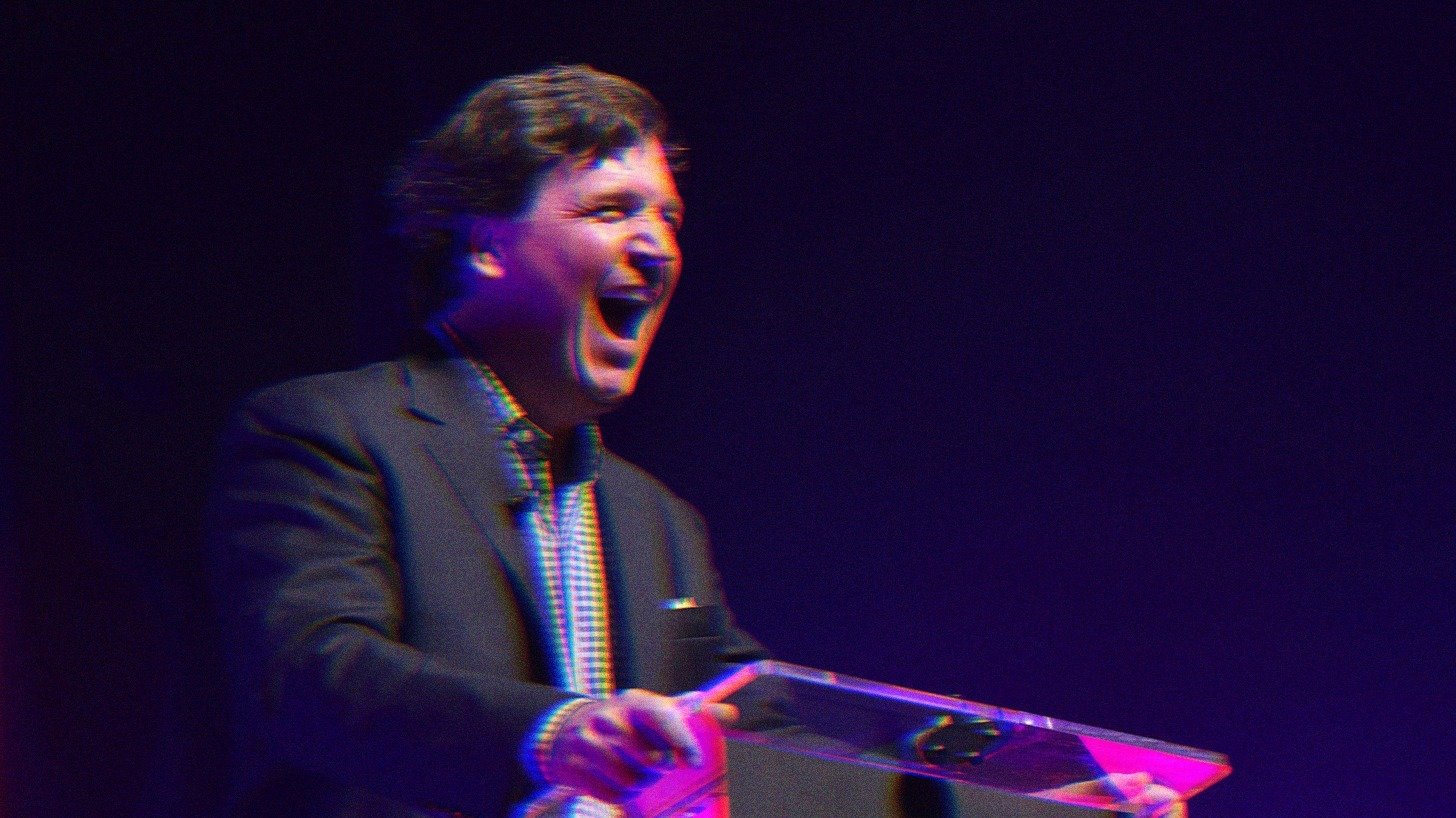 Image Description: Tucker Carlson standing at a podium mid laugh, smiling.
This essay appeared in the April 2, 2026 edition of UNFTR’s premium newsletter. Become a UNFTR member to receive our bonus newsletter each week and for other perks.
About nine months ago we signaled that Tucker Carlson—a white nationalist—was on the rise amid his newfound independence, potentially amassing more influence than ever—and that’s after years of boasting the highest-rated cable news show in primetime (including among Democrats).
Well, Carlson’s notoriety and broad appeal have seemingly grown leaps and bounds in the intervening months. Carlson is everywhere, churning out interview after interview, and growing into one of the most aggregated podcasters in the industry. His undressing of Zionist fanatic Sen. Ted Cruz was just the beginning. Since that testy interview provided Carlson with credibility among pro-Palestinian supporters on the internet, he has only further endeared himself to those fed up with Israel’s genocide of Palestinians and multiple other wars with neighboring countries—with Iran pushing Carlson into yet another realm of cultural and political relevancy.
If you’re not on the platform formerly known as Twitter, perhaps you’ve immunized yourself from the waves of Carlson saturation. But since Elon Musk’s platform continues to hold significant social influence, it’s critical that anyone spared from its troubling decline understands its role in making Carlson so ubiquitous.
And yet, it’s quite possible that the former Fox News host’s resurgence has already breached the firewall separating online discourse from IRL politics.
Here’s the journalist and Zeteo founder Mehdi Hasan talking about Carlson’s newly minted attraction among groups of people who for years disavowed him as ignorant and racist.
“[T]he number of leftists and Muslims and just apolitical folks I meet who now love Carlson and say they’d be willing to vote for him for president is off the charts,” Hasan wrote on X. “Democrats and liberals and ‘progressives against Palestine’ really left a lane wide open for him, as they did for Trump in 2016 and again in 2024.”
While several of Carlson’s recent interviews have produced provocative, viral moments, few were as poignant as his interrogation of Israel’s so-called “right to exist” with The Economist’s editor-in-chief, Zanny Minton Beddoes. It was a similar line of questioning that Carlson used in his interview with Mike Huckabee, the U.S. Ambassador to Israel, a staunch Christian Zionist.
The exchange took on a life of its own, and it revealed the gigantic schism between establishment Democrats and the modern left, the latter of which has been waiting for someone from the liberal-sphere to probe this very question (a common lament by many who shared the viral clip).
Here’s how it played out, edited for clarity:
Carlson: “What does that mean, a ‘right to exist’?”
Beddoes: “The existence of the political state of Israel.”
Carlson: “But it has a right—what does that mean?”
Beddoes: “That you think it should continue in its existence as a state right now. You do not agree with Iran, for example.”
Carlson: “Since you asked me the question, it’s fair for me to get you to define the terms so I can answer it. You’ve asked two questions: The first was do you believe Israel has a right to exist? And the second question was do you believe Israel should continue to go on as a nation state? And those are very different questions.”
Carlson continued: “Does it have a right to exist—is that what you’re asking?”
Beddoes: “I don’t want to get hung up on the right…”
Carlson: “The phrase you used was devised by the Israeli government. ‘Does it have a right to exist?’ And so my question to you would be, what does that mean?”
As the two went back and forth, Carlson noted that he has no desire to see Israel destroyed—a notion that, according to Beddoes, makes him narrowly a Zionist.
“What right are you talking about?” Carlson later said. “Does Britain have a right to exist? Does the United States have a right to exist?”
Ignoring the question entirely, Beddoes recalled the establishment of borders in 1945 as evidence of a country’s apparent right.
From there, she was cooked.
“The first thing Israel did within two weeks of this war starting, which is supposedly existential for them, was take southern Lebanon. Take someone else’s country, as they have done repeatedly, and no one even mentions that. And so I guess I would be opposed to that, because, I guess, I think Lebanon has a ‘right’ to exist. I thought Gaza has a ‘right’ to exist. But I noticed as soon as we start apportioning rights, only one country gets it.”
“This is a mustwatch not just as it’s the 1st time I have seen a major figure on an establishment media outlet question a journalist’s ‘right to exist’ pro-Israel propaganda phrase but also because the interviewer is the Economist editor who thinks anti Zionism is defined by…Iran,” Hasan posted on X.
For anyone paying attention, this moment was months in the making—and one that came just weeks after Carlson held Huckabee’s feet to the fire during their contentious interview in Israel. That episode sparked a geopolitical crisis after Huckabee endorsed Israel seizing and occupying more land from Arab states (“It would be fine if they took it all”)—effectively saying the U.S. supports the so-called Greater Israel Project.
On his March 2 podcast—“Israel’s war and what it means”—Carlson reinforced that the war of choice was foisted upon the United States by Israel—he conveniently leaves out the part that Trump has agency and could’ve told Israeli Prime Minister Benjamin Netanyahu ‘No’—and that the United States gains no strategic advantage by battling Iran.
On March 18, he interviewed newly resigned director of the National Counterterrorism Center, Joe Kent, who revealed in his resignation letter that “Iran posed no imminent threat” to the U.S. and that Trump started the war “due to pressure from Israel and its powerful American lobby.”
Other episodes include a look into Netanyahu’s corruption allegations, the decline of the U.S. empire and the chilling of free speech amid Israel’s many wars (including genocide), featuring Glenn Greenwald, who became popular among a segment of the right during the Biden administration.
In an era in which the genocide in Gaza played a significant role in the Democrats losing the White House in 2024 and many Americans, including a vast majority of Democrats, disagree with the war with Iran, it’s Carlson who has emerged as a leading anti-war critic. Tucker Carlson. The same guy who trafficked the “Great Replacement” theory and continues to question whether there’s a grand scheme to reduce “native” populations in the West.
Carlson’s ubiquity and attraction aren’t actually surprising—anyone untethered from deep-seated partisanship could’ve seen this coming. What his rise underscores is this: The electorate, especially those on the left, are begging for a prominent figure to challenge conventional wisdom constructed by the neoliberal order. They want someone who is truly anti-war and is unafraid to challenge and question authority. Someone who can use that platform to elevate cases they care for, and perhaps even, leverage that for political power.
Who is that person on the left? By default—but not shockingly—when it comes to this calamitous war, it’s the person best positioned for a power grab. Will Carlson run for president? Will the broader left resist him so long as destructive wars undergird everything? I have no clue. All I know is it shouldn’t have taken this long for supposed political masterminds to see this coming. And it forces the rest of us to confront a much more damning question: Did feckless Democrats, by consistently endorsing war, failing to stand up for civil liberties and for aiding and abetting the genocide of Palestinians, help Carlson become one of the most influential people in politics?
Image Source
- Gage Skidmore, CC BY-SA 4.0, via Wikimedia Commons. Changes were made.
 Rashed Mian
Rashed Mian is the managing editor of the award-winning News Beat podcast and co-founder of the newly launched Free The Press (FTP) Substack newsletter. Throughout his career, he has reported on a wide range of issues, with a particular focus on civil liberties, systemic injustice and U.S. hegemony. You can find Rashed on X @rashedmian and on Bluesky @rashedmian.bsky.social.