

Bezos Burns It Down.
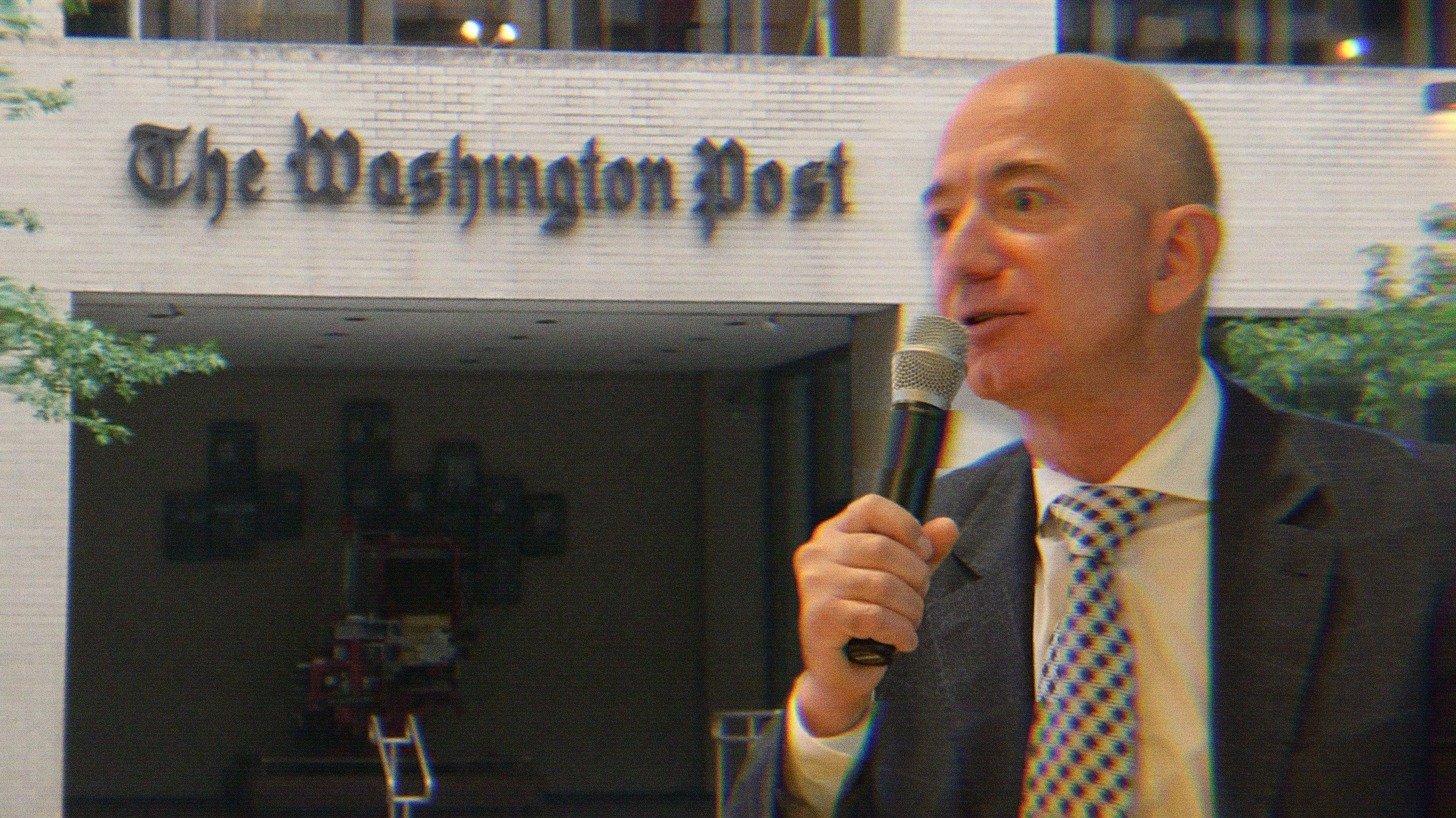 Image Description: An image of Jeff Bezos speaking into a microphone overlayed on an image of the former Washington Post headquarters.
This essay appeared in the Feb. 5, 2026 edition of UNFTR’s premium newsletter. Become a UNFTR member to receive our bonus newsletter each week and for other perks.
Billionaires suck, actually.
That was the collective response, at least in the case of Jeff Bezos, the world’s foremost Melania Trump enthusiast, from journalists and other media watchers on Wednesday as news broke that the Washington Post, which the former Amazon boss purchased in 2013, was taking a machete to its news operation.
The outlet announced that it was firing more than 300 journalists, scrapping its sports and books sections, suspending its flagship podcast, and slashing international coverage—one of the most consequential sections of the Post, which has been able to give its readers, historically a local audience, a broad view of the world. Overall, one-third of its staff was laid off in this latest round of cuts, representing a significant decline for a paper that, amid Donald Trump’s rise to power, styled itself a warrior on the frontlines of the battle for democracy.’
The layoffs had been rumored for weeks—so much so that WaPo journalists made direct appeals to Bezos himself.
Few, however, were surprised with the scale of the journalistic blood-letting.
As former star WaPo political reporter Ashley Parker wrote in The Atlantic, which has benefited from the brain drain at the once-storied paper, “We’re witnessing a murder.”
She’s right—in more ways than one.
Unlike The New York Times, which is now as much a gaming, food, and consumer product reviews app as it is a news outlet, WaPo has suffered from a string of recent blunders that have done considerable damage to both its bottom line and credibility.
It all appears to go back to Bezos’ purchase of the paper in 2013 for $250 million. At the time, Bezos’ intentions were not clear. Bezos, who doesn’t give many interviews, spoke a good game at the time. “The values of The Post do not need changing,” he said, adding that the paper’s “duty will remain to its readers and not to the private interests of its owners.”
As many will recall, the timing of the purchase was curious, given the industry’s nosedive amid digital disruption and declining print subscription rates: Was this charity? Was Bezos okay with the paper effectively being a money pit, so long as he could leverage its iconic status for influence? Or did he think he could actually reimagine journalism? Could he monopolize news like he did books?
Alas, some bought into the idea that Bezos was behaving as some sort of White Knight that would serve as the failing news industry’s savior. He was a billionaire, after all—and billionaires do things. What exactly? No one knows for sure. But they insist on colonizing space, so a newspaper shouldn’t be that hard to revive, right?
Here are just a few of the optimistic takes on Bezos’ foray into journalism:
- When the shocking sale was announced—even the WaPo staff were caught off guard—Post publisher Katharine Weymouth said: “He’s everything we were looking for—a business leader with a track record of entrepreneurship who believes in our values and cares about journalism, and someone who was willing to pay a fair price to our shareholders.”
- A Forbes contributor bizarrely hailed Bezos’ purchase as a public relations win for journalism for the simple fact that, in their words, it was a “positive” story for an industry constantly drowning in negative attention.
- Henry Blodget, who co-founded Business Insider after a career as a Wall Street analyst, cheered the new direction WaPo was going in, saying, “Whenever there’s an opportunity to reinvest would-be profits today in an exciting project that might pay off tomorrow, Jeff Bezos will take it. And when he’s an investor in your company, you’ll feel like you should take it, too…So, anyone rooting for the Washington Post to transform into a successful digital business should be thrilled that Jeff Bezos is buying it.”
It would seem Bezos ran into some luck at the beginning of his reign, which neatly coincided with Trump’s political rise leading up to the 2016 election. The paper’s digital subscriptions rose significantly, as did traffic to its site. Some of its reporters turned into stars and seemingly held guest spots on the airwaves of MSNBC, appearances that became catnip for primetime cable news shows eager for a nightly notebook-dump of Trump scandals and rumors of purported collusion with Russia.
It’s not hyperbole to suggest that WaPo’s emergence in the early Trump years was as much a credit to its reporters as it was to anything Bezos had done, particularly since he wasn’t overseeing the operations on a full-time basis.
But then cracks started to emerge. On the business side, the Post misjudged the value of its internal content publishing system, which it believed could become a lucrative part of its operations—but that never materialized. Later, it had dreams of licensing its ad-tech software called Zeus Prime, which it eventually folded.
Soon cost-cutting began to impact the news business. The company discontinued its decades-old Sunday magazine in November 2022, and days later fear gripped the newsroom after what was characterized as a contentious town hall led by then-publisher Fred Ryan, who stepped down the following summer.
In 2023, Bezos hired a veteran media executive from the U.K. and former Wall Street Journal executive, Will Lewis, to serve as publisher. Lewis immediately crafted plans for a highly publicized newsroom restructuring, which never amounted to anything. (Lewis resigned on Feb. 7 amid widespread anger over the newsroom’s gutting.)
“As a business decision, the hire made no sense,” The Bulwark, an independent outlet, wrote about the failings at WaPo. “Lewis was a disgraced Brit with no experience in American media and no track record of success in digital publishing. He was a reliable hack, though: He would do whatever he was told and clearly he had been told to make the paper friendlier to Donald Trump, no matter the cost…Lewis’s tenure has been an unbroken streak of failure. Every single initiative he has undertaken became a cost-sink: The ‘third newsroom’; the pivot to Trump; the remaking of the Opinion section; the creation of an aggregator called ‘Ripple’; and, finally, the restructuring of the paper.” (Take a look at The Washington Posts’s Instagram feed, for instance, and you’ll notice it’s mostly bereft of actual news—its core competency and why people subscribe.)
The so-called “pivot to Trump” is perhaps the most damning evidence of Bezos’ failures. Recall what he said on the day the sale was announced: “The paper’s duty will remain to its readers and not to the private interests of its owners.”
As has been widely reported, in the lead-up to the 2024 presidential election, Bezos personally killed a presidential endorsement of Kamala Harris in its Editorial section, with Lewis claiming the decision was about the outlet preserving its independence.
“An endorsement of Harris had been drafted by Post editorial page staffers but had yet to be published, according to two people who were briefed on the sequence of events and who spoke on the condition of anonymity because they were not authorized to speak publicly,” WaPo itself reported. “The decision to no longer publish presidential endorsements was made by The Post’s owner, Amazon founder Jeff Bezos, according to four people who were briefed on the decision.”
After the news, more than 250,000 (!!!) readers canceled their subscriptions to the outlet.
In yet another move seen as a further capitulation to Trump, Bezos announced last year that the outlet’s Op-Ed section would focus on “personal liberties and free markets,” and, in the outlet’s words, “won’t publish anything that opposes those ideas.” Importantly, the byline for the article outlining the changing philosophy simply read “Washington Post staff,” which is generally an indication in news publishing of a staffer protest.
On Wednesday, amid the outrage over the layoffs, Nate Silver published a chart on X that showed a steep decline for the Washington Post following its much-publicized editorial changes, especially when compared to its main competitor, The New York Times.
While not one to defend the corporate media, it goes without saying that the loss of journalism jobs makes any society worse off. Whenever news of deep cuts are announced, the conventional wisdom suggests news has no value, and the people producing the coverage are somehow at fault.
In this case, it’s clear that the billionaire “savior” has a lot of explaining to do. But when your wealth allows you to jet off to outer space, what difference does any of this make? You’re one with the gods—untouchable, unaccountable.
The aforementioned Parker dubbed the recent events a “murder.” In The Bulwark, Jonathan Last described it as “civil vandalism and the mutilation of a great paper.”
“The free market will not save the Post, because its owner is immune to market signals,” Last wrote. “Politics will not save the Post, because so long as Republican voters demand authoritarianism, no one can own a media outlet without taking on outsized risk. As sad as it is to admit, the Washington Post is beyond help.”
With billionaires running amok, the same can be said about the American experience.
Image Sources
- U.S. Space Force image by Van Ha, Public domain, via Wikimedia Commons. Changes were made.
- Michael Fleischhacker, Public domain, via Wikimedia Commons. Changes were made.
 Rashed Mian
Rashed Mian is the managing editor of the award-winning News Beat podcast and co-founder of the newly launched Free The Press (FTP) Substack newsletter. Throughout his career, he has reported on a wide range of issues, with a particular focus on civil liberties, systemic injustice and U.S. hegemony. You can find Rashed on X @rashedmian and on Bluesky @rashedmian.bsky.social.

.jpeg)
